Jean-Pascal Gond - Böcker
Visar alla böcker från författaren Jean-Pascal Gond. Handla med fri frakt och snabb leverans.
4 produkter
4 produkter
18 529 kr
Skickas inom 10-15 vardagar
Although the idea of social responsibility has a long and distinguished intellectual pedigree, Corporate Social Responsibility (or ‘CSR’) has re-emerged during the last fifteen years or so as a high-profile concept in both academia and business practice. This revitalized interest has come about largely because of the development of the ‘markets for virtue’ that have institutionalized CSR in business practices in an unprecedented manner. CSR has achieved organizational distinctiveness within companies (e.g. in managerial and board responsibilities); social and environmental reporting requirements have dramatically increased; socially responsible investment funds have not only established themselves in their own right, but have also informed more mainstream investment criteria, particularly regarding social and environmental risk; a CSR consultancy industry has emerged, along with various ‘vanguard groups’ and NGOs who seek not only to promote CSR, but also to bring critical perspectives to bear and to raise CSR standards; and governments around the globe have encouraged investment in CSR, better reporting of these activities, and the implementation of CSR initiatives that complement broader public policies.As research in and around CSR blossoms as never before, this new four-volume collection from Routledge’s acclaimed Critical Perspectives on Business and Management series meets the need for an authoritative reference work to make sense of a rapidly growing and ever more complex corpus of literature. Edited by two scholars from Nottingham University’s world-class International Centre for Corporate Social Responsibility, the collection gathers foundational and canonical work, together with innovative and cutting-edge applications and interventions.With a full index, together with a comprehensive introduction, newly written by the editors, which places the collected material in its historical and intellectual context, Corporate Social Responsibility is an essential work of reference. The collection will be particularly useful as an essential database allowing scattered and often fugitive material to be easily located. It will also be welcomed as a crucial tool permitting rapid access to less familiar—and sometimes overlooked—texts. For researchers, students, practitioners, and policy-makers, it is as a vital one-stop research and pedagogic resource.
2 258 kr
Kommande
This book showcases the experiences and perspectives of instructors and researchers who are pioneering sustainable finance research and education.Sustainable finance broadly defined refers to the integration of sustainability issues within financial practices. Given the urgency of funding sustainable development, meeting new regulatory agendas, and navigating the increasing politicization of sustainable finance, demands for immediate sustainable finance expertise and training has grown. Yet, the pedagogical implications of increasing scholarly and practitioner interest in sustainable finance have been largely neglected. Filling this gap, Pathways to Teaching Sustainable Finance examines how curriculums can be redesigned to accommodate sustainable finance education. It discusses the specific skills, tools, and theoretical insights that constitute an emerging sustainable finance ‘corpus’ and provides critical perspectives on the field. Each chapter engages with the different strategies, theoretical frameworks, pedagogical tools and learning objectives informed by the authors’ own teaching practice or by their research.Chapters also include cases, suggestions for assignments, and other resources that can support the design of sustainable finance courses and syllabi. Collating insights from a broad range of experts in the field, this book therefore provides theoretical and critical reflections alongside practical insight for faculty and higher education institutions, as well as market, public, and non-profit actors who have been calling for better expertise in sustainable finance.
559 kr
Kommande
This book showcases the experiences and perspectives of instructors and researchers who are pioneering sustainable finance research and education.Sustainable finance broadly defined refers to the integration of sustainability issues within financial practices. Given the urgency of funding sustainable development, meeting new regulatory agendas, and navigating the increasing politicization of sustainable finance, demands for immediate sustainable finance expertise and training has grown. Yet, the pedagogical implications of increasing scholarly and practitioner interest in sustainable finance have been largely neglected. Filling this gap, Pathways to Teaching Sustainable Finance examines how curriculums can be redesigned to accommodate sustainable finance education. It discusses the specific skills, tools, and theoretical insights that constitute an emerging sustainable finance ‘corpus’ and provides critical perspectives on the field. Each chapter engages with the different strategies, theoretical frameworks, pedagogical tools and learning objectives informed by the authors’ own teaching practice or by their research.Chapters also include cases, suggestions for assignments, and other resources that can support the design of sustainable finance courses and syllabi. Collating insights from a broad range of experts in the field, this book therefore provides theoretical and critical reflections alongside practical insight for faculty and higher education institutions, as well as market, public, and non-profit actors who have been calling for better expertise in sustainable finance.
Del 52 - Research in the Sociology of Organizations
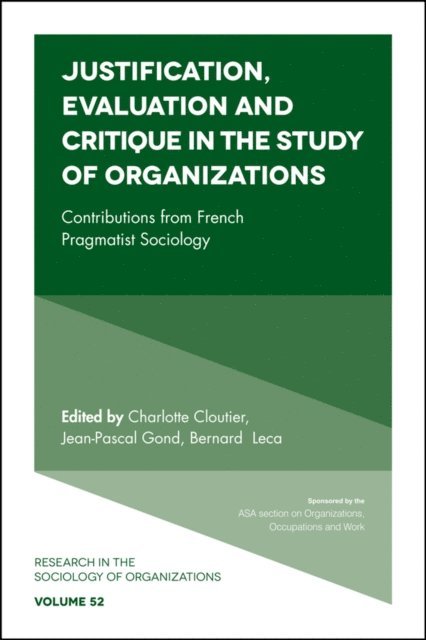
Justification, Evaluation and Critique in the Study of Organizations
Contributions from French Pragmatist Sociology
Inbunden, Engelska, 2017
1 412 kr
Skickas inom 7-10 vardagar
The papers included in the volume explore how mobilizing Boltanski and Thévenot’s EW framework helps address questions regarding the premises and dynamics of agreement and disagreement in coordinated action, both within and across organizations, and by so doing, help advance our understanding of organizational processes more generally. The book is organized into four sections, each with contributions that address one of the four core theoretical objectives around which the volume is structured (1) to clarify how individuals manage the contradictions and compromises inherent to organizational pluralism; (2) to look at organizations critically by unpacking the roles of rhetoric and justification in the practice of critique; (3) to reconsider valuation and evaluation in organizations; and (4) to push the boundaries of the EW framework. These four objectives provide a scaffolding that helps further embed the framework in our contemporary thinking about organizations.