
Jean-Pierre Majoral – författare
Visar alla böcker från författaren Jean-Pierre Majoral. Handla med fri frakt och snabb leverans.
11 produkter
11 produkter
2 139 kr
Skickas inom 10-15 vardagar
This series presents critical reviews of the present position and future trends in modern chemical research.
3 205 kr
Skickas inom 10-15 vardagar
2 139 kr
Skickas inom 10-15 vardagar
with contributions by numerous experts
3 205 kr
Skickas inom 10-15 vardagar
Undoubtedly the chemistry of phosphorus appears more and more attractive in the sense that phosphorus presents an extraordinary versatile behaviour that allows the synthesis of a large number of different phosphorus reagents usable for applications in different fields, from biology to material science without f- getting key applications in catalysis. The full maturity of this topic of research can be explained by all the acquired knowledge over these twenty last years. Organic and inorganic chemistries of P , P and P species have been the s- in ]V v ject of thousands of publications while the chemistry of low coordinated ph- phorus derivatives experienced its hour of glory from the 1970s to the early 1990s. In parallel, interactions between phosphorus compounds and transition metals afforded many complexes, a lot of which present fascinating properties as catalysts. The interest in all these themes really is not decreasing, indeed some fas- nating areas of research are emerging or are the subject of many investigations: the medicinal chemistry of bisphosphonates, the role of phosphorus in biology, phosphorus ligands in radiopharmaceutical chemistry, phosphorus in material science, new polymers and dendrimers incorporating phosphorus, and as- metric catalysis to name but a few. Indeed researchers, benefitting from their background in basic phosphorus chemistry are developing many new fields of research.
3 205 kr
Skickas inom 10-15 vardagar
Strong non-ionic bases are highly advantageous as stoichiometric reagents and as catalysts in synthetic organic chemistry owing to side reactions that f- quently occur when ionic bases such as LDA or alkali metal alkoxides are employed. A second reason that non-ionic bases are frequently more useful in these applications is that such bases are often more soluble in less polar organic solvents,particularly at low temperatures. Thirdly,non-ionic bases can provide reactive naked or tightly associated deprotonated substrate anions that are s- bilized by the relatively large,poorly solvated cations formed by the protonated base. In such cations,extensive positive charge delocalization can occur. Prior to our work on pro-azaphosphatranes of type 1 (Scheme 1),the very strong n- ionic bases utilized for organic transformations were largely confined to the nitrogenous bases shown below (Scheme 2). Scheme 1 Scheme 2 4 J. G. Verkade 2 Uses of Strong Nonionic Nitrogen Bases 2. 1 Amines One of the earliest strong non-ionic bases to make its appearance was Proton Sponge and its derivatives [1] and these systems have been reviewed [2].More recently Proton Sponge has been used in the palladium-catalyzed arylation of 2,3-dihydrofuran [3], and it also catalyzes Knoevenagel condensations of s- strates possessing activated methylene groups [4]. Recently the synthesis of the macrocyclic tetramine below (Scheme 3) was reported [5]. The encrypted nitrogens are very basic (pK ,24.
2 139 kr
Skickas inom 10-15 vardagar
3 205 kr
Skickas inom 10-15 vardagar
3 205 kr
Skickas inom 10-15 vardagar
Undoubtedly the chemistry of phosphorus appears more and more attractive in the sense that phosphorus presents an extraordinary versatile behaviour that allows the synthesis of a large number of different phosphorus reagents usable for applications in different fields, from biology to material science without f- getting key applications in catalysis. The full maturity of this topic of research can be explained by all the acquired knowledge over these twenty last years. Organic and inorganic chemistries of P , P and P species have been the s- in ]V v ject of thousands of publications while the chemistry of low coordinated ph- phorus derivatives experienced its hour of glory from the 1970s to the early 1990s. In parallel, interactions between phosphorus compounds and transition metals afforded many complexes, a lot of which present fascinating properties as catalysts. The interest in all these themes really is not decreasing, indeed some fas- nating areas of research are emerging or are the subject of many investigations: the medicinal chemistry of bisphosphonates, the role of phosphorus in biology, phosphorus ligands in radiopharmaceutical chemistry, phosphorus in material science, new polymers and dendrimers incorporating phosphorus, and as- metric catalysis to name but a few. Indeed researchers, benefitting from their background in basic phosphorus chemistry are developing many new fields of research.
3 205 kr
Skickas inom 10-15 vardagar
Strong non-ionic bases are highly advantageous as stoichiometric reagents and as catalysts in synthetic organic chemistry owing to side reactions that f- quently occur when ionic bases such as LDA or alkali metal alkoxides are employed. A second reason that non-ionic bases are frequently more useful in these applications is that such bases are often more soluble in less polar organic solvents,particularly at low temperatures. Thirdly,non-ionic bases can provide reactive naked or tightly associated deprotonated substrate anions that are s- bilized by the relatively large,poorly solvated cations formed by the protonated base. In such cations,extensive positive charge delocalization can occur. Prior to our work on pro-azaphosphatranes of type 1 (Scheme 1),the very strong n- ionic bases utilized for organic transformations were largely confined to the nitrogenous bases shown below (Scheme 2). Scheme 1 Scheme 2 4 J. G. Verkade 2 Uses of Strong Nonionic Nitrogen Bases 2. 1 Amines One of the earliest strong non-ionic bases to make its appearance was Proton Sponge and its derivatives [1] and these systems have been reviewed [2].More recently Proton Sponge has been used in the palladium-catalyzed arylation of 2,3-dihydrofuran [3], and it also catalyzes Knoevenagel condensations of s- strates possessing activated methylene groups [4]. Recently the synthesis of the macrocyclic tetramine below (Scheme 3) was reported [5]. The encrypted nitrogens are very basic (pK ,24.
2 139 kr
Skickas inom 10-15 vardagar
with contributions by numerous experts
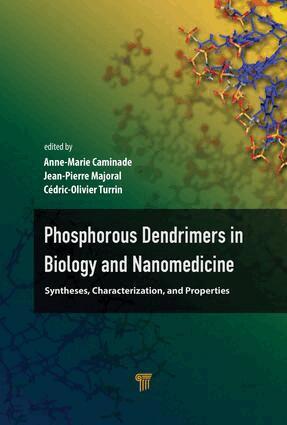
Phosphorous Dendrimers in Biology and Nanomedicine
Syntheses, Characterization, and Properties
Inbunden, Engelska, 2018
1 967 kr
Skickas inom 10-15 vardagar
Dendrimers, which are hyperbranched synthetic macromolecules, have attracted researchers’ increasing interest over the last three decades owing to their numerous properties, in particular, in the fields of biology and nanomedicine. This book is an up-to-date collection of the most recent achievements in the use of dendrimers in nanomedicine, exemplified by phosphorus-containing dendrimers. Starting with the synthesis and characterization of phosphorus dendrimers, the book discusses their use as biomaterials, carriers of biological entities, and anti-inflammatory drugs; in bioimaging; and against prion diseases, Alzheimer’s, HIV, and cancer. It compares phosphorus dendrimers with other types of dendrimers. Supplemented with numerous references and abundant illustrations, the book opens new perspectives for the researchers working on dendrimers.