Jean Tirole - Böcker
Visar alla böcker från författaren Jean Tirole. Handla med fri frakt och snabb leverans.
13 produkter
13 produkter
1 566 kr
Skickas inom 5-8 vardagar
1 605 kr
Skickas inom 5-8 vardagar
924 kr
Tillfälligt slut
874 kr
Tillfälligt slut
11 737 kr
Skickas inom 10-15 vardagar
This section covers a wide range of new approaches to a crucial area of economics. It addresses the impact of game theory, the new institutional economics and the interaction of economics and business strategy.
984 kr
Skickas inom 7-10 vardagar
The past twenty years have seen great theoretical and empirical advances in the field of corporate finance. Whereas once the subject addressed mainly the financing of corporations--equity, debt, and valuation--today it also embraces crucial issues of governance, liquidity, risk management, relationships between banks and corporations, and the macroeconomic impact of corporations. However, this progress has left in its wake a jumbled array of concepts and models that students are often hard put to make sense of. Here, one of the world's leading economists offers a lucid, unified, and comprehensive introduction to modern corporate finance theory. Jean Tirole builds his landmark book around a single model, using an incentive or contract theory approach. Filling a major gap in the field, The Theory of Corporate Finance is an indispensable resource for graduate and advanced undergraduate students as well as researchers of corporate finance, industrial organization, political economy, development, and macroeconomics.Tirole conveys the organizing principles that structure the analysis of today's key management and public policy issues, such as the reform of corporate governance and auditing; the role of private equity, financial markets, and takeovers; the efficient determination of leverage, dividends, liquidity, and risk management; and the design of managerial incentive packages. He weaves empirical studies into the book's theoretical analysis. And he places the corporation in its broader environment, both microeconomic and macroeconomic, and examines the two-way interaction between the corporate environment and institutions. Setting a new milestone in the field, The Theory of Corporate Finance will be the authoritative text for years to come.
414 kr
Skickas inom 7-10 vardagar
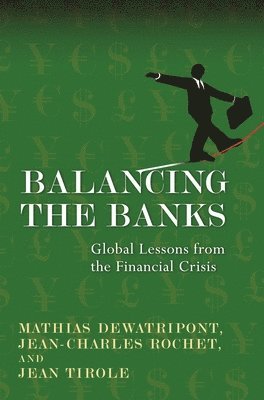
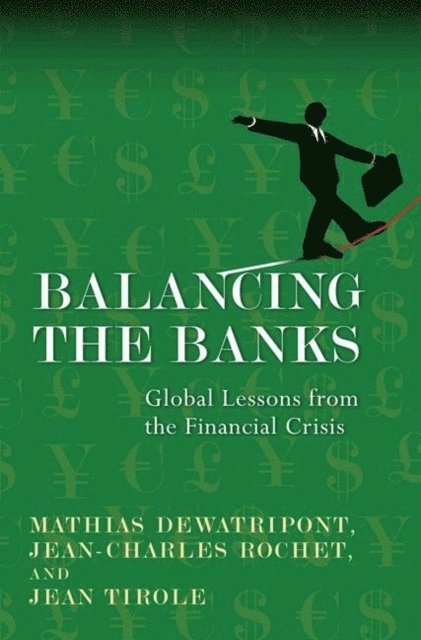
The financial crisis that began in 2007 in the United States swept the world, producing substantial bank failures and forcing unprecedented state aid for the crippled global financial system. Bringing together three leading financial economists to provide an international perspective, Balancing the Banks draws critical lessons from the causes of the crisis and proposes important regulatory reforms, including sound guidelines for the ways in which distressed banks might be dealt with in the future. While some recent policy moves go in the right direction, others, the book argues, are not sufficient to prevent another crisis. The authors show the necessity of an adaptive prudential regulatory system that can better address financial innovation. Stressing the numerous and complex challenges faced by politicians, finance professionals, and regulators, and calling for reinforced international coordination (for example, in the treatment of distressed banks), the authors put forth a number of principles to deal with issues regarding the economic incentives of financial institutions, the impact of economic shocks, and the role of political constraints.Offering a global perspective, Balancing the Banks should be read by anyone concerned with solving the current crisis and preventing another such calamity in the future.
251 kr
Skickas inom 7-10 vardagar
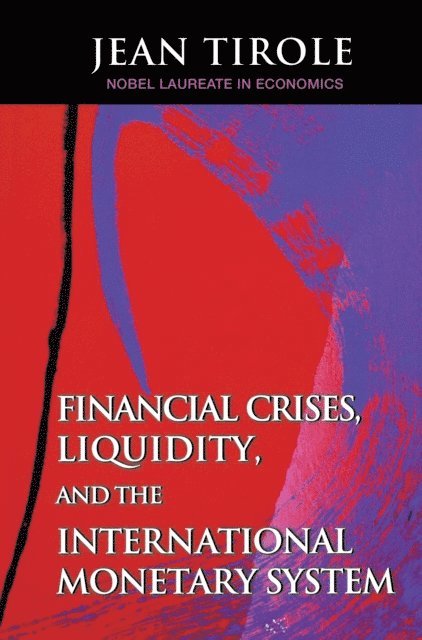
Once upon a time, economists saw capital account liberalization--the free and unrestricted flow of capital in and out of countries--as unambiguously good. Good for debtor states, good for the world economy. No longer. Spectacular banking and currency crises in recent decades have shattered the consensus. In this remarkably clear and pithy volume, one of Europe's leading economists examines these crises, the reforms being undertaken to prevent them, and how global financial institutions might be restructured to this end. Jean Tirole first analyzes the current views on the crises and on the reform of the international financial architecture. Reform proposals often treat the symptoms rather than the fundamentals, he argues, and sometimes fail to reconcile the objectives of setting effective financing conditions while ensuring that a country "owns" its reform program. A proper identification of market failures is essential to reformulating the mission of an institution such as the IMF, he emphasizes. Next he adapts the basic principles of corporate governance, liquidity provision, and risk management of corporations to the particulars of country borrowing.Building on a "dual- and common-agency perspective," he revisits commonly advocated policies and considers how multilateral organizations can help debtor countries reap enhanced benefits while liberalizing their capital accounts. Based on the Paolo Baffi Lecture the author delivered at the Bank of Italy, this refreshingly accessible book is teeming with rich insights that researchers, policymakers, and students at all levels will find indispensable.
194 kr
Skickas inom 7-10 vardagar
The financial crisis that began in 2007 in the United States swept the world, producing substantial bank failures and forcing unprecedented state aid for the crippled global financial system. Bringing together three leading financial economists to provide an international perspective, Balancing the Banks draws critical lessons from the causes of the crisis and proposes important regulatory reforms, including sound guidelines for the ways in which distressed banks might be dealt with in the future. While some recent policy moves go in the right direction, others, the book argues, are not sufficient to prevent another crisis. The authors show the necessity of an adaptive prudential regulatory system that can better address financial innovation. Stressing the numerous and complex challenges faced by politicians, finance professionals, and regulators, and calling for reinforced international coordination (for example, in the treatment of distressed banks), the authors put forth a number of principles to deal with issues regarding the economic incentives of financial institutions, the impact of economic shocks, and the role of political constraints.Offering a global perspective, Balancing the Banks should be read by anyone concerned with solving the current crisis and preventing another such calamity in the future.
Rethinking Innovation
How Knowledge-Sharing Organizations are Shaping the Twenty-First Century
Inbunden, Engelska, 2026
447 kr
Kommande
How corporations have increasingly embraced the sharing of knowledge as a competitive strategyInnovation is more important than ever, yet breakthroughs are becoming harder to achieve. Modern technologies, from artificial intelligence and 5G networks to biotech, are so complex that they require collaboration across companies, industries, and countries. Increasingly, firms are discovering that sharing knowledge can be more powerful, and more profitable, than guarding it. In Rethinking Innovation, distinguished economists Josh Lerner and Jean Tirole examine ways that corporations have embraced the sharing of knowledge as a competitive strategy. Open-source software, for example, has seen multibillion-dollar public offerings and shifting business strategies, producing high-profile disputes over what openness actually entails. Across high-tech industries, new forms of knowledge-sharing are transforming how companies develop and exploit new technologies.Lerner and Tirole explore three key organizational structures that make this collaboration possible: patent pools, which bundle essential patents and make them available to firms seeking to license them; standard-setting organizations, where companies agree on common technical templates and commit to making related patents available on fair terms; and open-source communities, in which users share innovations freely with others. Drawing on decades of pioneering research, Lerner and Tirole explain how these institutions emerged, how they work in practice, and how they can both promote innovation and create new challenges for competition and policy. Combining economic insight with vivid case studies—from early efforts to coordinate aircraft patents to contemporary battles over artificial intelligence and global technology standards—Rethinking Innovation reveals how firms collaborate to develop and commercialize complex technologies. Clear and accessible throughout, this book offers a guide to the forces reshaping modern innovation for managers, policymakers, and scholars.
284 kr
Skickas inom 7-10 vardagar
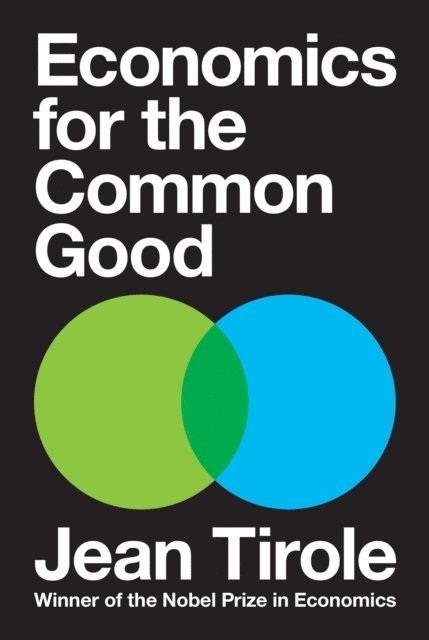
From Nobel Prize-winning economist Jean Tirole, a bold new agenda for the role of economics in society When Jean Tirole won the 2014 Nobel Prize in Economics, he suddenly found himself being stopped in the street by complete strangers and asked to comment on issues of the day, no matter how distant from his own areas of research. His transformation from academic economist to public intellectual prompted him to reflect further on the role economists and their discipline play in society. The result is Economics for the Common Good, a passionate manifesto for a world in which economics, far from being a "dismal science," is a positive force for the common good. Economists are rewarded for writing technical papers in scholarly journals, not joining in public debates. But Tirole says we urgently need economists to engage with the many challenges facing society, helping to identify our key objectives and the tools needed to meet them.To show how economics can help us realize the common good, Tirole shares his insights on a broad array of questions affecting our everyday lives and the future of our society, including global warming, unemployment, the post-2008 global financial order, the Euro crisis, the digital revolution, innovation, and the proper balance between the free market and regulation. Providing a rich account of how economics can benefit everyone, Economics for the Common Good sets a new agenda for the role of economics in society.
161 kr
Skickas inom 7-10 vardagar
From the Nobel Prize–winning economist, a bold new agenda for the role of economics in societyWhen Jean Tirole won the Nobel Prize in Economics, he suddenly found himself being stopped in the street by strangers and asked to comment on current events far from his own research. His transformation from academic economist to public intellectual prompted him to reflect more deeply on the role economists and their discipline play in society. The result is Economics for the Common Good, a passionate manifesto for a world in which economics can help us improve the shared lot of societies and humanity as a whole. To show how, Tirole shares his insights on a broad range of questions affecting our everyday lives and the future of our society, including global warming, unemployment, the post-2008 global financial order, the euro crisis, the digital revolution, innovation, and the proper balance between the free market and regulation. Compelling and accessible, Economics for the Common Good sets a new agenda for the role of economics in society.

3 227 kr
Skickas inom 3-6 vardagar