Jeff Forret - Böcker
Visar alla böcker från författaren Jeff Forret. Handla med fri frakt och snabb leverans.
7 produkter
7 produkter
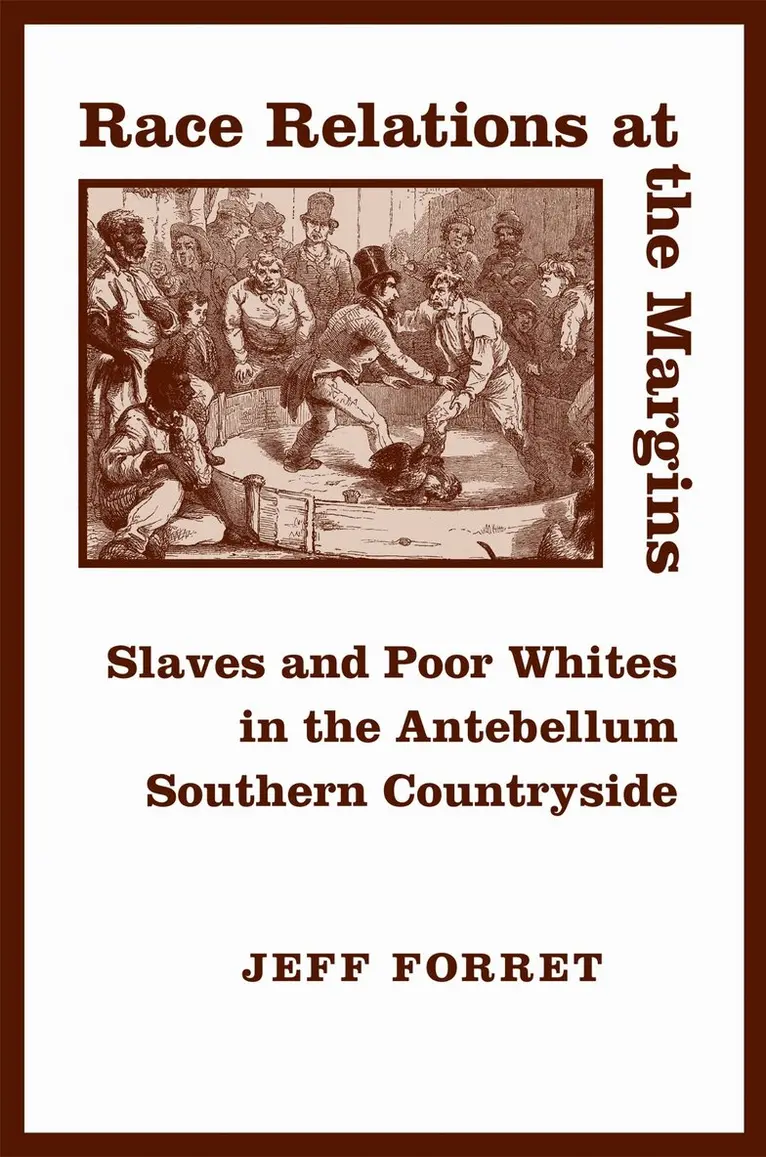
Race Relations at the Margins
Slaves and Poor Whites in the Antebellum Southern Countryside
Häftad, Engelska, 2010
323 kr
Skickas inom 10-15 vardagar
Covering a broad geographic scope from Virginia to South Carolina between 1820 and 1860, Jeff Forret scrutinizes relations among rural poor whites and slaves, a subject previously unexplored and certainly under-reported. Forret's findings challenge historians' long-held assumption that mutual violence and animosity characterized the two groups' interactions; he reveals that while poor whites and slaves sometimes experienced bouts of hostility, often they worked or played in harmony and camaraderie. Race Relations at the Margins is remarkable for its focus on lower-class whites and their dealings with slaves outside the purview of the master. Race and class, Forret demonstrates, intersected in unique ways for those at the margins of southern society, challenging the belief that race created a social cohesion among whites regardless of economic status.As Forret makes apparent, colonial-era flexibility in race relations never entirely disappeared despite the institutionalization of slavery and the growing rigidity of color lines. His book offers a complex and nuanced picture of the shadowy world of slave- poor white interactions, demanding a refined understanding and new appreciation of the range of interracial associations in the Old South.
712 kr
Skickas inom 7-10 vardagar
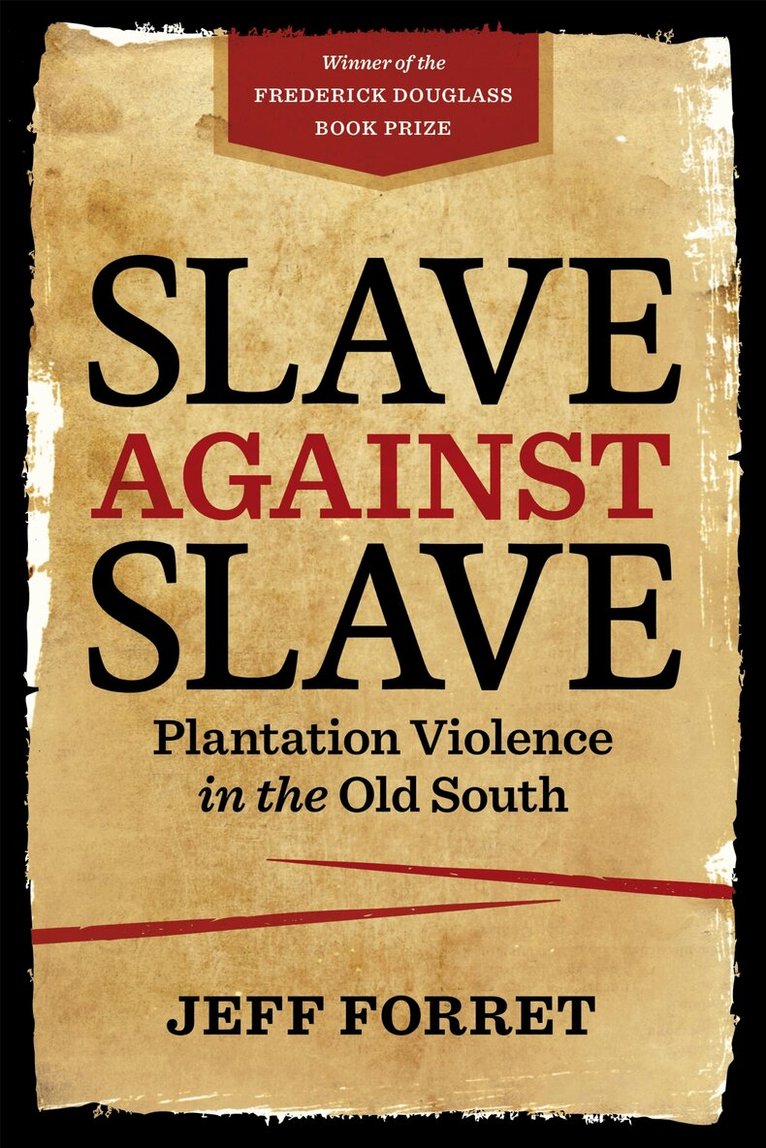
In the first-ever comprehensive analysis of violence between slaves in the antebellum South, Jeff Forret challenges persistent notions of slave communities as sites of unwavering harmony and solidarity. Though existing scholarship shows that intraracial black violence did not reach high levels until after Reconstruction, contemporary records bear witness to its regular presence among enslaved populations. Slave against Slave explores the roots of and motivations for such violence and the ways in which slaves, masters, churches, and civil and criminal laws worked to hold it in check. Far from focusing on violence alone, Forret's work also adds depth to our understanding of morality among the enslaved, revealing how slaves sought to prevent violence and punish those who engaged in it.Forret mines a vast array of slave narratives, slaveholders' journals, travelers' accounts, and church and court records from across the South to approximate the prevalence of slave-against-slave violence prior to the Civil War. A diverse range of motives for these conflicts emerges, from tensions over status differences, to disagreements originating at work and in private, to discord relating to the slave economy and the web of debts that slaves owed one another, to courtship rivalries, marital disputes, and adulterous affairs. Forret also uncovers the role of explicitly gendered violence in bondpeople's constructions of masculinity and femininity, suggesting a system of honor among slaves that would have been familiar to southern white men and women, had they cared to acknowledge it.Though many generations of scholars have examined violence in the South as perpetrated by and against whites, the internal clashes within the slave quarters have remained largely unexplored. Forret's analysis of intraracial slave conflicts in the Old South examines narratives of violence in slave communities, opening a new line of inquiry into the study of American slavery.
447 kr
Skickas inom 10-15 vardagar
The history of capitalist development in the United States is long, uneven, and overwhelmingly focused on the North. Macroeconomic studies of the South have primarily emphasized the role of the cotton economy in global trading networks. Until now, few in-depth scholarly works have attempted to explain how capitalism in the South took root and functioned in all of its diverse-and duplicitous-forms. Southern Scoundrels explores the lesser-known aspects of the emergence of capitalism in the region: the shady and unscrupulous peddlers, preachers, slave traders, war profiteers, thieves, and marginal men who seized available opportunities to get ahead and, in doing so, left their mark on the southern economy.Eschewing conventional economic theory, this volume features narrative storytelling as engaging and seductive as the cast of shifty characters under examination. Contributors cover the chronological sweep of the nineteenth-century South, from the antebellum era through the tumultuous and chaotic Civil War years, and into Reconstruction and beyond. The geographic scope is equally broad, with essays encompassing the Chesapeake, South Carolina, the Lower Mississippi Valley, Texas, Missouri, and Appalachia. These essays offer a series of social histories on the nineteenth-century southern economy and the changes wrought by capitalist transformation. Tracing that story through the kinds of oily individuals who made it happen, Southern Scoundrels provides fascinating insights into the region's hucksters and its history.
433 kr
Skickas inom 10-15 vardagar
In the first-ever comprehensive analysis of violence among enslaved people in the antebellum South, Jeff Forret challenges persistent notions of slave communities as sites of unwavering harmony and solidarity. Though existing scholarship shows that intraracial black violence did not reach high levels until after Reconstruction, contemporary records bear witness to its regular presence among enslaved populations. Using a vast array of primary sources, Slave against Slave explores the roots of and motivations for such violence and the ways in which slaves, masters, churches, and civil and criminal laws worked to hold it in check. Far from focusing on violence alone, the book also deepens understanding of morality among the enslaved, revealing how they sought to prevent violence and punish those who engaged in it. With this groundbreaking work, Forret has opened a new line of inquiry into the study of American slavery.
526 kr
Skickas inom 7-10 vardagar
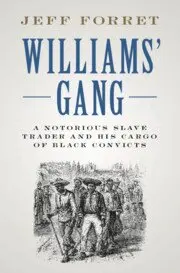
William H. Williams operated a slave pen in Washington, DC, known as the Yellow House, and actively trafficked in enslaved men, women, and children for more than twenty years. His slave trading activities took an extraordinary turn in 1840 when he purchased twenty-seven enslaved convicts from the Virginia State Penitentiary in Richmond with the understanding that he could carry them outside of the United States for sale. When Williams conveyed his captives illegally into New Orleans, allegedly while en route to the foreign country of Texas, he prompted a series of courtroom dramas that would last for almost three decades. Based on court records, newspapers, governors' files, slave manifests, slave narratives, travelers' accounts, and penitentiary data, Williams' Gang examines slave criminality, the coastwise domestic slave trade, and southern jurisprudence as it supplies a compelling portrait of the economy, society, and politics of the Old South.
258 kr
Skickas inom 7-10 vardagar
William H. Williams operated a slave pen in Washington, DC, known as the Yellow House, and actively trafficked in enslaved men, women, and children for more than twenty years. His slave trading activities took an extraordinary turn in 1840 when he purchased twenty-seven enslaved convicts from the Virginia State Penitentiary in Richmond with the understanding that he could carry them outside of the United States for sale. When Williams conveyed his captives illegally into New Orleans, allegedly while en route to the foreign country of Texas, he prompted a series of courtroom dramas that would last for almost three decades. Based on court records, newspapers, governors' files, slave manifests, slave narratives, travelers' accounts, and penitentiary data, Williams' Gang examines slave criminality, the coastwise domestic slave trade, and southern jurisprudence as it supplies a compelling portrait of the economy, society, and politics of the Old South.
265 kr
Skickas inom 5-8 vardagar
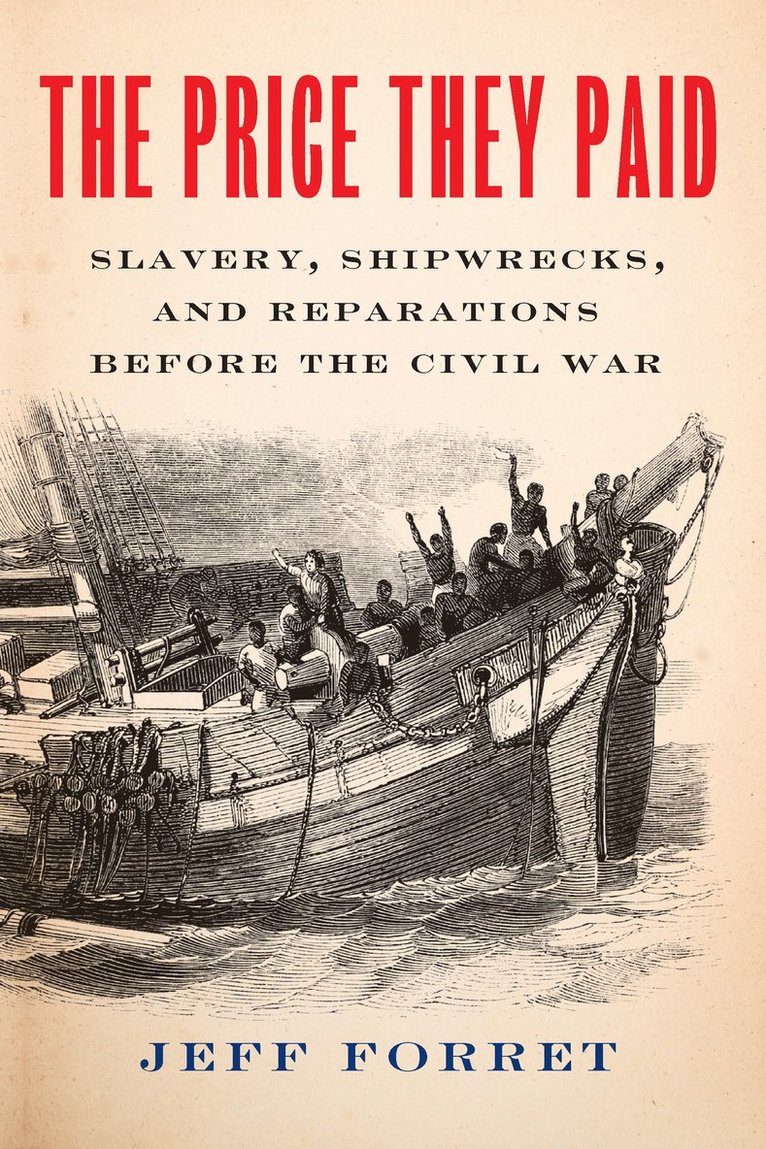
A prizewinning historian uncovers one of the earliest instances of reparations in America—ironically, though perhaps not surprisingly, paid to slaveholders, not former slaves“A spectacular achievement of historical research. Forret shows for the first time just how far the American government went to secure reparations.”—Robert Elder‚ author of Calhoun: American HereticWinner of the Carr P. Collins Award for Best Book of NonfictionWinner, John Lyman Book Award in North American Maritime HistoryIn 1831, the American ship Comet, carrying 165 enslaved men, women, and children, crashed onto a coral reef near the shore of the Bahamas, then part of the British Empire. Shortly afterward, the Vice Admiralty Court in Nassau, over the outraged objections of the ship’s owners, set the rescued captives free. American slave owners and the companies who insured the liberated human cargo would spend years lobbying for reparations from Great Britain, not for the emancipated slaves, of course, but for the masters deprived of their human property.In a work of profoundly relevant research and storytelling, historian and Frederick Douglass Prize–winner Jeff Forret uncovers how the Comet incident—as well as similar episodes that unfolded over the next decade—resulted in the British Crown making reparations payments to a U.S. government that strenuously represented slaveholder interests. Through a story that has never been fully explored, The Price They Paid shows how, unlike their former owners and insurers, neither the survivors of the Comet and other vessels, nor their descendants, have ever received reparations for the price they paid in their lives, labor, and suffering during slavery.Any accounting of reparations today requires a fuller understanding of how the debts of slavery have been paid, and to whom. The Price They Paid represents a major step forward in that effort.