Jeff Maynard - Böcker
Visar alla böcker från författaren Jeff Maynard. Handla med fri frakt och snabb leverans.
5 produkter
5 produkter
Frontier Below
The Past, Present and Future of Our Quest to Go Deeper Underwater
Inbunden, Engelska, 2023
295 kr
Skickas
Triumphs and disasters in the deep sea This is a journey through time and water, to the bottom of the ocean and the future of our planet. We do not see the ocean when we look at the water that blankets more than two thirds of our planet. We only see the entrance to it. Beyond that entrance is a world hostile to humans, yet critical to our survival. The first divers to enter that world held their breath and splashed beneath the surface, often clutching rocks to pull them down. Over centuries, they invented wooden diving bells, clumsy diving suits, and unwieldy contraptions in attempts to go deeper and stay longer. But each advance was fraught with danger, as the intruders had to survive the crushing weight of water, or the deadly physiological effects of breathing compressed air. The vertical odyssey continued when explorers squeezed into heavy steel balls dangling on cables, or slung beneath floats filled with flammable gasoline. Plunging into the narrow trenches between the tectonic plates of the Earth’s crust, they eventually reached the bottom of the ocean in the same decade that men first walked on the moon.Today, as nations scramble to exploit the resources of the ocean floor, The Frontier Below recalls a story of human endeavour that took 2,000 years to travel seven miles, then investigates how we will explore the ocean in the future.Meticulously researched and drawing extensively on unpublished sources and personal interviews, The Frontier Below is the untold story of the pioneers who had the right stuff, but were forgotten because they went in the wrong direction.
Frontier Below
The Past, Present and Future of Our Quest to Go Deeper Underwater
Häftad, Engelska, 2023
203 kr
Skickas
Triumphs and disasters in the deep sea This is a journey through time and water, to the bottom of the ocean and the future of our planet. We do not see the ocean when we look at the water that blankets more than two thirds of our planet. We only see the entrance to it. Beyond that entrance is a world hostile to humans, yet critical to our survival. The first divers to enter that world held their breath and splashed beneath the surface, often clutching rocks to pull them down. Over centuries, they invented wooden diving bells, clumsy diving suits, and unwieldy contraptions in attempts to go deeper and stay longer. But each advance was fraught with danger, as the intruders had to survive the crushing weight of water, or the deadly physiological effects of breathing compressed air. The vertical odyssey continued when explorers squeezed into heavy steel balls dangling on cables, or slung beneath floats filled with flammable gasoline. Plunging into the narrow trenches between the tectonic plates of the Earth’s crust, they eventually reached the bottom of the ocean in the same decade that men first walked on the moon.Today, as nations scramble to exploit the resources of the ocean floor, The Frontier Below recalls a story of human endeavour that took 2,000 years to travel seven miles, then investigates how we will explore the ocean in the future.Meticulously researched and drawing extensively on unpublished sources and personal interviews, The Frontier Below is the untold story of the pioneers who had the right stuff, but were forgotten because they went in the wrong direction.
Frontier Below
The Past, Present and Future of Our Quest to Go Deeper Underwater
Häftad, Engelska, 2024
134 kr
Skickas
Triumphs and disasters in the deep sea This is a journey through time and water, to the bottom of the ocean and the future of our planet. We do not see the ocean when we look at the water that blankets more than two thirds of our planet. We only see the entrance to it. Beyond that entrance is a world hostile to humans, yet critical to our survival. The first divers to enter that world held their breath and splashed beneath the surface, often clutching rocks to pull them down. Over centuries, they invented wooden diving bells, clumsy diving suits, and unwieldy contraptions in attempts to go deeper and stay longer. But each advance was fraught with danger, as the intruders had to survive the crushing weight of water, or the deadly physiological effects of breathing compressed air. The vertical odyssey continued when explorers squeezed into heavy steel balls dangling on cables, or slung beneath floats filled with flammable gasoline. Plunging into the narrow trenches between the tectonic plates of the Earth’s crust, they eventually reached the bottom of the ocean in the same decade that men first walked on the moon.Today, as nations scramble to exploit the resources of the ocean floor, The Frontier Below recalls a story of human endeavour that took 2,000 years to travel seven miles, then investigates how we will explore the ocean in the future.Meticulously researched and drawing extensively on unpublished sources and personal interviews, The Frontier Below is the untold story of the pioneers who had the right stuff, but were forgotten because they went in the wrong direction.
Antarctica's Lost Aviator
The Epic Adventure to Explore the Last Frontier on Earth
Inbunden, Engelska, 2019
221 kr
Skickas inom 11-20 vardagar
The astonishing voyage of the first solo crossing of Antarctica by the unlikeliest of arctic explorers.By the 1930s, no one had yet crossed Antarctica, and its vast interior remained a mystery frozen in time. Hoping to write his name in the history books, wealthy American Lincoln Ellsworth announced he would fly across the unexplored continent. And to honor his hero, Wyatt Earp, he would carry his gun belt on the flight. The main obstacles to Ellsworth’s ambition were numerous: he didn’t like the cold, he avoided physical work, and he couldn’t navigate. Consequently, he hired the experienced Australian explorer, Sir Hubert Wilkins, to organize the expedition on his behalf. While Ellsworth battled depression and struggled to conceal his homosexuality, Wilkins purchased a ship, hired a crew, and ordered a revolutionary new airplane constructed. The Ellsworth Trans-Antarctic Expeditions became epics of misadventure, as competitors plotted to beat Ellsworth, pilots refused to fly, crews mutinied, and the ship was repeatedly trapped in the ice. Finally, in 1935, Ellsworth took off to fly from the Weddell Sea to the Ross Sea. A few hours after leaving, radio contact with him was lost and the world gave him up for dead. Antarctica’s Lost Aviator brings alive one of the strangest episodes in polar history, using previously unpublished diaries, correspondence, photographs, and film to reveal the amazing true story of the first crossing of Antarctica and how, against all odds, it was achieved by the unlikeliest of heroes.
245 kr
Kommande
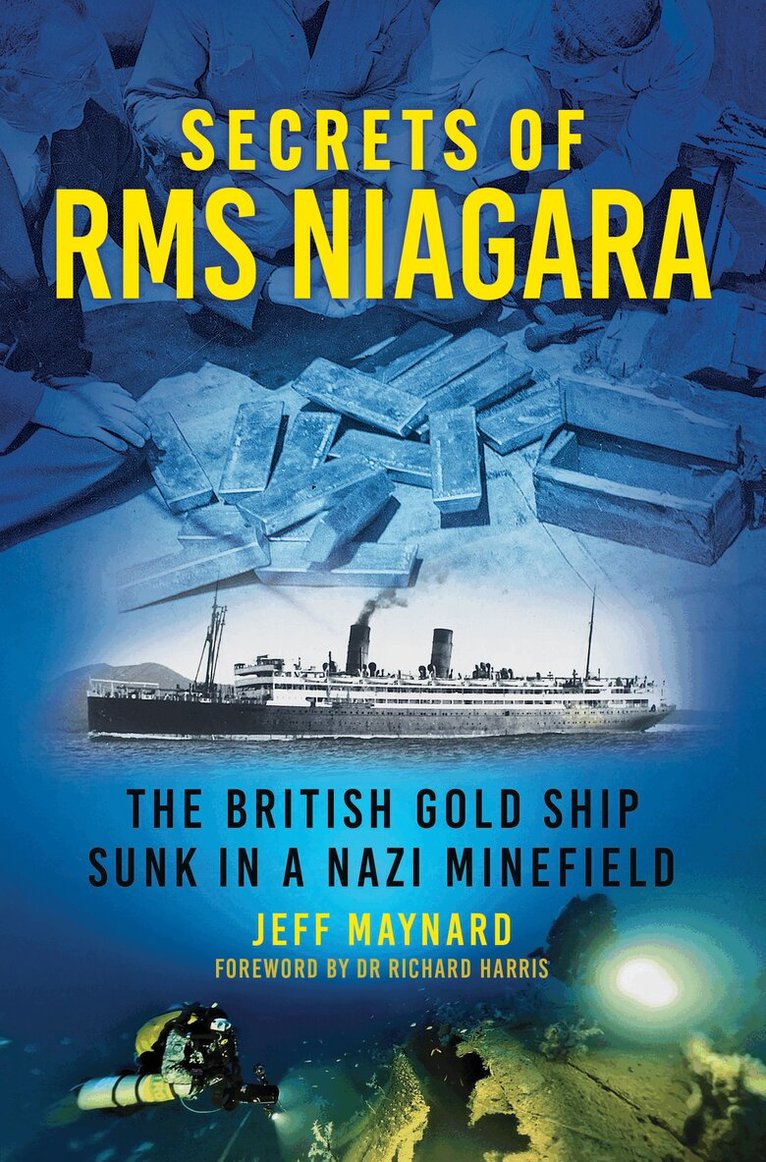
At the outbreak of World War Two, the Bank of England was shipping gold to America to purchase arms and munitions. In June 1940, RMS Niagara was secretly carrying 8 tons of British gold when it hit a German mine and sank off New Zealand. The Royal Navy declared salvage was impossible because the water was too deep, so the desperate Bank of England offered the job to a retired sea captain, John Williams. Within weeks, Williams hired a deep-sea diver, built an experimental diving bell, employed a team of misfits, and refloated a rusting hulk to use as a salvage ship. Then, against orders, Williams sailed into the minefield to search for the sunken liner.Over the coming months, the crew battled bureaucracy, storms, German mines, and each other, as they dove to record depths. But the closer they got to the gold, the more they realised they would be betrayed by the people who sent them on their mission. With exclusive access to diaries, reports, logbooks, correspondence and interviews, Jeff Maynard tells a story of underdogs overcoming insurmountable odds, and the people of a small coastal community who welcomed them, revealing the truth behind one of the most incredible adventures of the Second World War.