Jefferson Cowie - Böcker
Visar alla böcker från författaren Jefferson Cowie. Handla med fri frakt och snabb leverans.
5 produkter
5 produkter
193 kr
Skickas inom 7-10 vardagar
Where does the New Deal fit in the big picture of American history? What does it mean for us today? What happened to the economic equality it once engendered? In The Great Exception, Jefferson Cowie provides new answers to these important questions. In the period between the Great Depression and the 1970s, he argues, the United States government achieved a unique level of equality, using its considerable resources on behalf of working Americans in ways that it had not before and has not since. If there is to be a comparable battle for collective economic rights today, Cowie argues, it needs to build on an understanding of the unique political foundation for the New Deal. Anyone who wants to come to terms with the politics of inequality in the United States will need to read The Great Exception.
794 kr
Skickas inom 10-15 vardagar
Find a pool of cheap, pliable workers and give them jobs—and soon they cease to be as cheap or as pliable. What is an employer to do then? Why, find another poor community desperate for work. This route—one taken time and again by major American manufacturers—is vividly chronicled in this fascinating account of RCA's half century-long search for desirable sources of labor. Capital Moves introduces us to the people most affected by the migration of industry and, most importantly, recounts how they came to fight against the idea that they were simply "cheap labor."Jefferson Cowie tells the dramatic story of four communities, each irrevocably transformed by the opening of an industrial plant. From the manufacturer's first factory in Camden, New Jersey, where it employed large numbers of southern and eastern European immigrants, RCA moved to rural Indiana in 1940, hiring Americans of Scotch-Irish descent for its plant in Bloomington. Then, in the volatile 1960s, the company relocated to Memphis where African Americans made up the core of the labor pool. Finally, the company landed in northern Mexico in the 1970s—a region rapidly becoming one of the most industrialized on the continent.
314 kr
Skickas inom 10-15 vardagar
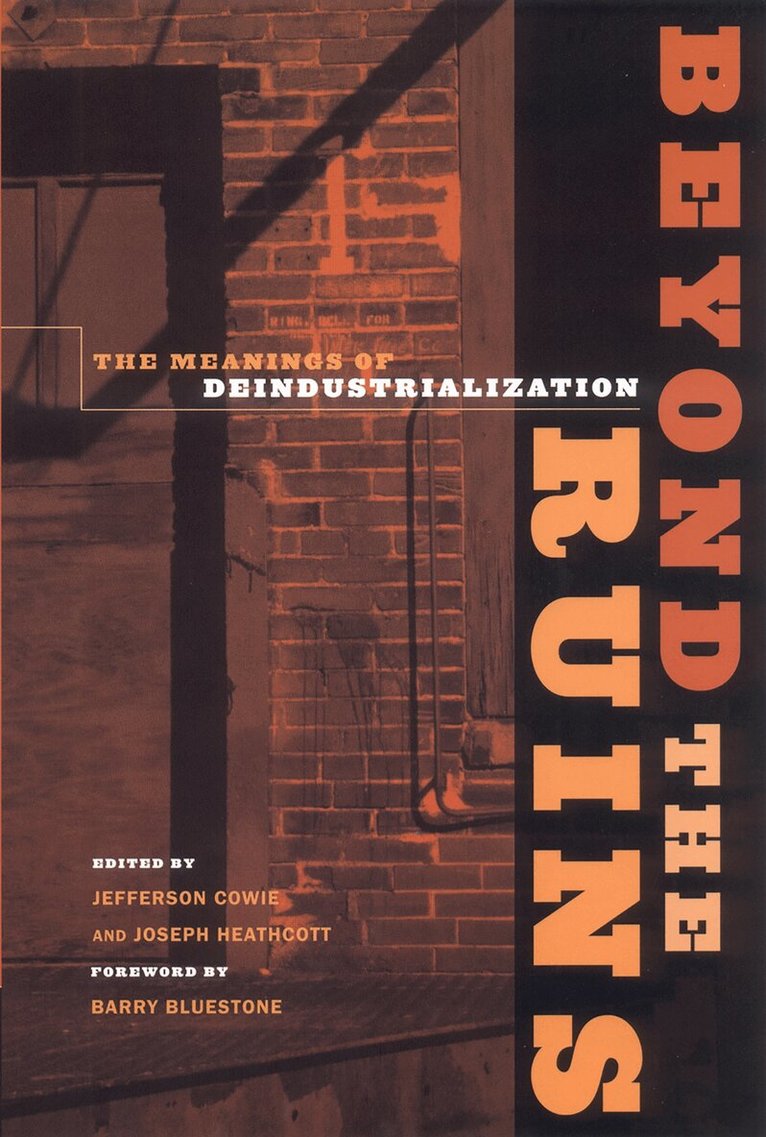
The immediate impact of deindustrialization—the suffering inflicted upon workers, their families, and their communities—has been widely reported by scholars and journalists. In this important volume, the authors seek to move discussion of America's industrial decline beyond the immediate ramifications of plant shutdowns by placing it into a broader social, political, and economic context. Emphasizing a historical approach, the authors explore the multiple meanings of one of the major transformations of the twentieth century.The concept of deindustrialization entered the popular and scholarly lexicon in 1982 with the publication of The Deindustrialization of America, by Barry Bluestone and Bennett Harrison. Beyond the Ruins both builds upon and departs from the insights presented in that benchmark study. In this volume, the authors rethink the chronology, memory, geography, culture, and politics of industrial change in America.Taken together, these original essays argue that deindustrialization is not a story of a single emblematic place, such as Flint or Youngstown, or a specific time period, such as the 1980s. Nor is it limited to the abandoned factory buildings associated with heavy industry. Rather, deindustrialization is a complex process that is uneven in its causes, timing, and consequences. The essays in this volume examine this process through a wide range of topics, from worker narratives and media imagery, to suburban politics, environmental activism, and commemoration.
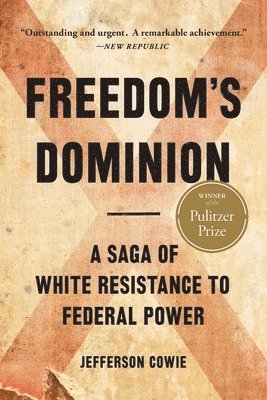
Freedom's Dominion (Winner of the Pulitzer Prize)
A Saga of White Resistance to Federal Power
Häftad, Engelska, 2024
233 kr
Skickas inom 7-10 vardagar
WINNER OF THE PULITZER PRIZE IN HISTORY! An "important, deeply affecting-and regrettably relevant" (New York Times Book Review) chronicle of a sinister idea of freedom: white Americans' freedom to oppress others and their fight against the government that got in their way American freedom is typically associated with the fight of the oppressed for a better world. But for centuries, whenever the federal government intervened on behalf of non-white people, many white Americans fought back in the name of freedom-their freedom to dominate others.In Freedom's Dominion, prizewinning historian Jefferson Cowie traces this complex saga by focusing on a quintessentially American place: Barbour County, Alabama, the ancestral home of political firebrand George Wallace. In a land shaped by settler colonialism and chattel slavery, freedom became a weapon. With freedom as their cry, white Americans seized Native lands, championed secession, overthrew Reconstruction, questioned the New Deal, and fought against the civil rights movement.Through a riveting account of two centuries of local clashes between white people and federal authorities, Freedom's Dominion offers a radically new history of federal power, democracy, and American freedom. This history summons us today to embrace a vigorous model of American citizenship, backed by a federal government that is not afraid to fight the many incarnations of the freedom to dominate.
242 kr
Skickas inom 5-8 vardagar
Jefferson Cowie's edgy and incisive book makes new sense of the 1970s as a crucial and poorly understood transition from New Deal America, with its large, optimistic middle class, to the widening economic inequalities, poverty and dampened expectations of the 1980s and into the present. Cowie also connects politics to culture, showing how the big screen and the juke box can help understand how the US turned away from the radicalism of the 1960s toward the patriotic promise of Ronald Reagan.