Joseph Heathcott - Böcker
Visar alla böcker från författaren Joseph Heathcott. Handla med fri frakt och snabb leverans.
8 produkter
8 produkter
Routledge Handbook of Infrastructure Design
Global Perspectives from Architectural History
Inbunden, Engelska, 2022
3 187 kr
Skickas inom 10-15 vardagar
The Routledge Handbook of Infrastructure Design explores the multifaceted nature of infrastructure through the global lens of architectural history. Infrastructure holds the world together. Yet even as it connects some people, it divides others, sorting access and connectivity through varied social categories such as class, race, gender, and citizenship. This collection examines themes across broad spans of time, raises questions of linkage and scale, investigates infrastructure as phenomenon and affect, and traces the interrelation of aesthetics, technology, and power. With a diverse range of contributions from 33 scholars, this volume presents new research from regions including South and East Asia, Sub-Saharan Africa, South America, North America, Western Europe, the Middle East, and the former Soviet Union. This extraordinary group of authors bring close attention to the materials, functions, and aesthetics of infrastructure systems as these unfold within their cultural and political contexts. They provide not only new knowledge of specific artifacts, such as the Valens Aqueduct, the Hong Kong waterfront, and the Pan-American Highway, but also new ways of conceptualizing, studying, and understanding infrastructure as a worlding process. The Routledge Handbook of Infrastructure Design provides richly textured, thoroughly evidenced, and imaginatively drawn arguments that deepen our understanding of the role of infrastructure in creating the world in which we live. It is a must-read for academics and students.
314 kr
Skickas inom 10-15 vardagar
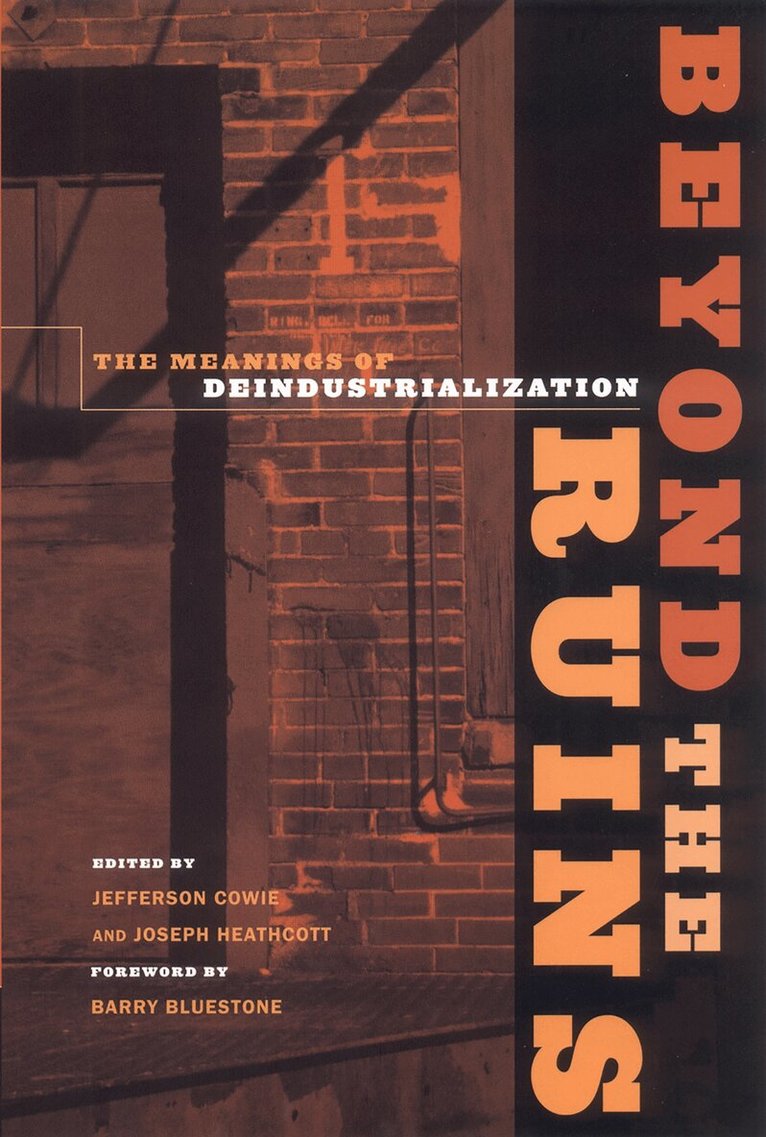
The immediate impact of deindustrialization—the suffering inflicted upon workers, their families, and their communities—has been widely reported by scholars and journalists. In this important volume, the authors seek to move discussion of America's industrial decline beyond the immediate ramifications of plant shutdowns by placing it into a broader social, political, and economic context. Emphasizing a historical approach, the authors explore the multiple meanings of one of the major transformations of the twentieth century.The concept of deindustrialization entered the popular and scholarly lexicon in 1982 with the publication of The Deindustrialization of America, by Barry Bluestone and Bennett Harrison. Beyond the Ruins both builds upon and departs from the insights presented in that benchmark study. In this volume, the authors rethink the chronology, memory, geography, culture, and politics of industrial change in America.Taken together, these original essays argue that deindustrialization is not a story of a single emblematic place, such as Flint or Youngstown, or a specific time period, such as the 1980s. Nor is it limited to the abandoned factory buildings associated with heavy industry. Rather, deindustrialization is a complex process that is uneven in its causes, timing, and consequences. The essays in this volume examine this process through a wide range of topics, from worker narratives and media imagery, to suburban politics, environmental activism, and commemoration.
Urban Infrastructure
Historical and Social Dimensions of an Interconnected World
Inbunden, Engelska, 2022
896 kr
Skickas inom 3-6 vardagar
Urban Infrastructures creates space for an encounter between historians, humanists, and social scientists who seek new methodological approaches to the history of urban infrastructure. It draws on recent work across history, anthropology, science and technology studies, geography, resilience/sustainability, and other disciplines to explore the social effects of infrastructure. The volume rejects narrow conceptions of infrastructure history as only the history of public works, and instead expands the definition to all business enterprises and public bodies that provide the goods and services essential for the day-to-day lives of most people. Essays examine traditional artifacts such as roads, highways, and waterworks, as well as nontraditional topics like regimes of heating and cooling, the processing and distribution of food, and even the metaphysics of electromagnetic infrastructure. Contributors reveal both the material grounding of urban social relations and the social life of material infrastructure. In the end, they show that infrastructure profoundly reshapes urban life even as residents fight to reshape infrastructure to their own ends.
Routledge Handbook of Infrastructure Design
Global Perspectives from Architectural History
Häftad, Engelska, 2023
663 kr
Skickas inom 10-15 vardagar
The Routledge Handbook of Infrastructure Design explores the multifaceted nature of infrastructure through the global lens of architectural history. Infrastructure holds the world together. Yet even as it connects some people, it divides others, sorting access and connectivity through varied social categories such as class, race, gender, and citizenship. This collection examines themes across broad spans of time, raises questions of linkage and scale, investigates infrastructure as phenomenon and affect, and traces the interrelation of aesthetics, technology, and power. With a diverse range of contributions from 33 scholars, this volume presents new research from regions including South and East Asia, Sub-Saharan Africa, South America, North America, Western Europe, the Middle East, and the former Soviet Union. This extraordinary group of authors bring close attention to the materials, functions, and aesthetics of infrastructure systems as these unfold within their cultural and political contexts. They provide not only new knowledge of specific artifacts, such as the Valens Aqueduct, the Hong Kong waterfront, and the Pan-American Highway, but also new ways of conceptualizing, studying, and understanding infrastructure as a worlding process. The Routledge Handbook of Infrastructure Design provides richly textured, thoroughly evidenced, and imaginatively drawn arguments that deepen our understanding of the role of infrastructure in creating the world in which we live. It is a must-read for academics and students.
386 kr
Skickas inom 7-10 vardagar
Winner, The David R. Coffin Publication Grant A vibrant exploration of the everyday life of one of the most diverse places in the world: Queens, New York.Remade by decades of immigration, Queens, New York, has emerged as an emblematic space of social mixing and encounters across multiple lines of difference. With its expansive subdivisions, tangled highways, and centerless form, it is also New York's most enigmatic borough. It can feel alternately like a big city, a tight-knit village, a featureless industrial zone, or a sprawling suburban community. Through more than 200 contemporary photographs, Joseph Heathcott captures this multifaceted borough and one of the most diverse places in the United States.Drawn from more than a decade of roaming around Queens and snapping photos, Heathcott conveys the juxtaposition of the ordinary and the extraordinary, the mundane and the surprising, and the staggering social diversity that best characterizes Queens. At the heart of the story are two separate but entwined histories: the rapid expansion of the borough's built environment through the twentieth century, and the millions of people who have traveled from near and far to call Queens home. Newcomers have had to confront discrimination, white racial hostility, legal challenges, and language barriers. They have had to struggle to find adequate housing, places to worship, and jobs that pay enough to survive. And they have done all of this in the borough's jumbled collection of neighborhoods, housing types, civic and religious institutions, factories and warehouses, commercial streets, and strip malls.Heathcott makes primary use of documentary photography to bring these social and spatial realities of everyday life into relief. He also draws on demographic data, archival sources, planning documents, news stories, and reports. The result is a visual meditation on Queens that provides clues about an urban future where notions of citizenship and belonging are negotiated across multiple lines of difference, but where a sense of "getting along"—however roughly textured and unfinished—has taken hold in the everyday life of the streets.
1 204 kr
Kommande
Captures the rich urban culture and everyday landscapes of Mexico City through photography, highlighting the interplay between tradition and modernity in its built environments.Mexico City is the largest metropolis in the Western Hemisphere and one of the most populous places on earth. With some twenty million people spread out over three states, its political, economic, and cultural dominance remain unchallenged by any of the country’s other cities. When we think of Mexico City, we tend to imagine it as vast, grandiose, frenetic, and vulnerable. And it is all of these things. However, in every nook and corner of the metropolitan expanse, a tangled patchwork of neighborhoods and communities has emerged over time, ordinary places that people call home.It is precisely the everyday life and landscape of these places that the present book explores. It uses photography to trace the rich urban culture and vernacular artistry of the city’s residents as they continually create and adapt the built environments that surround them. The photographs have been selected from thousands taken by the author from around Mexico City. The images reveal a city that is at once deeply rooted in urban traditions stretching over many centuries, and at the same time transformed by the changing political and social forces of an independent nation, a revolutionary state, and the vicissitudes of a globalizing world.The book includes 150 photographs divided into eight sections, featuring a wide variety of spaces and places, from the canals of Xochimilco to the bustling shops of Santo Domingo, and from the towers of Tlatelolco to the quiet streets of Santa Maria La Ribera. The images explore the layered materialities, aesthetics, and social relations of the urban landscape, and the many ways that people have shaped and adapted the city to suit their needs. An introduction and detailed captions help the reader to interpret the patterns and routines unfolding in the images, and to build a sense of how this bewildering city hangs together from day to day. In the end, even if the totality of Mexico City remains elusive, we can at least come to know it through its fragments, liniments, and traces.
531 kr
Kommande
Captures the rich urban culture and everyday landscapes of Mexico City through photography, highlighting the interplay between tradition and modernity in its built environments.Mexico City is the largest metropolis in the Western Hemisphere and one of the most populous places on earth. With some twenty million people spread out over three states, its political, economic, and cultural dominance remain unchallenged by any of the country’s other cities. When we think of Mexico City, we tend to imagine it as vast, grandiose, frenetic, and vulnerable. And it is all of these things. However, in every nook and corner of the metropolitan expanse, a tangled patchwork of neighborhoods and communities has emerged over time, ordinary places that people call home.It is precisely the everyday life and landscape of these places that the present book explores. It uses photography to trace the rich urban culture and vernacular artistry of the city’s residents as they continually create and adapt the built environments that surround them. The photographs have been selected from thousands taken by the author from around Mexico City. The images reveal a city that is at once deeply rooted in urban traditions stretching over many centuries, and at the same time transformed by the changing political and social forces of an independent nation, a revolutionary state, and the vicissitudes of a globalizing world.The book includes 150 photographs divided into eight sections, featuring a wide variety of spaces and places, from the canals of Xochimilco to the bustling shops of Santo Domingo, and from the towers of Tlatelolco to the quiet streets of Santa Maria La Ribera. The images explore the layered materialities, aesthetics, and social relations of the urban landscape, and the many ways that people have shaped and adapted the city to suit their needs. An introduction and detailed captions help the reader to interpret the patterns and routines unfolding in the images, and to build a sense of how this bewildering city hangs together from day to day. In the end, even if the totality of Mexico City remains elusive, we can at least come to know it through its fragments, liniments, and traces.
291 kr
Skickas inom 7-10 vardagar
During the first two decades of the twentieth century, the St. Louis Street Department generated one of the most extensive troves of photographs ever taken of the city. Ostensibly created to document municipal challenges and improvements, the images inadvertently captured richly detailed scenes of everyday life. Largely led by Charles Clement Holt (1866–1925), St. Louis’s photography operation expanded until it produced about six thousand images per year in 1914. Many of these photographs were lost, but a city historian salvaged a collection of three hundred glass plate negatives in the 1950s, which are now in the Missouri Historical Society collections. This small, but superb, group of photographs provides a wealth of information on the visual culture of St. Louis during a period of rapid transformation. Capturing the City is the first book to examine these photographs, placing the people and landscapes depicted within the broader context of a swiftly urbanizing and industrializing metropolis.Collected and analyzed here by Joseph Heathcott and Angela Dietz, the compelling images in Capturing the City reveal the national trend among cities to use the camera as a documentary tool. Reformers Jacob Riis and Lewis Hine imagined the camera as a truth-telling instrument and used their photographs to mobilize public consciousness. Across the nation, cities used photographers to document slums, workhouses, and crime scenes, as well as municipal improvements like street lighting, pavement, and model housing. In this vein, Holt and his staff showcased both the challenges and the successes of government action in St. Louis. Consistent with their Progressive-era peers, their efforts contributed to the record of ongoing public works while shaping the narrative of urban progress itself.