Jeffrey C. King - Böcker
Visar alla böcker från författaren Jeffrey C. King. Handla med fri frakt och snabb leverans.
5 produkter
5 produkter
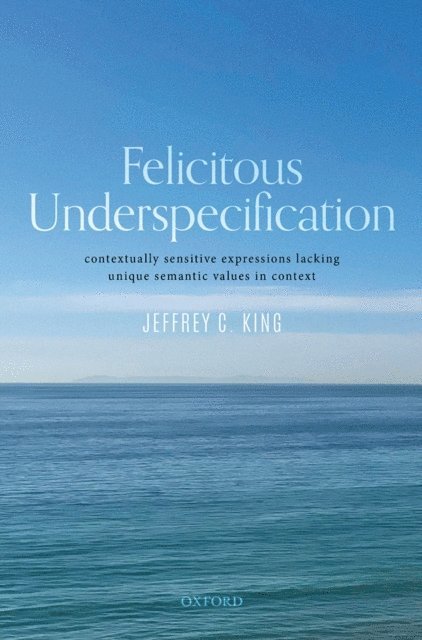
Felicitous Underspecification
Contextually Sensitive Expressions Lacking Unique Semantic Values in Context
Inbunden, Engelska, 2021
831 kr
Skickas inom 5-8 vardagar
Felicitous uses of contextually sensitive expressions generally have unique semantic values in context. For example, a felicitous use of the singular pronoun 'she' generally has a single female as its unique semantic value in context. In the present work, Jeffrey C. King argues that contextually sensitive expressions have felicitous uses where they lack unique semantic values in context. He calls such uses instances of felicitous underspecification. In such cases, he says that the underspecified expression is associated with a range of candidate semantic values in context. King provides a rule for updating the Stalnakerian common ground when sentences containing felicitous underspecified expressions are uttered and accepted in a conversation. He also gives an account of the mechanism that associates the range of candidate semantic values in context with an underspecified expression. Sentences containing felicitous underspecified expressions can be embedded in various constructions. King considers the result of embedding such sentences under negation and verbs of propositional attitude. He also considers the question of why some uses of underspecified expressions are felicitous and others aren't. This investigation yields the notion of a context being appropriate for a sentence (LF), where a context is appropriate for a sentence containing an underspecified expression if the sentence is felicitous in that context. Finally, he considers some difficulties that arise in virtue of the fact that pronouns and demonstratives have some sorts of implications of uniqueness that clash with their being underspecified.
509 kr
Skickas inom 5-8 vardagar
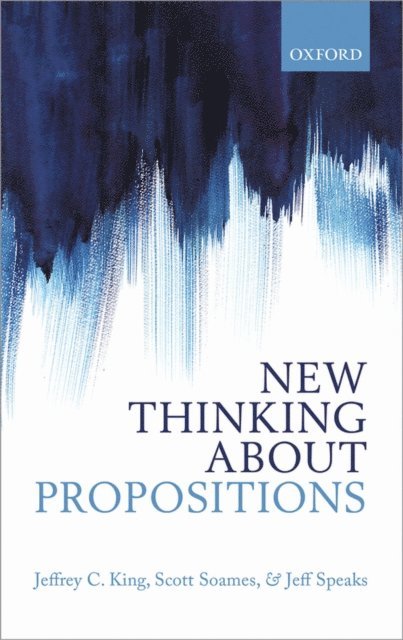
Philosophy (especially philosophy of language and philosophy of mind), science (especially linguistics and cognitive science), and common sense all sometimes make reference to propositions--understood as the things we believe and say, and the things which are (primarily) true or false. There is, however, no widespread agreement about what sorts of things these entities are. In New Thinking about Propositions, Jeffrey C. King, Scott Soames, and Jeff Speaks argue that commitment to propositions is indispensable, and that traditional accounts of propositions are inadequate. They each then defend their own views of the nature of propositions.
546 kr
Skickas inom 5-8 vardagar
Belief in propositions has had a long and distinguished history in analytic philosophy. Three of the founding fathers of analytic philosophy, Gottlob Frege, Bertrand Russell, and G. E. Moore, believed in propositions. Many philosophers since then have shared this belief; and the belief is widely, though certainly not universally, accepted among philosophers today. Among contemporary philosophers who believe in propositions, many, and perhaps even most, take them to be structured entities with individuals, properties, and relations as constituents. For example, the proposition that Glenn loves Tracy has Glenn, the loving relation, and Tracy as constituents. What is it, then, that binds these constituents together and imposes structure on them? And if the proposition that Glenn loves Tracy is distinct from the proposition that Tracy loves Glenn yet both have the same constituents, what is about the way these constituents are structured or bound together that makes them two different propositions? In The Nature and Structure of Content, Jeffrey C. King formulates a detailed account of the metaphysical nature of propositions, and provides fresh answers to the above questions. In addition to explaining what it is that binds together the constituents of structured propositions and imposes structure on them, King deals with some of the standard objections to accounts of propositions: he shows that there is no mystery about what propositions are; that given certain minimal assumptions, it follows that they exist; and that on his approach, we can see how and why propositions manage to have truth conditions and represent the world as being a certain way. The Nature and Structure of Content also contains a detailed account of the nature of tense and modality, and provides a solution to the paradox of analysis. Scholars and students working in the philosophy of mind and language will find this book rewarding reading.
1 240 kr
Skickas inom 7-10 vardagar
Philosophy (especially philosophy of language and philosophy of mind), science (especially linguistics and cognitive science), and common sense all sometimes make reference to propositions--understood as the things we believe and say, and the things which are (primarily) true or false. There is, however, no widespread agreement about what sorts of things these entities are. In New Thinking about Propositions, Jeffrey C. King, Scott Soames, and Jeff Speaks argue that commitment to propositions is indispensable, and that traditional accounts of propositions are inadequate. They each then defend their own views of the nature of propositions.
Del 2 - Contemporary Philosophical Monographs
Complex Demonstratives
A Quantificational Account
Häftad, Engelska, 2001
61 kr
Tillfälligt slut