
Jeffrey Linsky – författare
1 040 kr
Skickas inom 5-8 vardagar
1 105 kr
Läs direkt efter köp
Like planets in our solar system, exoplanets form, evolve, and interact with their host stars in many ways. As exoplanets acquire material and grow to the final size, their atmospheres are subjected to intense UV and X-radiation and high-energy particle bombardment from the young host star. Whether a planet can retain its atmosphere and the conditions for significant mass loss both depend upon the strength of the host star''s high-energy radiation and wind, the distance of the exoplanet from its host star, the gravitational potential of the exoplanet, and the initial chemical composition of the exoplanet atmosphere.
This introductory overview describes the physical processes responsible for the emission of radiation and acceleration of winds of host stars that together control the environment of an exoplanet, focusing on topics that are critically important for understanding exoplanetary atmospheres but are usually not posed from the perspective of host stars. Accordingly, both host stars and exoplanets are not studied in isolation but are treated as integrated systems. Stellar magnetic fields, which are the energy source for activity phenomena including high-energy radiation and winds, play a critical role in determining whether exoplanets are habitable.
This text is primarily for researchers and graduate students who are studying exoplanet atmospheres and habitability, but who may not have a background in the physics and phenomenology of host stars that provide the environment in which exoplanets evolve. It provides a comprehensive overview of this broad topic rather than going deeply into many technical aspects but includes a large list of references to guide those interested in pursuing these questions. Nonspecialists with a scientific background should also find this text a valuable resource for understanding the critical issues of contemporary exoplanet research.
1 078 kr
Skickas inom 10-15 vardagar
1 413 kr
Läs direkt efter köp
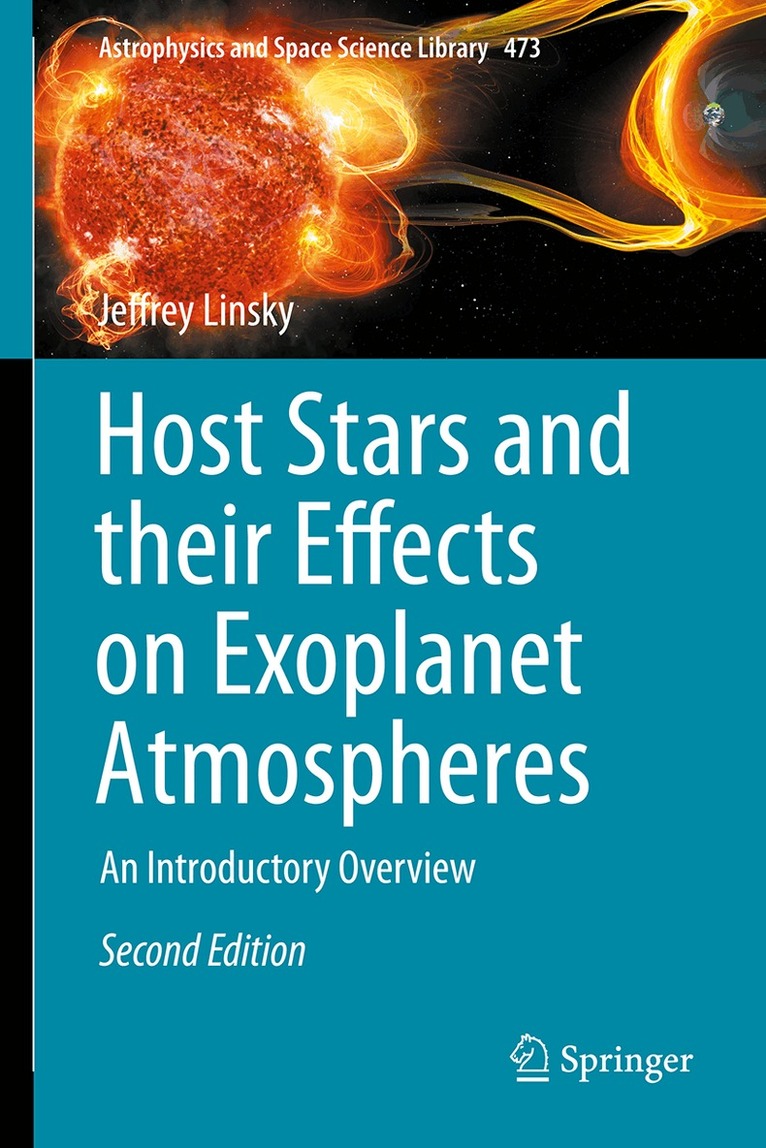
This comprehensive introductory overview describes the emission of radiation (X-rays to radio) and the winds of host stars and how they control the past, present, and future evolution of an exoplanet. The book focuses on topics that are critically important for understanding exoplanet atmospheres but are often posed without a comprehensive and detailed understanding of the host star and its effects on the exoplanet. Although both stars and exoplanets are usually studied in isolation, in this book they are treated as an integrated system. Whether or not an exoplanet can retain its atmosphere and the chemical composition of the atmosphere depends critically on the strength, time dependence, and spectral energy distribution of the host star''s radiation, flares, coronal mass ejections, and wind, which are described in detail in the book. The book describes the roles played by magnetic fields in the coronae and chromospheres of host stars that tie together stellar active phenomena with major effects on exoplanet atmospheres.
In the era of JWST and very sensitive ground- and space-based instruments, a critical topic is the noise imposed on radial velocity measurements and transit photometry and spectroscopy by the host star''s activity and variability that fundamentally limit our understanding of exoplanet properties. This topic is addressed in detail in the book.
This book is written primarily for graduate students and researchers who are studying exoplanet atmospheres and habitability, but who may not have a background in the physics and phenomenology of host stars. The book could serve as a reference book for graduate level classes on exoplanets. Nonspecialists with a scientific background should also find this text a valuable resource for understanding the critical issues of contemporary exoplanet research.
This new edition of “Host Stars and their Effects on Exoplanet Atmospheres" is a major revision of the existing book in the following ways:
It includes a new discussion of how stellar noise fundamentally limits our understanding of exoplanet atmospheresIt demonstrates in detail how stellar activity acts as fundamental driver of exoplanet atmosphere evolutionIt provides an outlook on how the field of exoplanet atmospheres and bio-astrophysics is being driven by powerful new telescopes and instrumentsIt extensively updates many chapters, in particular concerning host star extreme- and far-ultraviolet emission, stellar winds, stellar surface structures, the effects of space weather on exoplanets, and provides a realistic evaluation of habitability taking into account the evolution of host star activity.
1 078 kr
Skickas inom 10-15 vardagar
2 461 kr
Kommande