Jeffrey Record - Böcker
Visar alla böcker från författaren Jeffrey Record. Handla med fri frakt och snabb leverans.
14 produkter
14 produkter
350 kr
Skickas inom 5-8 vardagar
182 kr
Skickas inom 5-8 vardagar
257 kr
Skickas inom 3-6 vardagar
159 kr
Skickas inom 5-8 vardagar
300 kr
Skickas inom 3-6 vardagar
Failed States and Casualty Phobia
Implications for Force Structure and Technology Choices
Häftad, Engelska, 2012
159 kr
Skickas inom 5-8 vardagar
Japan's Decision for War in 1941
Some Enduring Lessons - Scholar's Choice Edition
Häftad, Engelska, 2015
291 kr
Skickas inom 3-6 vardagar
150 kr
Skickas inom 5-8 vardagar
141 kr
Skickas inom 5-8 vardagar
213 kr
Skickas inom 10-15 vardagar
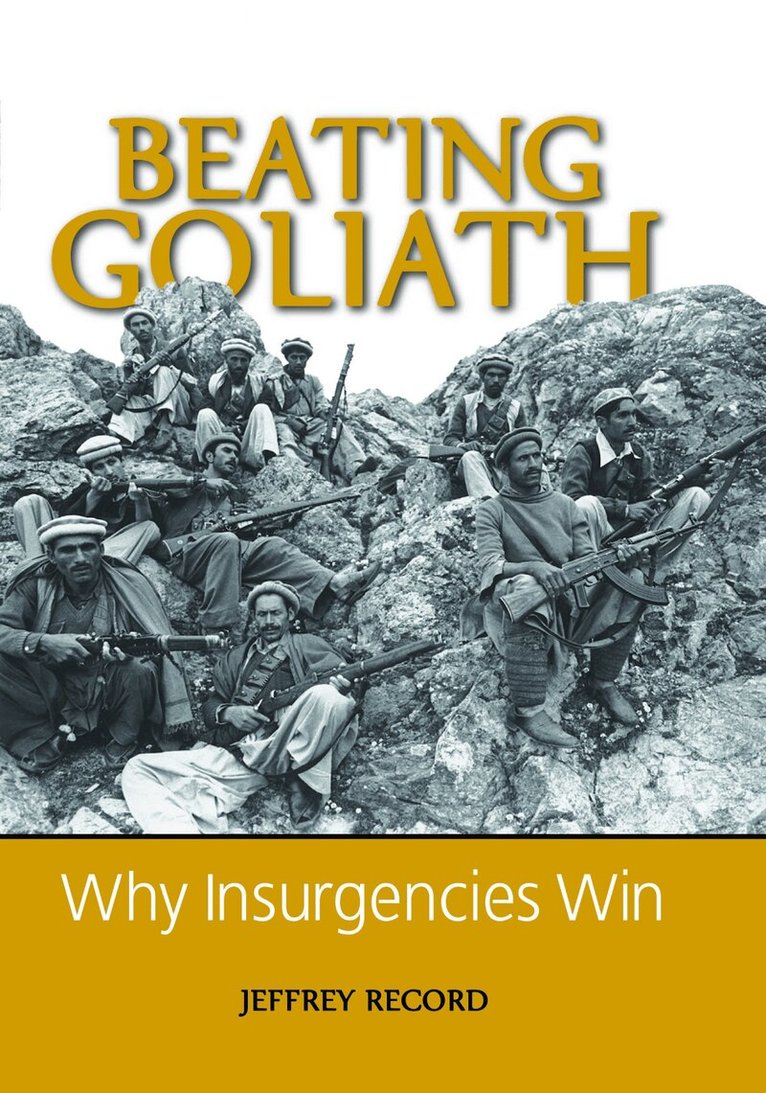
Beating Goliath examines the phenomenon of victories by the weak over the strong—more specifically, insurgencies that succeeded against great powers. Jeffrey Record reviews eleven insurgent wars from 1775 to the present and determines why the seemingly weaker side won. He concludes that external assistance correlates more consistently with insurgent success than any other explanation. He does not disparage the critical importance of will, strategy, and strong-side regime type or suggest that external assistance guarantees success. Indeed, in all cases, some combination of these factors is usually present. But Record finds few if any cases of unassisted insurgent victories except against the most decrepit regimes. Having identified the ingredients of insurgent success, Record examines the present insurgency in Iraq and whether the United States can win. In so doing, Record employs a comparative analysis of the Vietnam War and the Iraq War. He also identifies and assesses the influence of distinctive features of the American way of war on the U.S. forces' performance against the Iraqi insurgency. Make no mistake: insurgent victories are the exception, not the rule. But when David does beat Goliath, the consequences can be earth shattering and change the course of history. Jeffrey Record's persuasive logic and clear writing make this timely book a must read for scholars, policymakers, military strategists, and anyone interested in the Iraq War's outcome.
336 kr
Skickas inom 10-15 vardagar
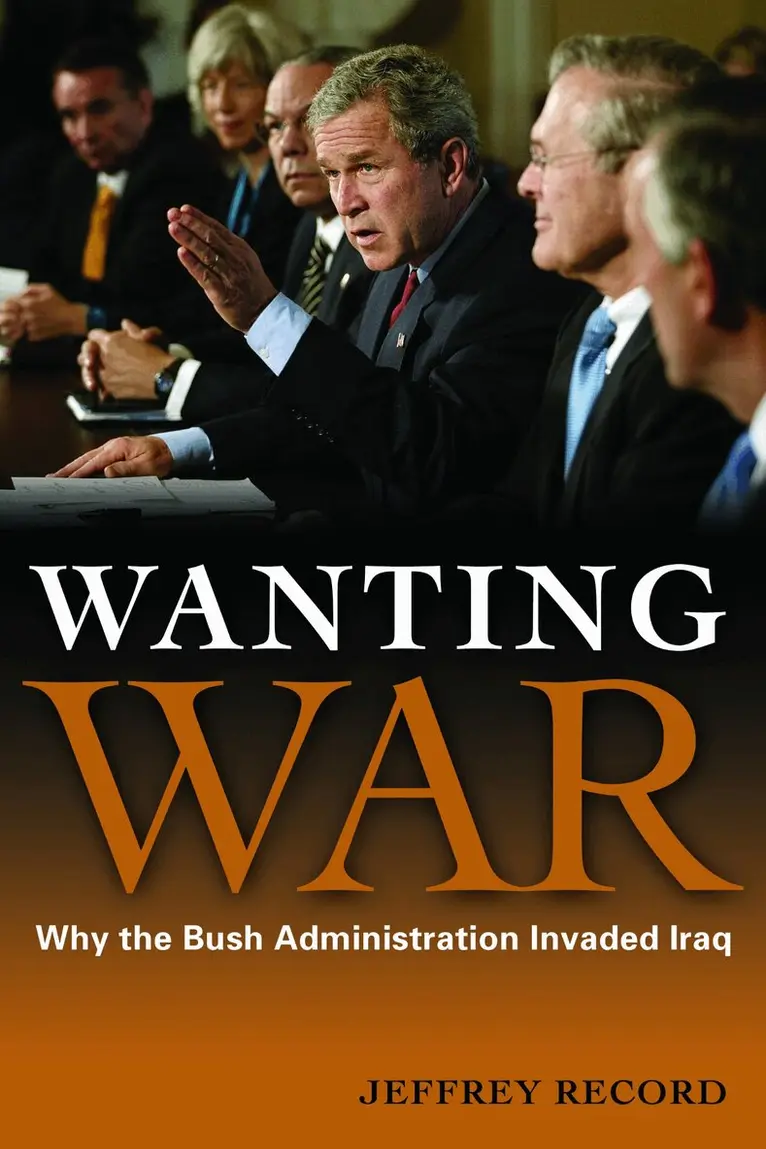
Wanting War is the first comprehensive analysis of the often contradictory reasons why President George W. Bush went to war in Iraq and of the war's impact on future U.S. armed intervention abroad. Though the White House sold the war as a necessity to eliminate an alleged Iraqi threat, other agendas were at play. Drawing on new assessments of George W. Bush's presidency, recent memoirs by key administration decision makers, and Jeffrey Record's own expertise on U.S. military interventions since World War II, Wanting War contends that Bush's invasion of Iraq was more about the arrogance of post–Cold War American power than it was about Saddam Hussein. Ultimately, Iraq was selected not because it posed a convincing security threat but because Baghdad was militarily helpless. Operation Iraqi Freedom was a demonstration of American power, especially the will to use it. Ironically, as Record points out, a war launched to advertise American combativeness is likely to lead U.S. foreign policymakers and military leaders to be averse to using force in all but the most favorable circumstances. But this new respect for the limits of America's conventional military power, especially as an instrument of ffecting political change in foreign cultures, and for the inherent risks and uncertainties of war, may prove to be one of the Iraq War's few positive legacies. Record argues that the American experience in Iraq ought to be a cautionary tale for those who advocate for further U.S. military action.
388 kr
Skickas inom 3-6 vardagar
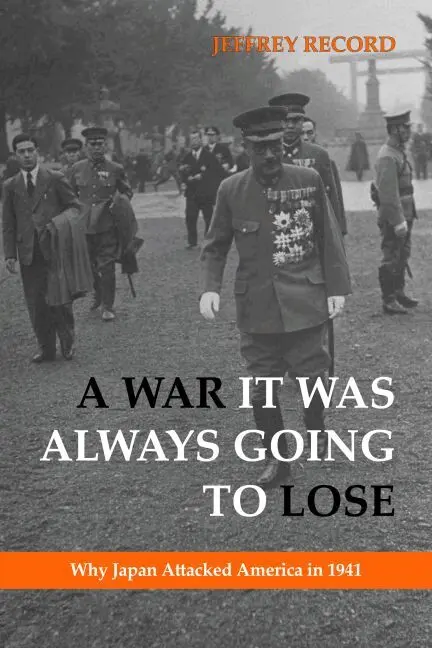
Jeffrey Record has specialized in investigating the causes of war. In The Specter of Munich: Reconsidering the Lessons of Appeasing Hitler (Potomac Books, Inc., 2006), he contended that Hitler could not have been deterred from going to war by any action the Allies could plausibly have taken. In Beating Goliath: Why Insurgencies Win (Potomac Books, Inc., 2007), Record reviewed eleven insurgencies and evaluated the reasons for their success or failure, including the insurgents' stronger will to prevail. Wanting War: Why the Bush Administration Invaded Iraq (Potomac Books, Inc., 2009) includes one of Record's most cogent explanations of why an often uncritical belief in one's own victory is frequently (but not always) a critical component of the decision to make war. Record incorporates the lessons of these earlier books in his latest, A War It Was Always Going to Lose: Why Japan Attacked America in 1941. The attack on Pearl Harbor is one of the most perplexing cases in living memory of a weaker power seeming to believe that it could vanquish a clearly superior force. On closer inspection, however, Record finds that Japan did not believe it could win; yet, the Japanese imperial command decided to attack the United States anyway. Conventional explanations that Japan's leaders were criminally stupid, wildly deluded, or just plumb crazy don't fully answer all our questions, Record finds. Instead, he argues, the Japanese were driven by an insatiable appetite for national glory and economic security via the conquest of East Asia. The scope of their ambitions and their fear of economic destruction overwhelmed their knowledge that the likelihood of winning was slim and propelled them into a war they were always going to lose.
Making War, Thinking History
Munich, Vietnam, and Presidential Uses of Force from Korea to Kosovo
Häftad, Engelska, 2014
242 kr
Skickas inom 5-8 vardagar
In examining the influence of historical analogies on decisions to use--or not use--force, military strategist Jeffrey Record assesses every major application of U.S. force from the Korean War to the NATO war on Serbia. Specifically, he looks at the influence of two analogies: the democracies? appeasement of Hitler at Munich and America's defeat in the Vietnam War. His book judges the utility of these two analogies on presidential decision-making and finds considerable misuse of them in situations where force was optional. He points to the Johnson administration's application of the Munich analogy to the circumstances of Southeast Asia in 1965 as the most egregious example of their misuse, but also cites the faulty reasoning by historical analogy that prevailed among critics of Reagan's policy in Central America and in Clinton's use of force in Haiti and the former Yugoslavia. The author's findings show generational experience to be a key influence on presidential decision-making: Munich persuaded mid-twentieth-century presidents that force should be used early and decisively while Vietnam cautioned later presidents against using force at all. Both analogies were at work for the Gulf War, with Munich urging a decision for war and Vietnam warning against a graduated and highly restricted use of force. Record also reminds us of the times when presidents have used analogies to mobilize public support for action they have already decided to take. Addressing both the process of presidential decision-making and the wisdom of decisions made, this well-reasoned book offers timely lessons to a broad audience that includes political scientists, military historians, defense analysts, and policy makers, as well as those simply curious about history's influence.
Ends, Means, Ideology, and Pride
Why the Axis Lost and What We Can Learn From Its Defeat
Häftad, Engelska, 2018
204 kr
Skickas inom 5-8 vardagar