Jeffrey S. Librett - Böcker
Visar alla böcker från författaren Jeffrey S. Librett. Handla med fri frakt och snabb leverans.
5 produkter
5 produkter
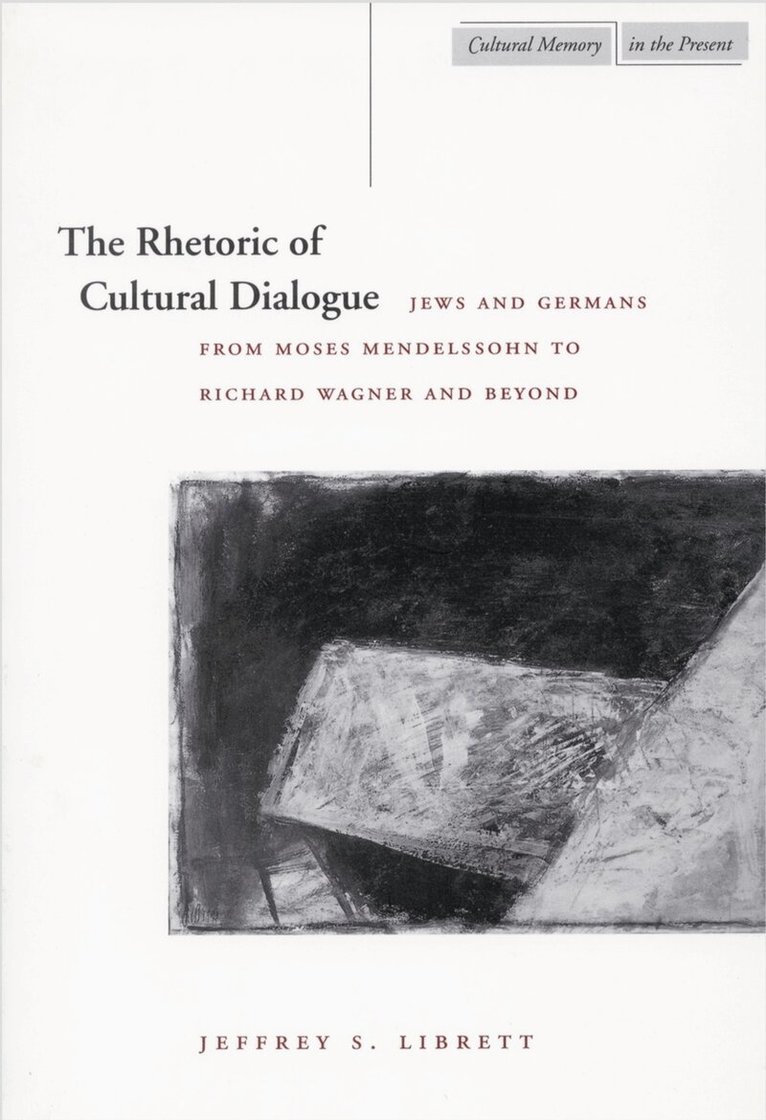
Rhetoric of Cultural Dialogue
Jews and Germans from Moses Mendelssohn to Richard Wagner and Beyond
Häftad, Engelska, 2000
534 kr
Skickas inom 7-10 vardagar
In this groundbreaking work, the author effects the first extended rhetorical-philosophical reading of the historically problematic relationship between Jews and Germans, based on an analysis of texts from the Enlightenment through Modernism by Moses Mendelssohn, Friedrich and Dorothea Schlegel, Karl Marx, Richard Wagner, Friedrich Nietzsche, and Sigmund Freud. The theoretical underpinning of the work lies in the author's rereading, in terms of contemporary rhetorical theory, of the medieval tradition known as "figural representation," which defines the Jewish-Christian relation as that between the dead, prefigural letter and the living, fulfilled spirit.After arguing that the German Enlightenment ultimately plays out the historical phantasm of a necessary "Judaization" of Protestant rationality, the author shows that German Early Romanticism consists fundamentally in the attempt to solve the aporias raised by this impossible confrontation between Protestant spirit and Jewish letter. In readings of Dorothea Schlegel—Mendelssohn's daughter—and her husband Friedrich Schlegel, the author provides a new interpretation of the Neo-Catholic turn of later German Romanticism. Further, he situates the proleptic end and reversal of the project of Jewish emancipation in the two extreme versions of late-nineteenth-century anti-Judaism, those of Marx and Wagner, here viewed as binary concretizations of a specifically post-Romantic paganized Protestantism.Finally, the author argues that twentieth-century Modernism as represented by Nietzsche and Freud renews, if in a multiply ironic displacement, the secret "Judaizing" tendencies of the Enlightenment. Fascism and Communism both denigrate this Modernism, which affirms the letter of language as quasi-synonymous with the force of temporality—or anticipatory repetition—that disrupts all claims to the full presence of spirit. The book ends with a note on recent debates about Holocaust memory.
1 167 kr
Skickas inom 10-15 vardagar
Orientalism and the Figure of the Jew proposes a new way of understanding modern Orientalism. Tracing a path of modern Orientalist thought in German across crucial writings from the late eighteenth to the mid–twentieth centuries, Librett argues that Orientalism and anti-Judaism are inextricably entangled.Librett suggests, further, that the Western assertion of "material" power, in terms of which Orientalism is often read, is overdetermined by a "spiritual" weakness: an anxiety about the absence of absolute foundations and values that coincides with Western modernity itself. The modern West, he shows, posits an Oriental origin as a fetish to fill the absent place of lacking foundations. This fetish is appropriated as Western through a quasi-secularized application of Christian typology. Further, the Western appropriation of the "good" Orient always leaves behind the remainder of the "bad," inassimilable Orient.The book traces variations on this theme through historicist and idealist texts of the nineteenth century and then shows how high modernists like Buber, Kafka, Mann, and Freud place this historicist narrative in question. The book concludes with the outlines of a cultural historiography that would distance itself from the metaphysics of historicism, confronting instead its underlying anxieties.
389 kr
Skickas inom 10-15 vardagar
Orientalism and the Figure of the Jew proposes a new way of understanding modern Orientalism. Tracing a path of modern Orientalist thought in German across crucial writings from the late eighteenth to the mid–twentieth centuries, Librett argues that Orientalism and anti-Judaism are inextricably entangled.Librett suggests, further, that the Western assertion of "material" power, in terms of which Orientalism is often read, is overdetermined by a "spiritual" weakness: an anxiety about the absence of absolute foundations and values that coincides with Western modernity itself. The modern West, he shows, posits an Oriental origin as a fetish to fill the absent place of lacking foundations. This fetish is appropriated as Western through a quasi-secularized application of Christian typology. Further, the Western appropriation of the "good" Orient always leaves behind the remainder of the "bad," inassimilable Orient.The book traces variations on this theme through historicist and idealist texts of the nineteenth century and then shows how high modernists like Buber, Kafka, Mann, and Freud place this historicist narrative in question. The book concludes with the outlines of a cultural historiography that would distance itself from the metaphysics of historicism, confronting instead its underlying anxieties.
1 295 kr
Skickas
Provides the foundations for a new form of psychoanalysis appropriate to the subject of the twenty-first century.A Psychoanalysis for a Reemergent Humanity presents and elaborates upon the mature thought of the Haitian-Quebecois analyst Willy Apollon. Apollon's work amounts to a thorough revision of the fundamental concepts of Freudian-Lacanian psychoanalysis in view of the situation of the human subject today, in an age of global cultural conflict and interpenetration that he calls "mondialisation." This landmark volume brings together a new foundational text by Apollon, seven original essays, including by Apollon's longtime collaborators Danielle Bergeron and volume coeditor Lucie Cantin, and an interview with Apollon. Synthesizing clinical, cultural-historical, and aesthetic perspectives, contributors offer rich redefinitions of the unconscious, the imaginary-symbolic-real triad, masculine and feminine, puberty and adolescence, address and transference, the symptom, the fantasy, and more. As distinct cultures and civilizations crumble, the world as a whole and the human emerge in a new way. A Psychoanalysis for a Reemergent Humanity meets this moment, positioning spirit as a crucial term for a human creativity that exceeds any given culture.
380 kr
Kommande
Provides the foundations for a new form of psychoanalysis appropriate to the subject of the twenty-first century.A Psychoanalysis for a Reemergent Humanity presents and elaborates upon the mature thought of the Haitian-Quebecois analyst Willy Apollon. Apollon's work amounts to a thorough revision of the fundamental concepts of Freudian-Lacanian psychoanalysis in view of the situation of the human subject today, in an age of global cultural conflict and interpenetration that he calls "mondialisation." This landmark volume brings together a new foundational text by Apollon, seven original essays, including by Apollon's longtime collaborators Danielle Bergeron and volume coeditor Lucie Cantin, and an interview with Apollon. Synthesizing clinical, cultural-historical, and aesthetic perspectives, contributors offer rich redefinitions of the unconscious, the imaginary-symbolic-real triad, masculine and feminine, puberty and adolescence, address and transference, the symptom, the fantasy, and more. As distinct cultures and civilizations crumble, the world as a whole and the human emerge in a new way. A Psychoanalysis for a Reemergent Humanity meets this moment, positioning spirit as a crucial term for a human creativity that exceeds any given culture.