Jennifer Deinhart – författare
365 kr
Läs direkt efter köp
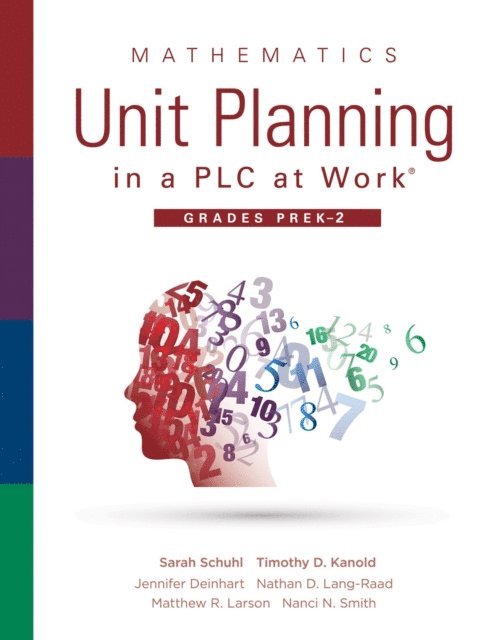
Bring a laser-like focus to the mathematics content your students need to learn throughout the year. Written by trusted mathematics experts, this resource helps PreK-2 teachers fully answer PLC critical question one: what do we want all students to know and be able to do? Read the book as a team to acquire detailed model mathematics units, learn how to perform seven collaborative tasks, and more.
Use this resource to increase mathematics achievement and provide students with a more equitable learning experience:
Understand how to collaboratively plan curriculum units in grades preK-2.Study the seven unit-planning elements and learn how to incorporate each in unit designs for early childhood education.Review the role of the PLC at Work®️ process in enhancing student learning and teacher collaboration.Observe four model units related to the foundations of addition and subtraction, one for each grade level.Receive tools and templates for effective unit planning in a professional learning community (PLC).Contents:Introduction by Timothy D. KanoldPart 1: Mathematics Unit Planning and Design ElementsChapter 1: Planning for Student Learning of Mathematics in Grades PreK-2Chapter 2: Unit Planning as a Collaborative Mathematics TeamPart 2: Foundations of Addition and Subtraction Unit Examples, Grades PreK-2Chapter 3: PreK Unit: Counting and CardinalityChapter 4: Kindergarten Unit: Addition and Subtraction to 10Chapter 5: Grade 1 Unit: Addition and Subtraction to 20Chapter 6: Grade 2 Unit: Multidigit Addition and SubtractionEpilogue: Mathematics Team OrganizationAppendix A: Create a Proficiency MapAppendix B: Team Checklist and Questions for Mathematics Unit PlanningReferences and ResourcesIndex
365 kr
Läs direkt efter köp
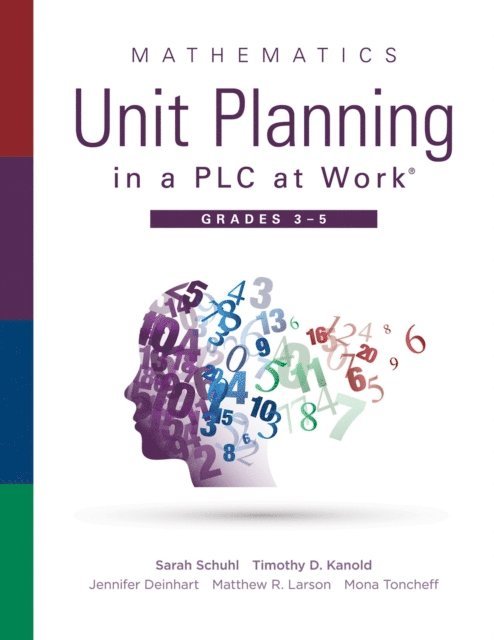
Build collaborative teacher teams committed to fostering student self-efficacy and increasing achievement in mathematics. Part of the Every Student Can Learn Mathematics series, this practical resource provides a framework for collectively planning a unit of study in grades 3–5. Grade-level teams will learn how to work together to perform key tasks—from unwrapping standards and creating team unit calendars to determining academic vocabulary and designing robust fraction units.
Help your team identify what students need to know by the end of each unit and build student self-efficacy:
Understand how to collaboratively plan thematic units in grades 3-5.Study the seven unit-planning elements and learn how to incorporate each in essential unit design.Review the role of the PLC at Work® process in enhancing collaborative student learning and teacher collaboration.Observe three model fraction units, one for each grade level.Receive tools and templates for effective unit planning.Contents:Introduction by Timothy D. KanoldPart 1: Mathematics Unit Planning and Design Elements Chapter 1: Planning for Student Learning of Mathematics in Grades 3–5 Chapter 2: Unit Planning as a Collaborative Mathematics TeamPart 2: Fraction Unit Examples, Grades 3–5 Chapter 3: Grade 3 Unit—Fraction Understanding Chapter 4: Grade 4 Unit—Fraction Equivalence, Addition, and Subtraction Chapter 5: Grade 5 Unit—Fraction Addition and SubtractionEpilogue: Mathematics Team OrganizationAppendix A: Create a Proficiency MapAppendix B: Checklist and Questions for Mathematics Unit PlanningReferences and Resources
376 kr
Läs direkt efter köp
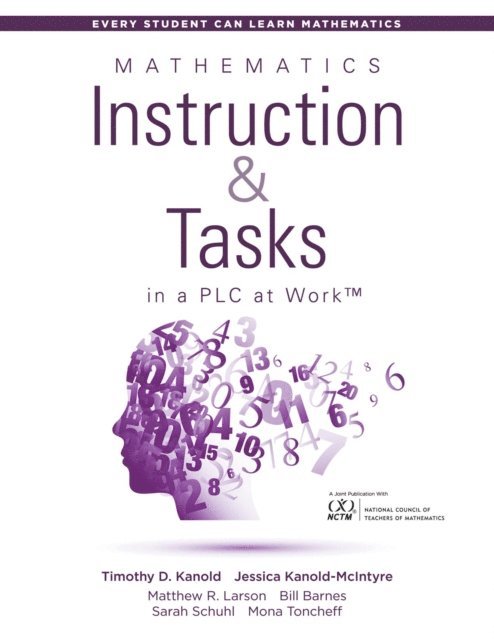
Build collective teacher efficacy and students’ mathematical thinking using the Mathematics in a PLC at Work™ lesson-design process. This second edition of the popular Mathematics Instruction and Tasks book guides preK–12 teacher teams in ensuring improved mathematics achievement. Gain new and enhanced understanding of research-affirmed instructional routines, and learn how to efficiently elicit high levels of student engagement and self-efficacy.Implement instructional strategies and methods of teaching mathematics in a professional learning community.
This book will help preK–12 mathematics teachers and teacher teams:Identify essential mathematics content standards students learn during a unit Understand the importance of communicating the why of the essential mathematics learning standards to students Plan for the use of balanced rigor and mathematical routines to teach each content standard during instruction Use a balance of appropriate mathematics activities and tasks needed to develop conceptual understanding, procedural fluency, and application of mathematical concepts and skillsImplement instructional math routines that ensure the formative learning of all students during lessonsContents:PrefaceIntroduction: The Mathematics at Work™ Lesson Design FrameworkChapter 1: Essential Learning Standards—The Why of the LessonChapter 2: Prior-Knowledge RoutinesChapter 3: Mathematics Language RoutinesChapter 4: A Balance of Mathematical TasksChapter 5: Mathematical Discourse RoutinesChapter 6: Lesson Closure RoutinesChapter 7: High-Quality Tier 1 Mathematics InterventionChapter 8: Analyzing the Effectiveness of Mathematics InstructionEpilogueAppendix AAppendix B: Cognitive-Demand-Level Task Analysis GuideAppendix C: Mathematics Instruction and Tasks in a PLC at Work Protocols and Tools