Jennifer E. Bauer – författare
Visar alla böcker från författaren Jennifer E. Bauer. Handla med fri frakt och snabb leverans.
12 produkter
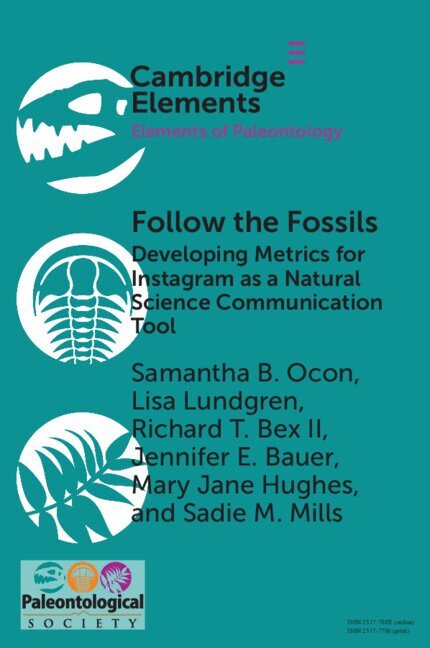
Follow the Fossils
Developing Metrics for Instagram as a Natural Science Communication Tool
Av Samantha B. Ocon, Lisa Lundgren m. fl.
Häftad, 2021
308 kr
Lägg i varukorg
The ability for people to connect, learn, and communicate about science has been enhanced through the Internet, specifically through social media platforms. Facebook and Twitter are well-studied, while Instagram is understudied. This Element provides insight into using Instagram as a science …
Follow the Fossils
Developing Metrics for Instagram as a Natural Science Communication Tool
Av Sadie M. Mills, Mary Jane Hughes m. fl.
E-bok, 2021
294 kr
Lägg i varukorg
The ability for people to connect, learn, and communicate about science has been enhanced through the Internet, specifically through social media platforms. Facebook and Twitter are well-studied, while Instagram is understudied. This Element provides insight into using Instagram as a science …
Follow the Fossils
Developing Metrics for Instagram as a Natural Science Communication Tool
Av Sadie M. Mills, Mary Jane Hughes m. fl.
E-bok, 2021
294 kr
Lägg i varukorg
The ability for people to connect, learn, and communicate about science has been enhanced through the Internet, specifically through social media platforms. Facebook and Twitter are well-studied, while Instagram is understudied. This Element provides insight into using Instagram as a science …
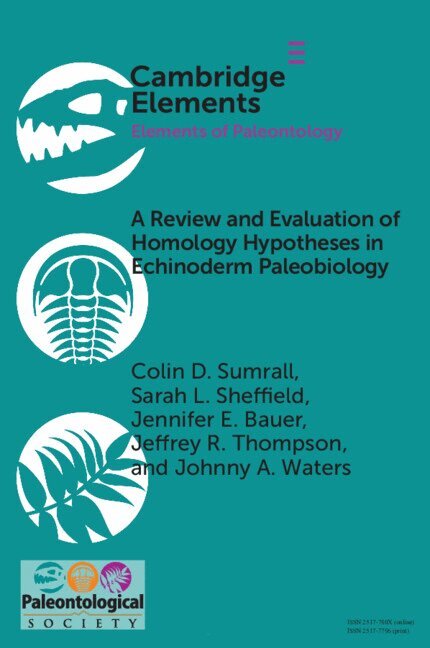
Review and Evaluation of Homology Hypotheses in Echinoderm Paleobiology
Av Johnny A. Waters, Jeffrey R. Thompson m. fl.
E-bok, 2023
294 kr
Lägg i varukorg
The extraxial-axial theory (EAT) and universal elemental homology (UEH) are often portrayed as mutually exclusive hypotheses of homology within pentaradiate Echinodermata. EAT describes homology upon the echinoderm bauplan, interpreted through early post-metamorphic growth and growth zones, …
Review and Evaluation of Homology Hypotheses in Echinoderm Paleobiology
Av Johnny A. Waters, Jeffrey R. Thompson m. fl.
E-bok, 2023
284 kr
Lägg i varukorg
The extraxial-axial theory (EAT) and universal elemental homology (UEH) are often portrayed as mutually exclusive hypotheses of homology within pentaradiate Echinodermata. EAT describes homology upon the echinoderm bauplan, interpreted through early post-metamorphic growth and growth zones, …
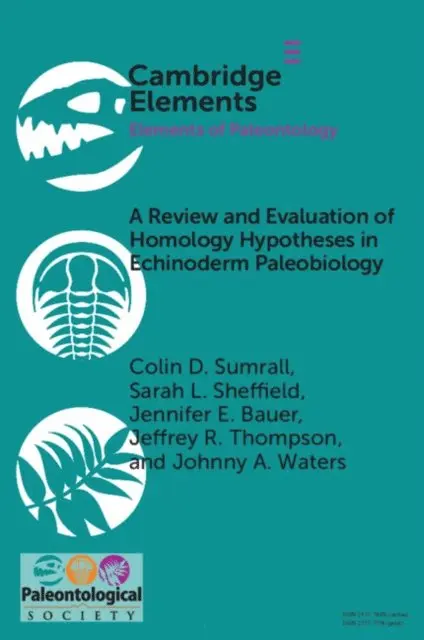
A Review and Evaluation of Homology Hypotheses in Echinoderm Paleobiology
Av Colin D. Sumrall, Sarah L. Sheffield m. fl.
Häftad, 2023
282 kr
Lägg i varukorg
The extraxial-axial theory (EAT) and universal elemental homology (UEH) are often portrayed as mutually exclusive hypotheses of homology within pentaradiate Echinodermata. EAT describes homology upon the echinoderm bauplan, interpreted through early post-metamorphic growth and growth zones, …
A Review of Blastozoan Echinoderm Respiratory Structures
Av Sarah L. Sheffield, Maggie R. Limbeck m. fl.
Häftad, 2023
308 kr
Lägg i varukorg
Echinoderms have evolved diverse and disparate morphologies throughout the Phanerozoic. Among them, blastozoans, an extinct group of echinoderms that were an important component of Paleozoic marine ecosystems, are primarily subdivided into groups based on the morphology of respiratory structures. …
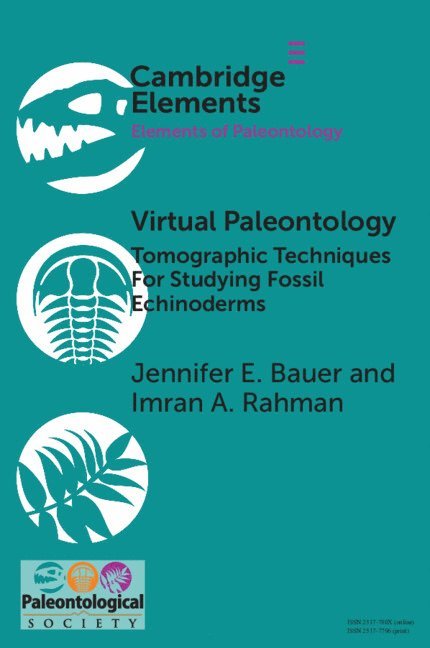
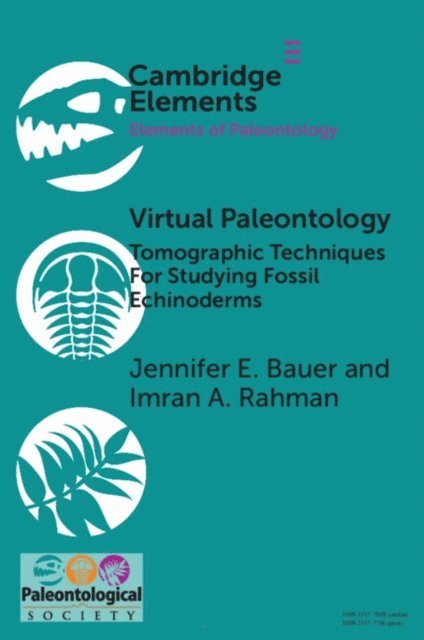
Virtual Paleontology
Tomographic Techniques For Studying Fossil Echinoderms
Av Jennifer E. Bauer, Imran A. Rahman
Häftad, 2021
302 kr
Lägg i varukorg
Imaging and visualizing fossils in three dimensions with tomography is a powerful approach in paleontology. Here, the authors introduce select destructive and non-destructive tomographic techniques that are routinely applied to fossils and review how this work has improved our understanding of the …
Review of Blastozoan Echinoderm Respiratory Structures
Av Martina Nohejlova, Stephen A. Hill m. fl.
E-bok, 2023
294 kr
Lägg i varukorg
Echinoderms have evolved diverse and disparate morphologies throughout the Phanerozoic. Among them, blastozoans, an extinct group of echinoderms that were an important component of Paleozoic marine ecosystems, are primarily subdivided into groups based on the morphology of respiratory structures. …
Virtual Paleontology
Tomographic Techniques For Studying Fossil Echinoderms
Av Imran A. Rahman, Jennifer E. Bauer
E-bok, 2021
284 kr
Lägg i varukorg
Imaging and visualizing fossils in three dimensions with tomography is a powerful approach in paleontology. Here, the authors introduce select destructive and non-destructive tomographic techniques that are routinely applied to fossils and review how this work has improved our understanding of the …
Virtual Paleontology
Tomographic Techniques For Studying Fossil Echinoderms
Av Imran A. Rahman, Jennifer E. Bauer
E-bok, 2021
294 kr
Lägg i varukorg
Imaging and visualizing fossils in three dimensions with tomography is a powerful approach in paleontology. Here, the authors introduce select destructive and non-destructive tomographic techniques that are routinely applied to fossils and review how this work has improved our understanding of the …
Review of Blastozoan Echinoderm Respiratory Structures
Av Martina Nohejlova, Stephen A. Hill m. fl.
E-bok, 2023
287 kr
Lägg i varukorg
Echinoderms have evolved diverse and disparate morphologies throughout the Phanerozoic. Among them, blastozoans, an extinct group of echinoderms that were an important component of Paleozoic marine ecosystems, are primarily subdivided into groups based on the morphology of respiratory structures. …