Jens Lorenz - Böcker
Visar alla böcker från författaren Jens Lorenz. Handla med fri frakt och snabb leverans.
2 produkter
2 produkter
806 kr
Skickas inom 7-10 vardagar
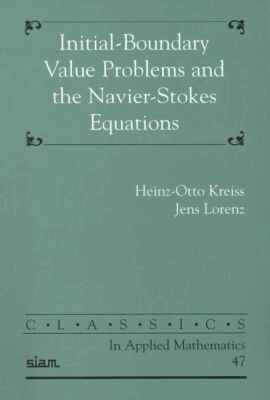
Initial-Boundary Value Problems and the Navier-Stokes Equations provides an introduction to the vast subject of initial and initial-boundary value problems for PDEs. Applications to parabolic and hyperbolic systems are emphasized in this text. The Navier-Stokes equations for compressible and incompressible flows are taken as an example to illustrate the results.Researchers and graduate students in applied mathematics and engineering will find Initial-Boundary Value Problems and the Navier-Stokes Equations invaluable. The subjects addressed in the book, such as the well-posedness of initial-boundary value problems, are of frequent interest when PDEs are used in modeling or when they are solved numerically. The book explains the principles of these subjects. The reader will learn what well-posedness or ill-posedness means and how it can be demonstrated for concrete problems. There are many new results, in particular on the Navier-Stokes equations.When the book was written, the main intent was to write a text on initial-boundary value problems that was accessible to a rather wide audience. Therefore, functional analytical prerequisites were kept to a minimum or were developed in the book. Boundary conditions are analyzed without first proving trace theorems, and similar simplications have been used throughout. The direct approach to the subject still gives a valuable introduction to an important area of applied analysis.
Del 118 - IMA Volumes in Mathematics and its Applications
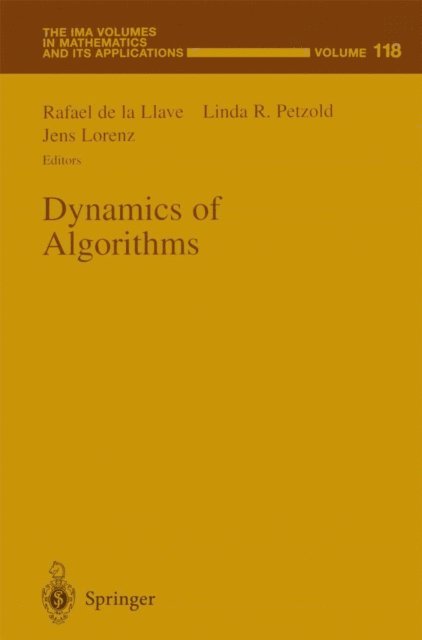
Dynamics of Algorithms
Häftad, Engelska, 2012
534 kr
Skickas inom 10-15 vardagar
The articles collected in this volume represent the contributions presented at the IMA workshop on "Dynamics of Algorithms" which took place in November 1997. The workshop was an integral part of the 1997 -98 IMA program on "Emerging Applications of Dynamical Systems." The interaction between algorithms and dynamical systems is mutually beneficial since dynamical methods can be used to study algorithms that are applied repeatedly. Convergence, asymptotic rates are indeed dynamical properties. On the other hand, the study of dynamical systems benefits enormously from having efficient algorithms to compute dynamical objects.