Jeremy J. Gray – författare
Visar alla böcker från författaren Jeremy J. Gray. Handla med fri frakt och snabb leverans.
8 produkter
Geometry
Av David A. Brannan, Matthew F. Esplen m. fl.
Häftad, 2011
924 kr
Lägg i varukorg
This richly illustrated and clearly written undergraduate textbook captures the excitement and beauty of geometry. The approach is that of Klein in his Erlangen programme: a geometry is a space together with a set of transformations of the space. The authors explore various geometries: affine, …
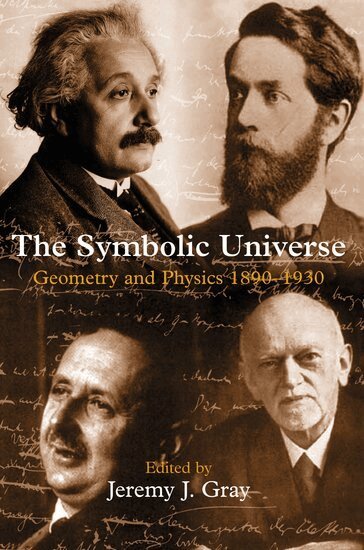
The Symbolic Universe
Geometry and Physics 1890-1930
Inbunden, 1999
3933 kr
Lägg i varukorg
With the development of the theory of relativity by Albert Einstein, physics underwent a revolution at the end of the 19th century. The boundaries of research were extended still further when in 1907-8 Minkowski applied geometrical ideas to this area of physics. This in turn opened the door to …
Episodes in the History of Modern Algebra (1800-1950)
Av Jeremy J. Gray, Karen Hunger Parshall
Häftad, 2011
1509 kr
Lägg i varukorg
Algebra, as a subdiscipline of mathematics, arguably has a history going back some 4000 years to ancient Mesopotamia. The history, however, of what is recognized today as high school algebra is much shorter, extending back to the sixteenth century, while the history of what practicing …
Geometry
Av Jeremy J. Gray, Matthew F. Esplen m. fl.
E-bok, 2011
909 kr
Lägg i varukorg
This richly illustrated and clearly written undergraduate textbook captures the excitement and beauty of geometry. The approach is that of Klein in his Erlangen programme: a geometry is a space together with a set of transformations of the space. The authors explore various geometries: affine, …
Geometry
Av Jeremy J. Gray, Matthew F. Esplen m. fl.
E-bok, 2011
929 kr
Lägg i varukorg
This richly illustrated and clearly written undergraduate textbook captures the excitement and beauty of geometry. The approach is that of Klein in his Erlangen programme: a geometry is a space together with a set of transformations of the space. The authors explore various geometries: affine, …
La correspondance entre Henri Poincaré et les mathématiciens
Av Philippe Nabonnand, Olivier Bruneau m. fl.
Inbunden, 2024
1643 kr
Lägg i varukorg
Indispensable for understanding Henri Poincaré's vast activity in the mathematical sciences. Provides new sources revealing Poincaré's involvement as president of the "Commission permanente du Répertoire bibliographique des sciences mathématiques" as an actor in the "Dreyfus Affair," and on his …
La correspondance entre Henri Poincaré et les mathématiciens
Av Scott A. Walter, Klaus Volkert m. fl.
E-bok, 2024
1687 kr
Lägg i varukorg
Indispensable for understanding Henri Poincaré''s vast activity in the mathematical sciences. Provides new sources revealing Poincaré''s involvement as president of the "Commission permanente du Répertoire bibliographique des sciences mathématiques" as an actor in the "Dreyfus Affair," and on his …