Jeroen Vandaele - Böcker
Visar alla böcker från författaren Jeroen Vandaele. Handla med fri frakt och snabb leverans.
6 produkter
6 produkter
2 150 kr
Skickas inom 10-15 vardagar
In the age of big data, evidence keeps suggesting that small, elusive and infrequent details make all the difference in our appreciation of humanistic texts—film, fiction, and philosophy. This book argues, from a cross-disciplinary perspective, that expertise in humanistic translation is precisely the capacity to capture those details that are bigger than they seem. In humanistic translation, the expert handling of big details usually serves audiences and the original, but mala fide translation also works the details for subtle manipulation and audience deception. A focus on textual detail is therefore characteristic of humanistic translators but also compatible with central claims of the cultural turn in translation studies. This book, written by a scholar and teacher of literary, essayistic, and audiovisual translation, endeavors to articulate a seemingly dual interest—on textual detail and cultural analysis—as a single one. It theorizes connections between micro and macro analysis, between translation as detail and translation as culture, thus hoping to build bridges between humanistic translators and translation scholars. It acknowledges tensions between practice and theory and proposes a way forward: practitioners and scholars share ways of thinking—varieties of "part-whole thinking"—that machines can never acquire.
725 kr
Skickas inom 10-15 vardagar
In the age of big data, evidence keeps suggesting that small, elusive and infrequent details make all the difference in our appreciation of humanistic texts—film, fiction, and philosophy. This book argues, from a cross-disciplinary perspective, that expertise in humanistic translation is precisely the capacity to capture those details that are bigger than they seem. In humanistic translation, the expert handling of big details usually serves audiences and the original, but mala fide translation also works the details for subtle manipulation and audience deception. A focus on textual detail is therefore characteristic of humanistic translators but also compatible with central claims of the cultural turn in translation studies. This book, written by a scholar and teacher of literary, essayistic, and audiovisual translation, endeavors to articulate a seemingly dual interest—on textual detail and cultural analysis—as a single one. It theorizes connections between micro and macro analysis, between translation as detail and translation as culture, thus hoping to build bridges between humanistic translators and translation scholars. It acknowledges tensions between practice and theory and proposes a way forward: practitioners and scholars share ways of thinking—varieties of "part-whole thinking"—that machines can never acquire.
2 772 kr
Skickas inom 10-15 vardagar
If civilizations are to cooperate as well as clash, our mediators must solve problems using serious thought about relations between Self and Other. Translation Studies has thus returned to questions of ethics. But this is no return to any prescriptive linguistics of equivalence. As the articles in this volume show, ethics is now a broadly contextual question, dependent on practice in specific cultural locations and situational determinants. It concerns people, perhaps more than texts. It involves representing dynamics, seeking specific goals, challenging established norms, and bringing theory closer to historical practice. The contributions to this volume study a wide range of translational activity, questioning global copyright regimes, denouncing exploitation within the translation profession, defending a Bible translation in terms of mutlilateral loyalty, and delving into the dynamics of popular genres, the culture bubbles of talk shows, the horrors of disaster relief in Turkey, military interpreters in the Balkans, and urgent political pleas from a Greek prison. The theoretical approaches range from empirical text analysis to applications of fuzzy logic, passing through a proposed Translator's Oath and converging in a common concern with cross-cultural alterity
663 kr
Skickas inom 10-15 vardagar
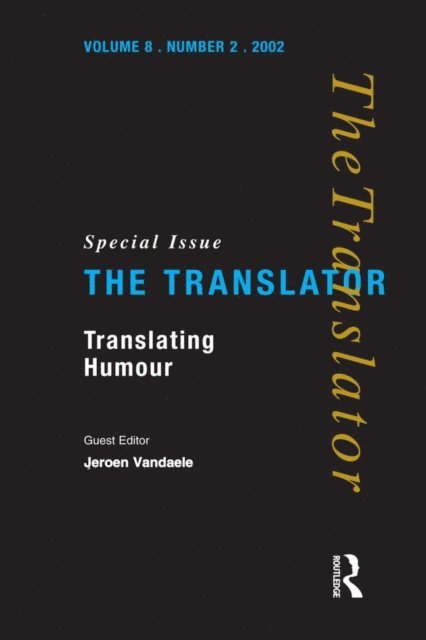
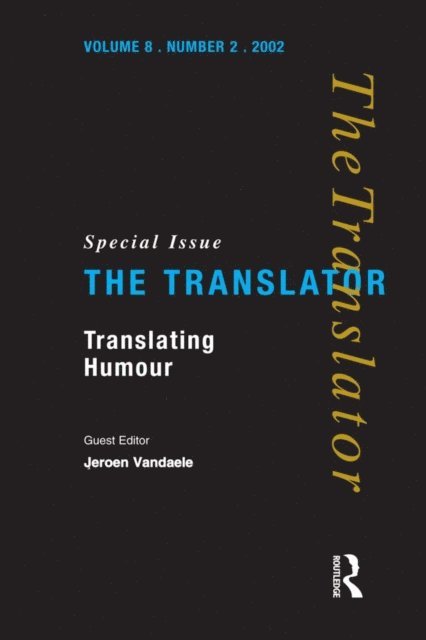
It is all too often assumed that humour is the very effect of a text. But humour is not a perlocutionary effect in its own right, nor is laughter. The humour of a text may be as general a characteristic as a serious text's seriousness. Like serious texts, humorous texts have many different purposes and effects. They can be subdivided into specific subgenres, with their own perlocutionary effects, their own types of laughter (or even other reactions).Translation scholars need to be able to distinguish between various kinds of humour (or humorous effect) when comparing source and target texts, especially since the notion of "effect" pops up so frequently in the evaluation of humorous texts and their translations. In this special issue of The Translator, an attempt is made to delineate types of humorous effect, through careful linguistic and cultural analyses of specific examples and/or the introduction of new analytical tools. For a translator, who is both a receiver of the source text and sender of the target text, such analyses and tools may prove useful in grasping and pinning down the perlocutionary effect of a source text and devising strategies for producing comparable effects in the target text. For a translation scholar, who is a receiver of both source and target texts, the contributions in this issue will hopefully provide an analytical framework for the comparison of source and target perlocutionary effects.
2 272 kr
Skickas inom 5-8 vardagar
For more than two decades now, cognitive science has been making overtures to literature and literary studies. Only recently, however, cognitive linguistics and poetics seem to be moving towards a more serious and reciprocal type of interdisciplinarity. In coupling cognitive linguistics and poetics, cognitive poeticians aim to offer cognitive readings of literary texts and formulate specific hypotheses concerning the relationship between aesthetic meaning effects and patterns in the cognitive construal and processing of literary texts. One of the basic assumptions of the endeavour is that some of the key topics in poetics (such as the construction of text worlds, characterization, narrative perspective, distancing discourse, etc.) may be fruitfully approached by applying cognitive linguistic concepts and insights (such as embodied cognition, metaphor, mental spaces, iconicity, construction grammar, figure/ground alignment, etc.), in an attempt to support, enrich or adjust ‘traditional’ poetic analysis. Conversely, the tradition of poetics may support, frame or call into question insights form cognitive linguistics.In order to capture the goals, gains and gaps of this rapidly growing interdisciplinary field of research, this volume brings together some of the key players and critics of cognitive poetics. The eleven chapters are grouped into four major sections, each dealing with central concerns of the field: (i) the cognitive mechanisms, discursive means and mental products related to narrativity (Semino, Herman, Culpeper); (ii) the different incarnations of the concept of figure in cognitive poetics (Freeman, Steen, Tsur); (iii) the procedures that are meant to express or create discursive attitudes, like humour, irony or distance in general (Antonopoulou and Nikiforidou, Dancygier and Vandelanotte, Giora et al.); and (iv) a critical assessment of the current state of affairs in cognitive poetics, and more specifically the incorporation of insights from cognitive linguistics as only one of the contributing fields in the interdisciplinary conglomerate of cognitive science (Louwerse and Van Peer, Sternberg). The ensuing dialogue between cognitive and literary partners, as well as between advocates and opponents, is promoted through the use of short response articles included after ten chapters of the volume. Geert Brône, Katholieke Universiteit Leuven, Belgium; Jeroen Vandaele, University of Oslo, Norway.
Del 50 - Foro Hispánico
Estados de Gracia: Billy Wilder y la censura franquista (1946-1975)
Häftad, Spanska, 2015
1 891 kr
Skickas inom 5-8 vardagar
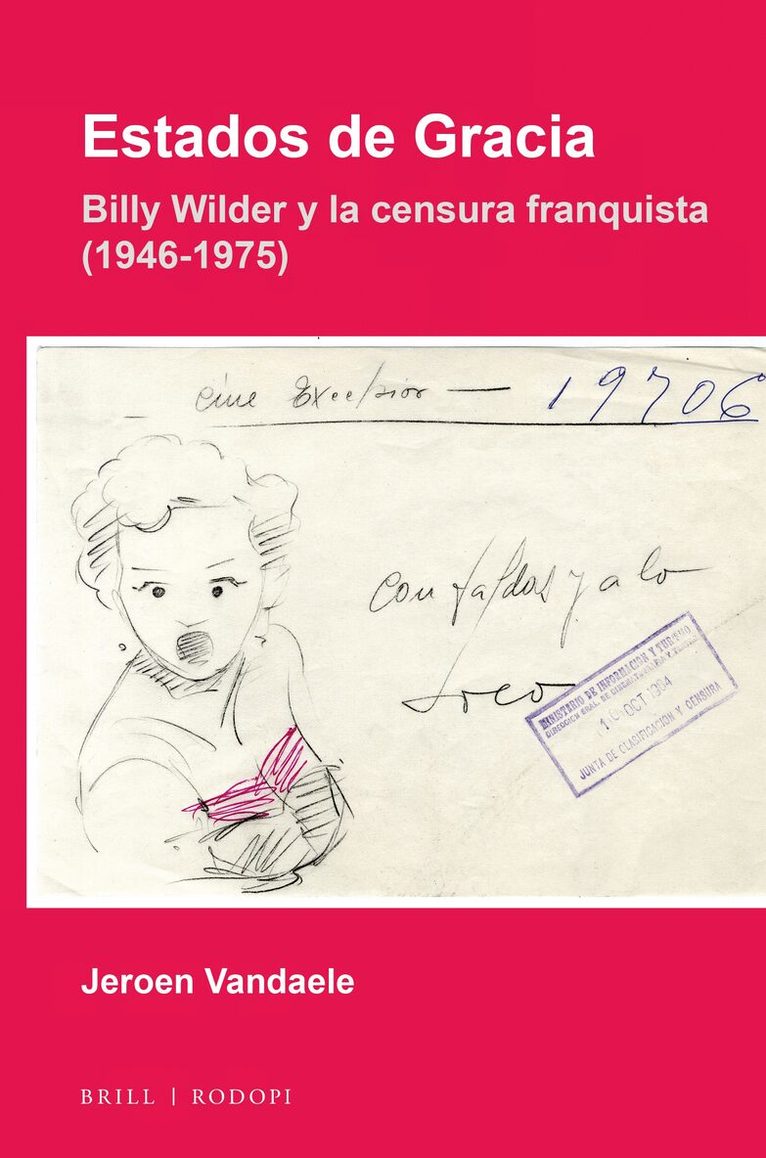
Billy Wilder is more popular and glorified in Spain than anywhere else. Estados de Gracia traces this remarkable fact back to Wilder’s key role in renewing the film repertoire under Franco. Even though Wilder’s films were rewritten and censored in Francoist Spain, many viewers still found them far more exciting than most domestic productions.Drawing on a wealth of censorship files, reviews and dubbings, Estados de Gracia illuminates this paradoxical process of canonization despite censorship. Vandaele studies the censors and their activities, the manipulative translations, and the Francoist system of norms applied to Wilder. He also asks if Wilder’s humor somehow helped subvert that system and signals that the Spanish dubbings shown today are still partly Francoist.Billy Wilder es más popular y glorificado en España que en cualquier otro país. Estados de Gracia relaciona esta observación con el papel clave que desempeñó Wilder en la renovación del repertorio cinematográfico bajo Franco. Aunque manipuladas, sus películas encarnaban para muchos espectadores algo emocionante en vez de dogmáticamente franquista.Apoyándose en informes de censura, reseñas y doblajes franquistas, Vandaele ilumina este paradójico proceso de canonización y censura. Estudia a los censores y sus actividades, las traducciones manipulativas, y el sistema normativo franquista aplicado a Wilder. Investiga si el humor de Wilder contribuyó posiblemente a subvertir dicho sistema y señala que muchos doblajes que circulan hoy en día todavía presentan reminiscencias del franquismo.