JJJJJerome Ellis - Böcker
Visar alla böcker från författaren JJJJJerome Ellis. Handla med fri frakt och snabb leverans.
2 produkter
2 produkter
288 kr
Skickas inom 3-6 vardagar
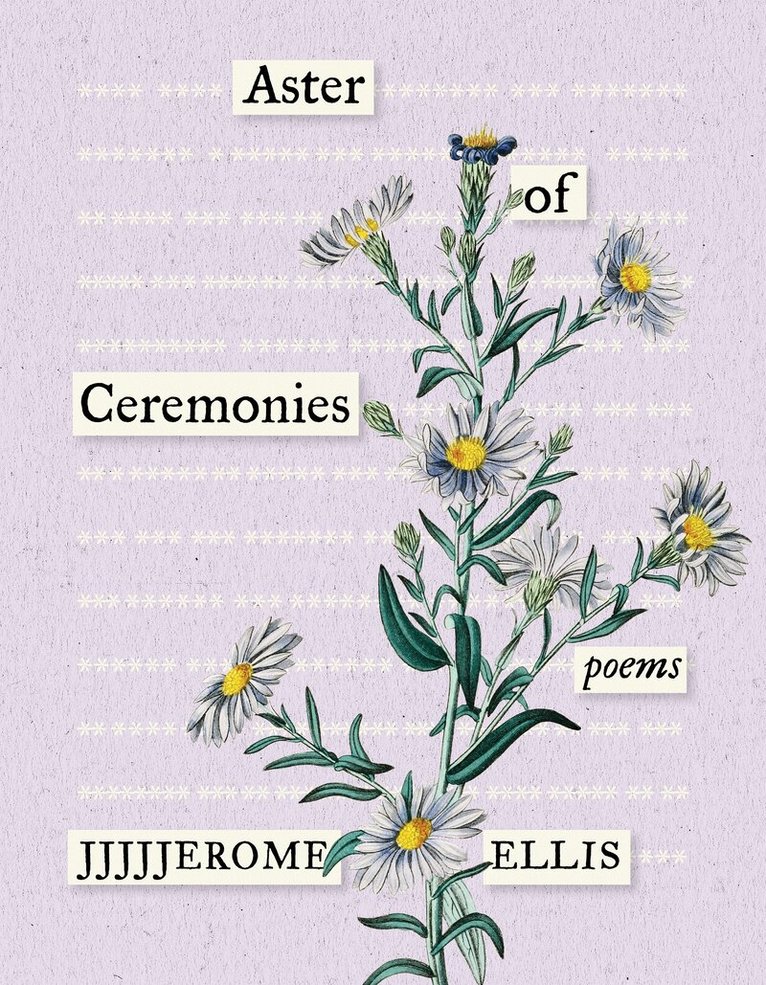
A polyphonic new entry in Multiverse—a literary series written and curated by the neurodivergent—JJJJJerome Ellis’s Aster of Ceremonies beautifully extends the vision of his debut book and album, The Clearing, a “lyrical celebration of and inquiry into the intersections of blackness, music, and disabled speech” (Claudia Rankine).Aster of Ceremonies asks what rites we need now and how poetry, astir in the asters, can help them along. What is the relationship between fleeing and feeling? How can the voices of those who came before—and the stutters that leaven those voices—carry into our present moment, mingling with our own? When Ellis writes, “Bring me the stolen will / Bring me the stolen well,” his voice is a conduit, his “me” is many. Through the grateful invocations of ancestors—Hannah, Mariah, Kit, Jan, and others—and their songs, he rewrites history, creating a world that blooms backward, reimagining what it means for Black and disabled people to have taken, and to continue to take, their freedom. By weaving a chorus of voices past and present, Ellis counters the attack of “all masters of all vessels” and replaces it with a family of flowers. He models how—as with his brilliant transduction of escaped slave advertisements—we might proclaim lost ownership over literature and history. “Bring me to the well,” he chants, implores, channels. “Bring me to me.” In this bringing, in this singing, he proclaims our collective belonging to shared worlds where we can gather and heal.The Aster of Ceremonies audiobook read and performed by JJJJJerome Ellis is available everywhere you listen to audiobooks.
267 kr
Tillfälligt slut
JJJJJerome Ellis’s The Clearing asks how stuttering, blackness, and music can be practices of refusal against hegemonic governance of time, speech, and encounter. Taking his glottal block stutter as a point of departure, Ellis figures the aporia and the block as clearing to consider how dysfluency, opacity, and refusal can open a new space for relation. Stemming from Ellis's essay "The clearing: Music, dysfluency, Blackness, and time,” published in 2020 in the Journal of Interdisciplinary Voice Studies (Volume 5, Issue 2) the present volume transcribes and translates his investigation across genres and media, turning to the page to ask: How can a book bear the trace of music, and the racialized, disabled body? Can a book be not just a manuscript, but a glottoscript? Ellis opens space for thinking liberation theoretically, historically, and lyrically.