J.K. Feibleman - Böcker
Visar alla böcker från författaren J.K. Feibleman. Handla med fri frakt och snabb leverans.
11 produkter
11 produkter
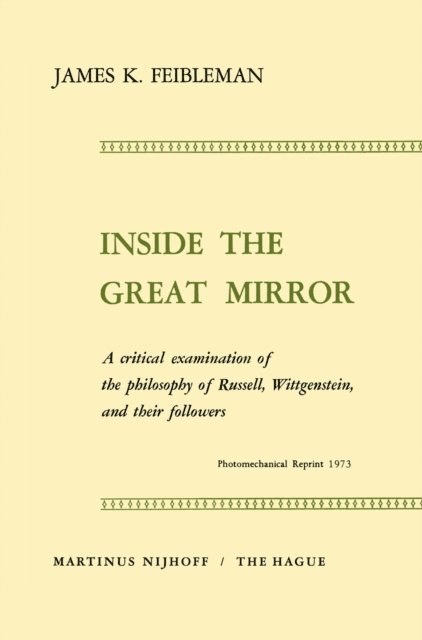
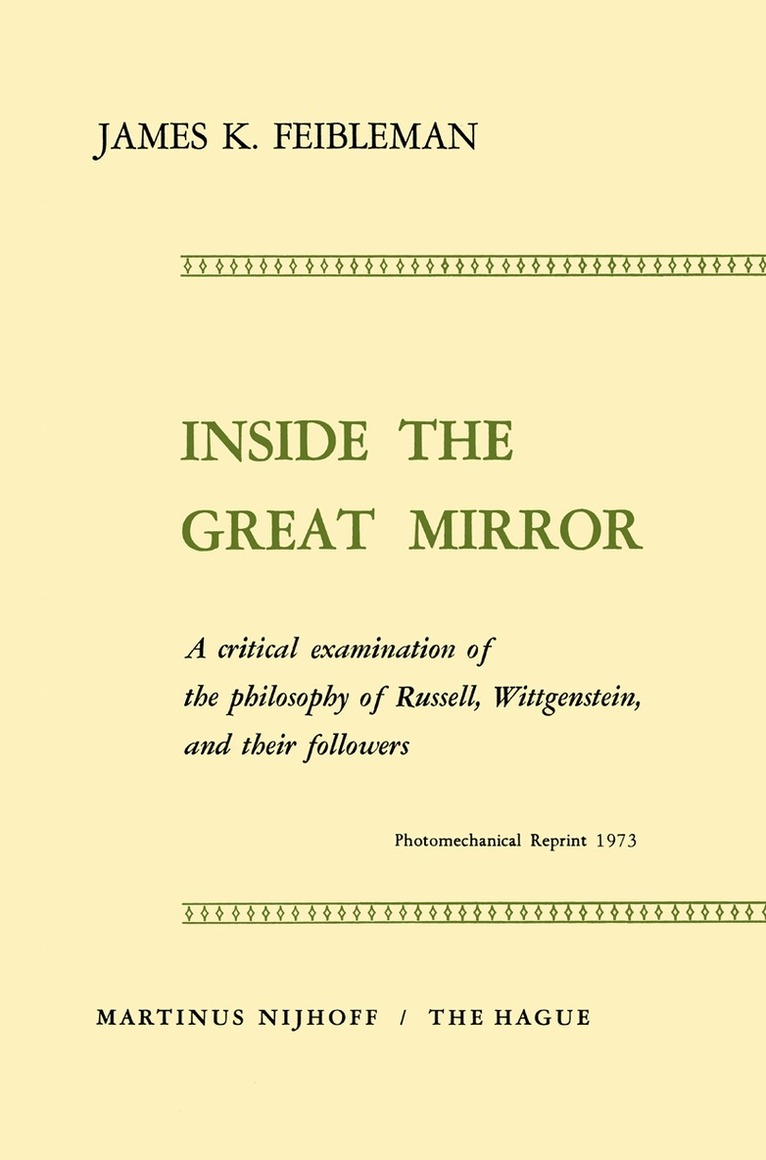
Inside the Great Mirror
A Critical Examination of the Philosophy of Russell, Wittgenstein, and their Followers
Häftad, Engelska, 1973
534 kr
Skickas inom 10-15 vardagar
physical realist heavily bverlaid with the interpretation afforded by linguistic analysis, so he changed, too. But at the time, which was approximately during the second decade of the twentieth century, they were no doubt very close in their views. Russell acknowledged the influence of Wittgenstein in several places in the 1918 lectures on logical atomism. Wittgenstein might not have written the Tractatus had Russell not given the lectures on logical atomism, or at least had he not maintained the views there expressed. Certainly it is true in a very large sense that the Tractatus may be interpreted as a commentary on the 1918 lectures of Russell. Wittgenstein certainly did not hear them but, as Russell said, the topics were discussed together; and the debt of the Tractatus to the views of the contents of the lectures is obvious. Since Wittgenstein was the pupil and Russell the teacher, we may assume, despite the mutual influence, that the greater effect was Russell's. There is no space in which to go into a thorough analysis of the predecessors of Wittgenstein and of the influences upon him. In addition, there is not sufficient data. One clue, however, we are given. One of his friends has informed us that Wittgenstein "did read and enjoy Plato" and "recognized congenial features" in his philosophical method 1, although, to be sure, Wittgenstein is not said to have been a great reader of philosophy.
534 kr
Skickas inom 10-15 vardagar
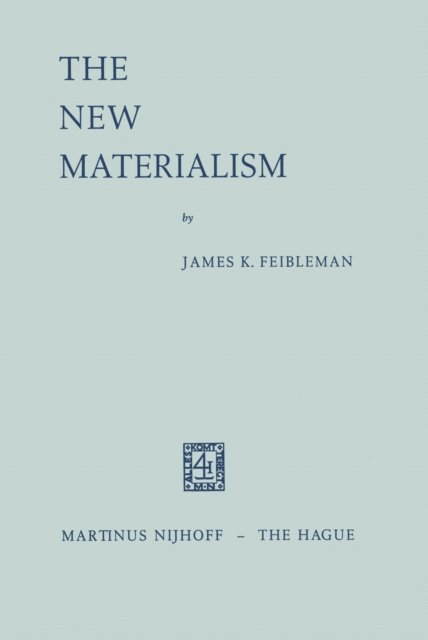
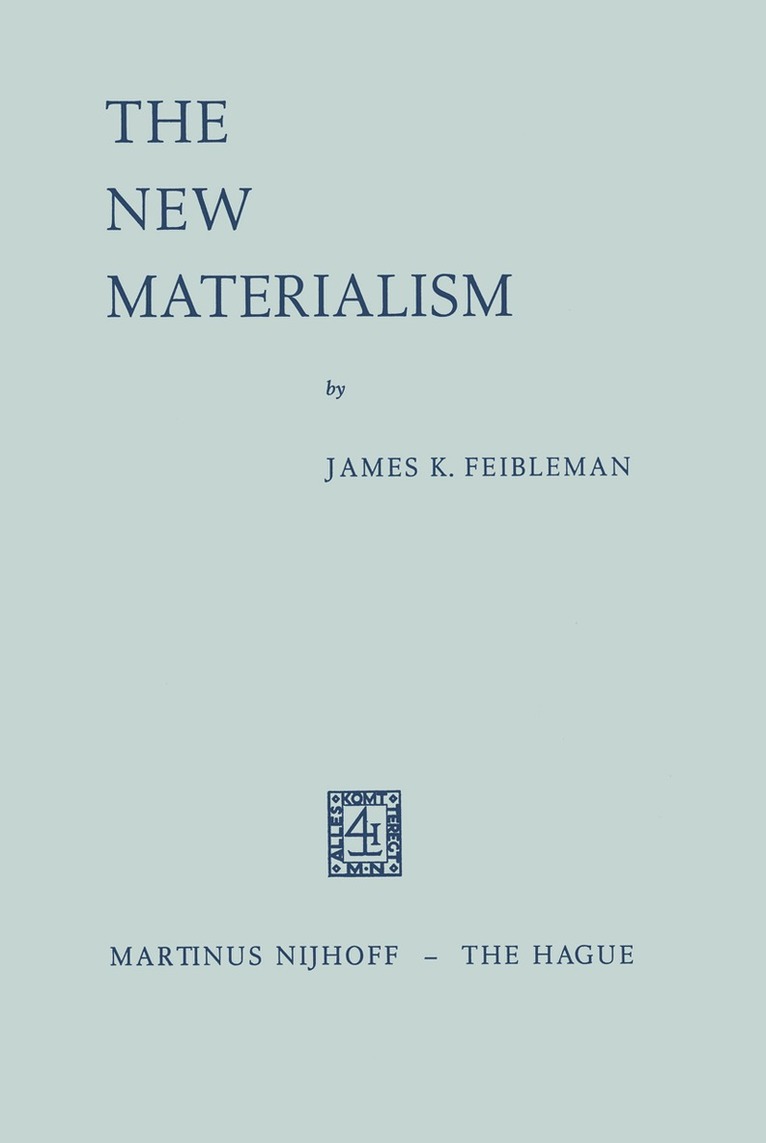
A wholly new theory of matter has been advanced in the last half century by modern physics, but there has been no new theory of ma terialism to match it. The occurrence of a revolution of such magni tude in science will have to be understood as calling for a corresponding one in philosophy. The present work is an attempt to make a start in that direction. Grateful acknowledgment is hereby made to the Editors of the fol lowing journals for permission to reprint articles which first appeared in their pages: to Darshana for "Human Nature and Institutions"; to Diogenes for "Full Concreteness and the Re-Materialization of Matter"; to Perspectives in Biology and Medicine for "The Ambiva lence of Aggression and the Moralization of Man"; to Philosophy and Phenomenological Research for "Formal Materialism Reconfirmed" (which appears here revised and extended as "Formal Materialism: The New Version"), and for "Artifactualism: The Origin of Man and His Tools"; to Philosophy Today for "How Abstract Objects Survive"; to Religious Studies for "A Religion for the New Materialism"; and to Tulane Studies in PhilosoPhy for "A Material Theory of Reference. " PART ONE INTRODUCTION AND METHOD CHAPTER I THE SUBJECTIVE DIGRESSION Every philosophy endeavors to be as comprehensive as possible, and when philosophers speak they do so for the whole world.
1 062 kr
Skickas inom 10-15 vardagar
1 062 kr
Skickas inom 10-15 vardagar
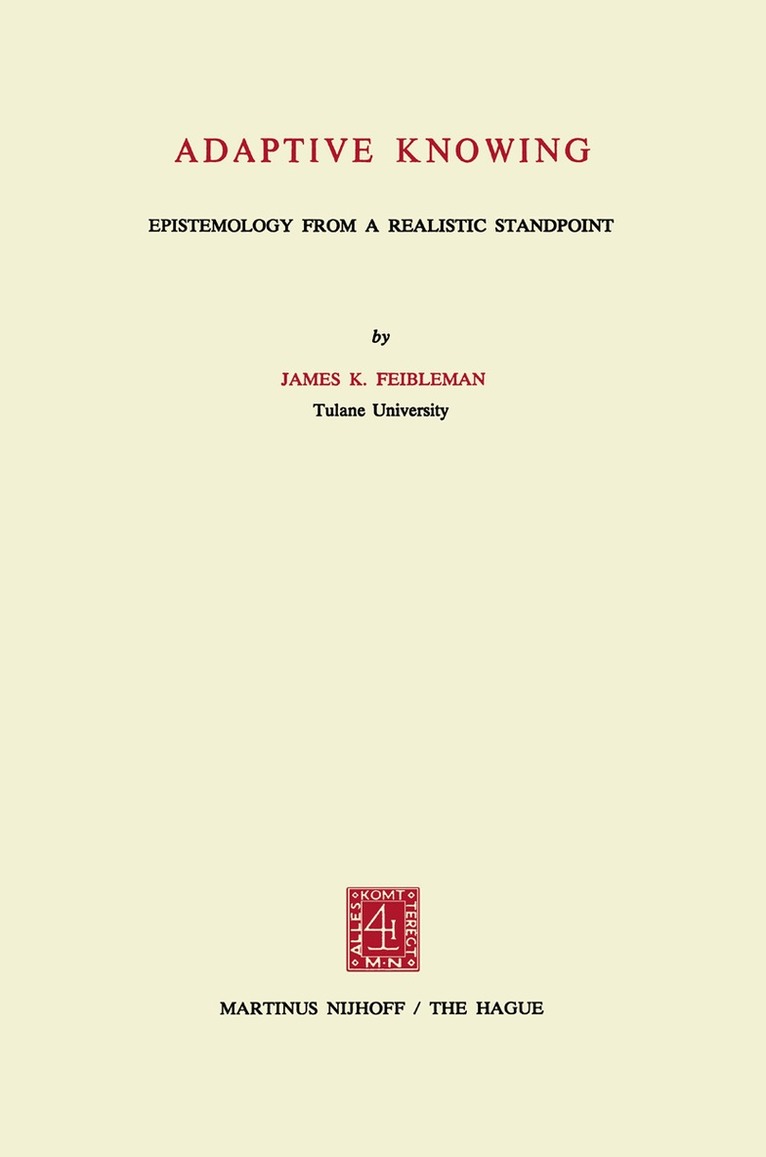
The acquisition of knowledge is not a single unrelated occasion but rather an adaptive process in which past acquisitions modify present and future ones. In Part I of this essay in epistemology it is argued that coping with knowledge is not a passive affair but dynamic and active, involving its continuance into the stages of assimilation and deployment. In Part II a number of specific issues are raised and discussed in order to explore the dimensions and the depths of the workings of adaptive knowing. ACKNOWLEDGMENTS "Activity as A Source of Knowledge" first appeared in Tulane Studies in Philosophy, XII, 1963; "Knowing, Doing and Being" in Ratio, VI, 1964; "On Beliefs and Believing" in Tulane Studies, XV, 1966; "Absent Objects" in Tulane Studies, XVII, 1968; "The Reality Game" in Tulane Studies, XVIII, 1969; "Adaptive Responses and The Ecosys tem" in Tulane Studies, XVIII, 1969; "The Mind-Body Problem" in the Philosophical Journal, VII, 1970; and "The Knowledge of The Known" in the International Logic Review, I, 1970. PART I COPING WITH KNOWLEDGE CHAPTER I THE PROBLEM OF KNOWLEDGE I. THE CHOSEN APPROACH You are about to read a study of epistemology, one which has been made from a realistic standpoint. It is not the first of such interpre tations, and it will not be the last.
1 062 kr
Skickas inom 10-15 vardagar
A system of philosophy of the sort presented in this and the following volumes begins with logic. Philosophy properly speaking is characterized by the kind oflogic it employs, for what it employs it assumes, however silently; and what it assumes it presupposes. The logic stands behind the ontology and is, so to speak, metaphysically prior. One word of caution. The philosophical aspects of logic have lagged behind the mathematical aspects in point of view of interest and develop ment. The work of N. Rescher and others have gone a long way to correct this. However, their work on philosophical logic has been more concerned with the logical than with the philosophical aspects. I have in mind another approach, one that would call attention to the ontological (systematic meta physics) or metaphysical (critical ontology) aspects, whichever term you prefer. It is this approach which I have pursued in the following chapters. Since together they stand at the head of a system of philosophy which has been developed in some seventeen books, a system which ranges over all of the topics of philosophy, the chosen approach can be seen as the necessary one. But I have not written any logic, I have merely indicated the sort of logic that has to be written.
1 062 kr
Skickas inom 10-15 vardagar
In the following pages I have endeavored to show the impact on philosophy of tech nology and science; more specifically, I have tried to make up for the neglect by the classical philosophers of the historic role of technology and also to suggest what positive effects on philosophy the ahnost daily advances in the physical sciences might have. Above all, I wanted to remind the ontologist of his debt to the artificer: tech nology with its recent gigantic achievements has introduced a new ingredient into the world, and so is sure to influence our knowledge of what there is. This book, then, could as well have been called 'Ethnotechnology: An Explanation of Human Behavior by Means of Material Culture', but the picture is a complex one, and there are many more special problems that need to be prominently featured in the discussion. Human culture never goes forward on all fronts at the same time. In our era it is unquestionably not only technology but also the sciences which are making the most rapid progress. Philosophy has not been very successful at keeping up with them. As a consequence there is an 'enormous gulf between scientists and philosophers today, a gulf which is as large as it has ever been. ' (1) I can see that with science moving so rapidly, its current lessons for philosophy might well be outmoded tomorrow.
977 kr
Skickas inom 10-15 vardagar
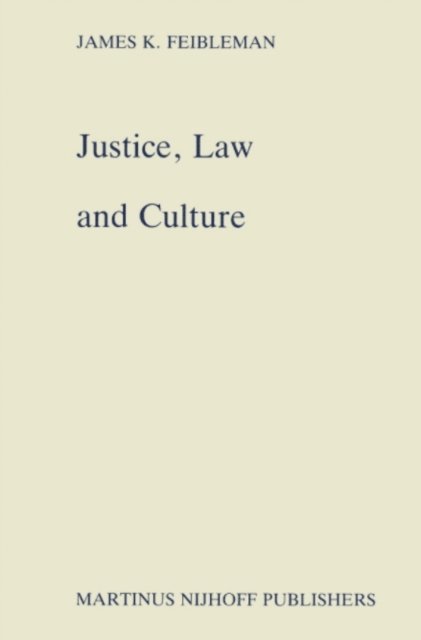
The following pages contain a theory of justice and a theory of law. Justice will be defined as the demand for a system of laws, and law as an established regulation which applies equally throughout a society and is backed by force. The demand for a system of laws is met by means of a legal system. The theory will have to include what the system and the laws are in tended to regulate. The reference is to all men and their possessions in a going concern. In the past all such theories have been discussed only in terms of society, justice as applicable to society and the laws promul gated within it. However, men and their societies are not the whole story: in recent centuries artifacts have played an increasingly important role. To leave them out of all consideration in the theory would be to leave the theory itself incomplete and even distorted. For the key conception ought to be one not of society but of culture. Society is an organization of men but culture is something more. I define culture (civilization has often been employed as a synonym) as an organization of men together with their material possessions. Such possessions consist in artifacts: material objects which have been altered through human agency in order to reduce human needs. The makers of the artifacts are altered by them. Men have their possessions together, and this objectifies and consolidates the culture.
1 032 kr
Skickas inom 10-15 vardagar
It has been asserted that there is no one universal proposition with which all philosophers would agree, including this one. The pre dicament has rarely been recognized and almost never accepted, although neither has it been successfully challenged. If the claim holds true for philosophy taken by itself, how much more must it of religion, the hold for crossfield interests, such as the philosophy philosophy of science and many others. The philosophy of educa tion is a particular case in point. The topic of education itself is generally regarded as a dull af fair, a charge not entirely without substance. The blame for this usually falls on the fact that it has no inherent subject matter. The teachers of history teach history, the teachers of biology teach biology; but what do the teachers of education teach? Presumably how to teach; but this simply will not do because every topic requires its own sort of instruction.
1 062 kr
Skickas inom 10-15 vardagar
A system of philosophy of the sort presented in this and the following volumes begins with logic. Philosophy properly speaking is characterized by the kind oflogic it employs, for what it employs it assumes, however silently; and what it assumes it presupposes. The logic stands behind the ontology and is, so to speak, metaphysically prior. One word of caution. The philosophical aspects of logic have lagged behind the mathematical aspects in point of view of interest and develop ment. The work of N. Rescher and others have gone a long way to correct this. However, their work on philosophical logic has been more concerned with the logical than with the philosophical aspects. I have in mind another approach, one that would call attention to the ontological (systematic meta physics) or metaphysical (critical ontology) aspects, whichever term you prefer. It is this approach which I have pursued in the following chapters. Since together they stand at the head of a system of philosophy which has been developed in some seventeen books, a system which ranges over all of the topics of philosophy, the chosen approach can be seen as the necessary one. But I have not written any logic, I have merely indicated the sort of logic that has to be written.
1 032 kr
Skickas inom 10-15 vardagar
It has been asserted that there is no one universal proposition with which all philosophers would agree, including this one. The pre dicament has rarely been recognized and almost never accepted, although neither has it been successfully challenged. If the claim holds true for philosophy taken by itself, how much more must it of religion, the hold for crossfield interests, such as the philosophy philosophy of science and many others. The philosophy of educa tion is a particular case in point. The topic of education itself is generally regarded as a dull af fair, a charge not entirely without substance. The blame for this usually falls on the fact that it has no inherent subject matter. The teachers of history teach history, the teachers of biology teach biology; but what do the teachers of education teach? Presumably how to teach; but this simply will not do because every topic requires its own sort of instruction.
534 kr
Skickas inom 10-15 vardagar
The acquisition of knowledge is not a single unrelated occasion but rather an adaptive process in which past acquisitions modify present and future ones. In Part I of this essay in epistemology it is argued that coping with knowledge is not a passive affair but dynamic and active, involving its continuance into the stages of assimilation and deployment. In Part II a number of specific issues are raised and discussed in order to explore the dimensions and the depths of the workings of adaptive knowing. ACKNOWLEDGMENTS "Activity as A Source of Knowledge" first appeared in Tulane Studies in PhilosoPhy, XII, 1963; "Knowing, Doing and Being" in Ratio, VI, 1964; "On Beliefs and Believing" in Tulane Studies, XV, 1966; "Absent Objects" in Tulane Studies, XVII, 1968; "The Reality Game" in Tulane Studies, XVIII, 1969; "Adaptive Responses and The Ecosys tem" in Tulane Studies, XVIII, 1969; "The Mind-Body Problem" in the Philosophical Journal, VII, 1970; and "The Knowledge of The Known" in the International Logic Review, I, 1970. PART I COPING WITH KNOWLEDGE CHAPTER I THE PROBLEM OF KNOWLEDGE 1. THE CHOSEN APPROACH You are about to read a study of epistemology, one which has been made from a realistic standpoint. It is not the first of such interpre tations, and it will not be the last.