J.N. Mohanty - Böcker
Visar alla böcker från författaren J.N. Mohanty. Handla med fri frakt och snabb leverans.
13 produkter
13 produkter
1 593 kr
Skickas inom 10-15 vardagar
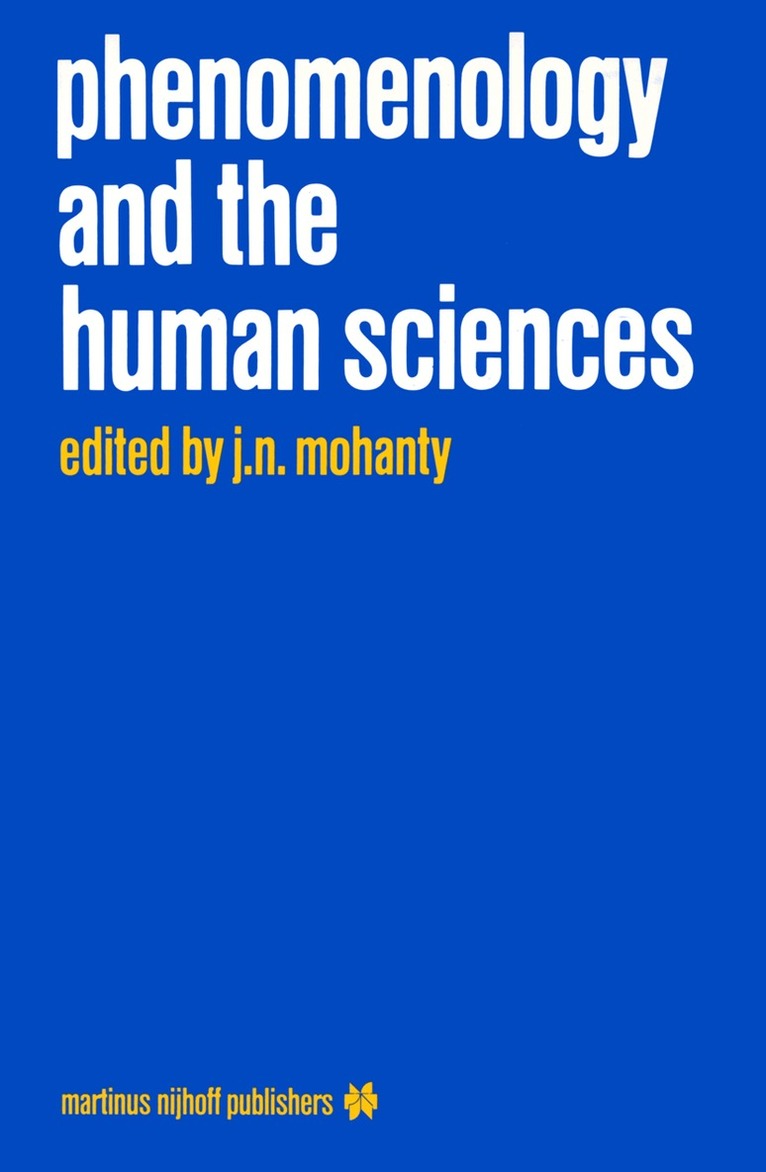
Thomas A. Fay Heidegger and the Formalization of Thought 1 Dagfinn F011esdal The Justification of Logic and Mathematics in Husserl's Phenomenology 25 Guillermo E. Rosado Haddock On Husserl's Distinction between State of Affairs (Sachverhalt) and Situation of Affairs (Sachlage) ...35 David Woodruff Smith On Situations and States of Affairs 49 Charles W. Harvey, Jaakko Hintikka Modalization and Modalities ...59 Gilbert T. Null Remarks on Modalization and Modalities 79 J. N. Mohanty Husserl's Formalism 93 Carl J. Posy Mathematics as a Transcendental Science 107 vi Gian-carlo Rota Mathematics and the Task of Phenomenology 133 John Scalon "Tertium Non Datur:" Husserl's Conception of a Definite Multiplicity ...139 Thomas M. Seebohm Psychologism Revisited 149 Gerald J. Massey Some Reflections on Psychologism 183 Robert S. Tragesser How Mathematical Foundation all but come about: A Report on Studies Toward a Phenomenological Critique of Godel's Views on Mathematical Intuition. . 195 Kenneth L. Manders On Geometric Intentionality 215 Dallas Willard Sentences which are True in Virtue of their Color ...225 John J.Drummond Willard and Husserl on Logical Form 243 Index of Names 257 Index of Subjects 259 PREFACE The phenomenology of logic and ideal objects is the topic of Husserl's Logical Investigations. This book determined the early development of the so called phenomenological movement. It is still the main source for many phenomenologists, even if they disagree with Husserl's transcendental turn and developed other phenomenological positions or positions beyond phenomenology he early sense.
1 064 kr
Skickas inom 10-15 vardagar
The essays in this volume develop the ideas of Kant, Hegel and Husserl, leading to an explication of the fundamental concepts of logic, the concepts of "judgment", "truth" and the modalities. It is a book on philosophy of logic, spanning the gap between Kant and Hegel on the one hand, and Husserl, Frege and Lask on the other, mediated by such thinkers as Heidegger and Konig. With the rejection of psychologism, logic is to be construed as concerned with meanings, meanings are to be tied nevertheless to intentional acts of thinking, truth becomes a coherence-theoretical reconstruction of correspondence and, in their origin, modalities are connected to the horizontal character of experience. At one end, logic develops, through formal and transcendental logics, to speculative logic. At the other end, pursuing the practical roots of thinking, it becomes hermeneutic logic. Then we begin to see the nature of logic as a whole.
Phenomenology on Kant, German Idealism, Hermeneutics and Logic
Philosophical Essays in Honor of Thomas M. Seebohm
Inbunden, Engelska, 2000
1 593 kr
Skickas inom 10-15 vardagar
This volume comprises systematic as well as historical essays, including contributions intended to give comprehensive overviews of such areas as genetic phenomenology, transcendental phenomenology, philosophy and history of logic and mathematics, Kant, hermeneutics, Hegel, and philosophy of language. The book is addressed to phenomenologists, particularly those who are interested in some or all of the areas mentioned. In his introduction Joseph J. Kockelmans indicates that these diverse areas enter into dialogue in the work of Thomas M. Seebohm, whom the editors and authors wish to honour, and the systematic papers mirror the state of the art of research in the above-mentioned disciplines.
1 593 kr
Skickas inom 10-15 vardagar
In this work I have tried to present HusserI's Philosophy of thinking and meaning in as clear a manner as I can. In doing this, I had in mind a two-fold purpose. I wanted on the one hand to disentangle what I have come to regard as the central line of thought from the vast mass of details of the Logische Unter suchungen and the Formale und transzendentale Logik. On the other hand, I tried to take into consideration the immense developments in logic and semantics that have taken place since HusserI's major logical studies were published. It is my belief that no one to day can look back upon the philosophers of the past except in the light of the admirable progress achieved and consolidated in the fields of logic and semantics in recent times. Fortunately enough, from this point of view HusserI fares remarkably well. He certainly anticipated many of those recent investigations. What is more, a true understanding and appraisal of his logical studies is not possible except in the light of the corresponding modern investigations. This last consider ation may provide us with some explanation of the rather puzzling fact that orthodox HusserIian scholarship both within and outside Germany has not accorded to his logical studies the central importance that they, from all points of view, unmis takeably deserve.
1 064 kr
Skickas inom 10-15 vardagar
I Edmund Husserl's Logische Untersuchungen is, by any standard and also by nearly common consent, a great philosophical work. Within the phenom enological movement, it is generally recognised that the breakthrough to pure phenomenology - not merely to eidetic phenomenology, but also to transcendental phenomenology - was first made in these investiga tions. But in the context of philosophy of logic and also of theory of know ledge in general, these investigations took decisive steps forward. Amongst their major achievements generally recognised are of course: the final death-blow to psychologism as a theory of logic in the Prolegomena, a new conception of analyticity which vastly improves upon Kant's, a theory of meaning which is many-sided in scope and widely ramified in its appli cations, a conception of pure logical grammar that eventually became epoch-making, a powerful restatement of the conception of truth in terms of 'evidence' and a theory of knowledge in terms of the dynamic movement from empty intention to graduated fulfillment. There are many other detailed arguments, counter-arguments, conceptual distinctions and phenomenolo gical descriptions which deserve the utmost attention, examination and assimilation on the part of any serious investigator. With the publication of J. N. Findlay's English translation of the Untersuchungen, it is expected that this work will find its proper place in the curriculum of the graduate programs in philosophy in the English speaking world.
1 593 kr
Skickas inom 10-15 vardagar
These essays span a period of fourteen years. The earliest was written in 1960, the latest in 1983. They all represent various attempts to understand the motives and the central concepts of Husserl's transcen dental phenomenology, and to locate the latter in the background of other varieties of transcendental philosophy. Implicitly, they also con tain a defense of transcendental philosophy, and make attempts to respond to the more familiar criticisms against it. It is hoped that they will contribute to a better understanding not only of Husserl's transcen dental phenomenology but also of transcendental philosophy in gener al. The ordering of the essays is not chronological. They are rather divided thematically into three groups. The first group of six essays is concerned with relating Husserlian phenomenology to more contem porary analytic concerns: in fact, the opening essay on Husserl and Frege establishes a certain continuity of concern with my last published book with that title. Of these, Essay 2 was written for an American Philosophical Association, Eastern Division symposium in which the other symposiast was John Searle. The discussion in that symposium concentrated chiefly on the relation between intentionality and causali ty - which led me to write Essay 6, later read as the Gurwitsch Memo rial Lecture at the Society for Phenomenology and Existential Philos ophy meetings in 1982 at Penn State.
1 064 kr
Skickas inom 10-15 vardagar
1 593 kr
Skickas inom 10-15 vardagar
These essays span a period of fourteen years. The earliest was written in 1960, the latest in 1983. They all represent various attempts to understand the motives and the central concepts of Husserl's transcen dental phenomenology, and to locate the latter in the background of other varieties of transcendental philosophy. Implicitly, they also con tain a defense of transcendental philosophy, and make attempts to respond to the more familiar criticisms against it. It is hoped that they will contribute to a better understanding not only of Husserl's transcen dental phenomenology but also of transcendental philosophy in gener al. The ordering of the essays is not chronological. They are rather divided thematically into three groups. The first group of six essays is concerned with relating Husserlian phenomenology to more contem porary analytic concerns: in fact, the opening essay on Husserl and Frege establishes a certain continuity of concern with my last published book with that title. Of these, Essay 2 was written for an American Philosophical Association, Eastern Division symposium in which the other symposiast was John Searle. The discussion in that symposium concentrated chiefly on the relation between intentionality and causali ty - which led me to write Essay 6, later read as the Gurwitsch Memo rial Lecture at the Society for Phenomenology and Existential Philos ophy meetings in 1982 at Penn State.
1 064 kr
Skickas inom 10-15 vardagar
The essays in this volume develop the ideas of Kant, Hegel and Husserl, leading to an explication of the fundamental concepts of logic - the concepts of 'judgment', 'truth' and the modalities. It is a book on philosophy of logic, spanning the gap between Kant and Hegel on the one hand, and Husserl, Frege and Lask on the other, mediated by such thinkers as Heidegger and Konig. With the rejection of psychologism, logic is to be construed as concerned with meanings, meanings are to be tied nevertheless to intentional acts of thinking, truth becomes a coherence-theoretical reconstruction of correspondence and, in their origin, modalities are connected to the horizontal character of experience. At one end, logic develops, through formal and transcendental logics, to speculative logic. At the other end, pursuing the practical roots of thinking, it becomes hermeneutic logic. Then we begin to see the nature of logic as a whole. Audience::Philosophers and logicians, both graduate and post-graduate.
Phenomenology on Kant, German Idealism, Hermeneutics and Logic
Philosophical Essays in Honor of Thomas M. Seebohm
Häftad, Engelska, 2010
1 593 kr
Skickas inom 10-15 vardagar
This volume comprises systematic as well as historical essays, including contributions intended to give comprehensive overviews of such areas as genetic phenomenology, transcendental phenomenology, philosophy and history of logic and mathematics, Kant, hermeneutics, Hegel, and philosophy of language. The book is addressed to phenomenologists, particularly those who are interested in some or all of the areas mentioned. In his introduction Joseph J. Kockelmans indicates that these diverse areas enter into dialogue in the work of Thomas M. Seebohm, whom the editors and authors wish to honor, and the systematic papers mirror the state of the art of research in the above-mentioned disciplines.
1 698 kr
Skickas inom 10-15 vardagar
In this work I have tried to present HusserI's Philosophy of thinking and meaning in as clear a manner as I can. In doing this, I had in mind a two-fold purpose. I wanted on the one hand to disentangle what I have come to regard as the central line of thought from the vast mass of details of the Logische Unter suchungen and the Formale und transzendentale Logik. On the other hand, I tried to take into consideration the immense developments in logic and semantics that have taken place since HusserI's major logical studies were published. It is my belief that no one to day can look back upon the philosophers of the past except in the light of the admirable progress achieved and consolidated in the fields of logic and semantics in recent times. Fortunately enough, from this point of view HusserI fares remarkably well. He certainly anticipated many of those recent investigations. What is more, a true understanding and appraisal of his logical studies is not possible except in the light of the corresponding modern investigations. This last consider ation may provide us with some explanation of the rather puzzling fact that orthodox HusserIian scholarship both within and outside Germany has not accorded to his logical studies the central importance that they, from all points of view, unmis takeably deserve.
536 kr
Skickas inom 10-15 vardagar
Most of the essays that follow have originally appeared in philosophical journals, Indian and Western. They are reprinted here with the hope that in spite of the wide variety of topics with which they deal there is nevertheless a certain unity of treatment. A few major ideas and distinctions run through all the essays: I need not further single them out here. For permission to reprint, I have to thank the editors of the journals and books in which the essays originally appeared. My former pupil Miss Manjusree Ray has been kind enough to help me in preparing the book for the press. J. N. MOHANTY May, I968, Calcutta CONTENTS Preface v Part One I. Modes of Givenness 3 II. The Given 12 III. Thought and Action 22 IV. Meaning and Truth-I 0 3 V. Meaning and Truth-II 50 VI. Language and Reality 60 VII. On Reference 2 7 VIII. Remarks on the Content Theory 84 IX. Phenomenology and Ontology 2 9 Part Two X. A Note on Modern Nominalism I07 XI. A recent Criticism of the Foundations of Nicolai Hartmann's Ontology II5 XII. Remarks on Nicolai Hartmann's Modal Doctrine 129 XIII. The 'Object' in Edmund Husserl's Phenomenology 138 XIV. Individual Fact and Essence in Edmund Husserl's Philosophy 152 XV. Gilbert Ryle's Criticisms of the Concept of Conscio- ness 163 XVI. On G. E. Moore's Defence of Common sense 170 Part Three XVII.
1 593 kr
Skickas inom 10-15 vardagar
Thomas A. Fay Heidegger and the Formalization of Thought 1 Dagfinn F011esdal The Justification of Logic and Mathematics in Husserl's Phenomenology 25 Guillermo E. Rosado Haddock On Husserl's Distinction between State of Affairs (Sachverhalt) and Situation of Affairs (Sachlage) ...35 David Woodruff Smith On Situations and States of Affairs 49 Charles W. Harvey, Jaakko Hintikka Modalization and Modalities ...59 Gilbert T. Null Remarks on Modalization and Modalities 79 J. N. Mohanty Husserl's Formalism 93 Carl J. Posy Mathematics as a Transcendental Science 107 vi Gian-carlo Rota Mathematics and the Task of Phenomenology 133 John Scalon "Tertium Non Datur:" Husserl's Conception of a Definite Multiplicity ...139 Thomas M. Seebohm Psychologism Revisited 149 Gerald J. Massey Some Reflections on Psychologism 183 Robert S. Tragesser How Mathematical Foundation all but come about: A Report on Studies Toward a Phenomenological Critique of Godel's Views on Mathematical Intuition. . 195 Kenneth L. Manders On Geometric Intentionality 215 Dallas Willard Sentences which are True in Virtue of their Color ...225 John J.Drummond Willard and Husserl on Logical Form 243 Index of Names 257 Index of Subjects 259 PREFACE The phenomenology of logic and ideal objects is the topic of Husserl's Logical Investigations. This book determined the early development of the so called phenomenological movement. It is still the main source for many phenomenologists, even if they disagree with Husserl's transcendental turn and developed other phenomenological positions or positions beyond phenomenology he early sense.