Joanne T. Mulligan – författare
Visar alla böcker från författaren Joanne T. Mulligan. Handla med fri frakt och snabb leverans.
3 produkter
3 produkter
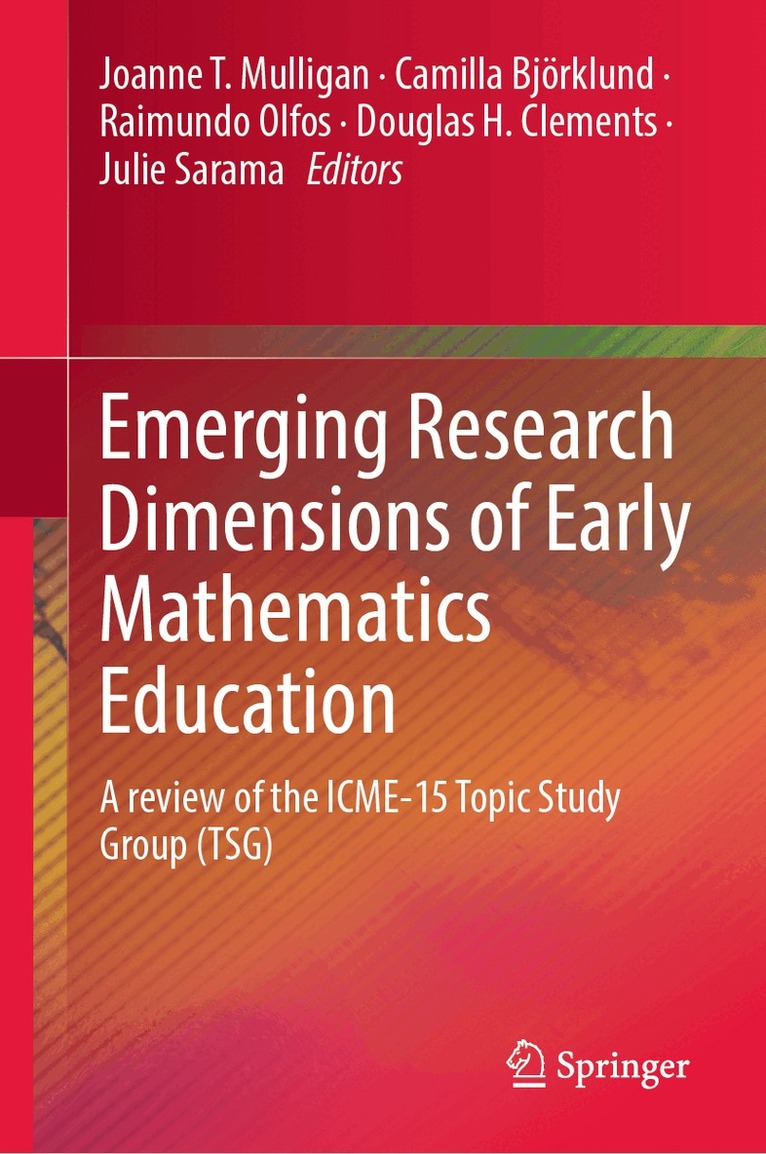
Emerging Research Dimensions of Early Mathematics Education
A Review of the ICME-15 Topic Group 3.1
Inbunden, Engelska, 2026
2 639 kr
Kommande
This edited volume provides and overview of the papers presented by the ICME-15 TSG3.1 Mathematics Education at the Early Childhood and Primary level at the 15th International Congress on Mathematical Education (ICME-15) in Sydney, Australia, 2024. The book discusses themes, theoretical perspectives and methodological approaches of the papers. It brings together complementary views of the TSG3.1 team who support collaborative development of research programs across a range of cultural contexts. The chapters enable the readers to focus on particular conceptual domains of interest including chapters on patterning and pattern and structure; counting; number concepts, operations and number sense; multiplicative thinking and fractions; spatial concepts and reasoning and statistical reasoning. There are examples of the role of technological tools in the development of mathematical thinking. The final section focuses on teacher education and the role of community and caregivers in promoting early mathematical thinking. This book is particularly suited for mathematics education researchers and educators.
1 033 kr
Skickas inom 10-15 vardagar
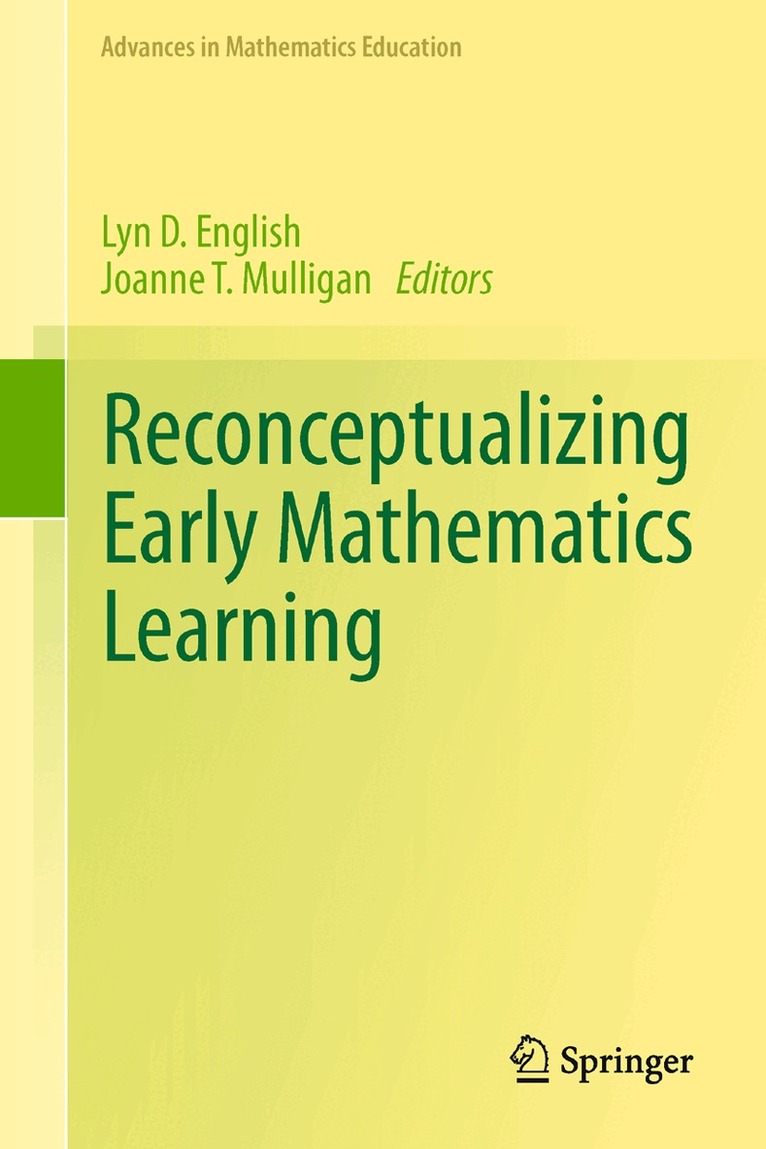
This book emanated primarily from concerns that the mathematical capabilities of young children continue to receive inadequate attention in both the research and instructional arenas.
1 033 kr
Skickas inom 10-15 vardagar
This book emanated primarily from concerns that the mathematical capabilities of young children continue to receive inadequate attention in both the research and instructional arenas. Research over many years has revealed that young children have sophisticated mathematical minds and a natural eagerness to engage in a range of mathematical activities. As the chapters in this book attest, current research is showing that young children are developing complex mathematical knowledge and abstract reasoning a good deal earlier than previously thought. A range of studies in prior to school and early school settings indicate that young learners do possess cognitive capacities which, with appropriately designed and implemented learning experiences, can enable forms of reasoning not typically seen in the early years. Although there is a large and coherent body of research on individual content domains such as counting and arithmetic, there have been remarkably few studies that have attempted to describe characteristics of structural development in young students’ mathematics. Collectively, the chapters highlight the importance of providing more exciting, relevant, and challenging 21st century mathematics learning for our young students. The chapters provide a broad scope in their topics and approaches to advancing young children’s mathematical learning. They incorporate studies that highlight the importance of pattern and structure across the curriculum, studies that target particular content such as statistics, early algebra, and beginning number, and studies that consider how technology and other tools can facilitate early mathematical development. Reconceptualising the professional learning of teachers in promoting young children’s mathematics, including a consideration of the role of play, is also addressed.