Jochen Gläser - Böcker
Visar alla böcker från författaren Jochen Gläser. Handla med fri frakt och snabb leverans.
6 produkter
6 produkter
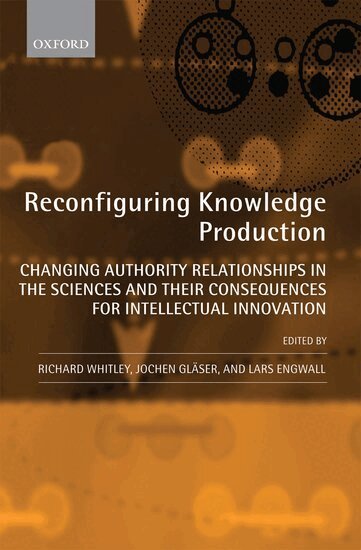
Reconfiguring Knowledge Production
Changing Authority Relationships in the Sciences and their Consequences for Intellectual Innovation
Inbunden, Engelska, 2010
1 962 kr
Skickas inom 5-8 vardagar
The governance of the public sciences has profoundly changed since the Second World War, especially with regard to funding structures, the autonomy, and accountability of public research organizations and universities, and the extent to which research is steered towards societal usefulness. Going beyond previous analyses of these changes in science studies, science policy, and higher education studies, this book presents and applies a novel approach that provides an integrated assessment of changes in public science systems and their impact on scientific innovation. Its basic assumptions are (i) that all changes in public science systems (PSS) affect authority relations - the interests and action capabilities of authoritative agencies in science - and (ii) that the authority relations concerning the selection of goals and approaches in research as well as the integration of research results are the channel through which changes in PSS affect the production of scientific knowledge and particularly scientific innovation. This focus on authority relations as the key interface integrating changes in governance and translating them into changes in the production of scientific knowledge is an important innovation because the effects of governance at the performance level of the science system have been largely neglected by other approaches. By demonstrating that changes in authority relations are field-specific and have field-specific effects on knowledge production , and that these field-specific authority relations do indeed affect the conditions for intellectual innovation, the perspective explored in this book challenges science policy studies to 'bring work back in' to the study of the organisation and governance of the sciences.
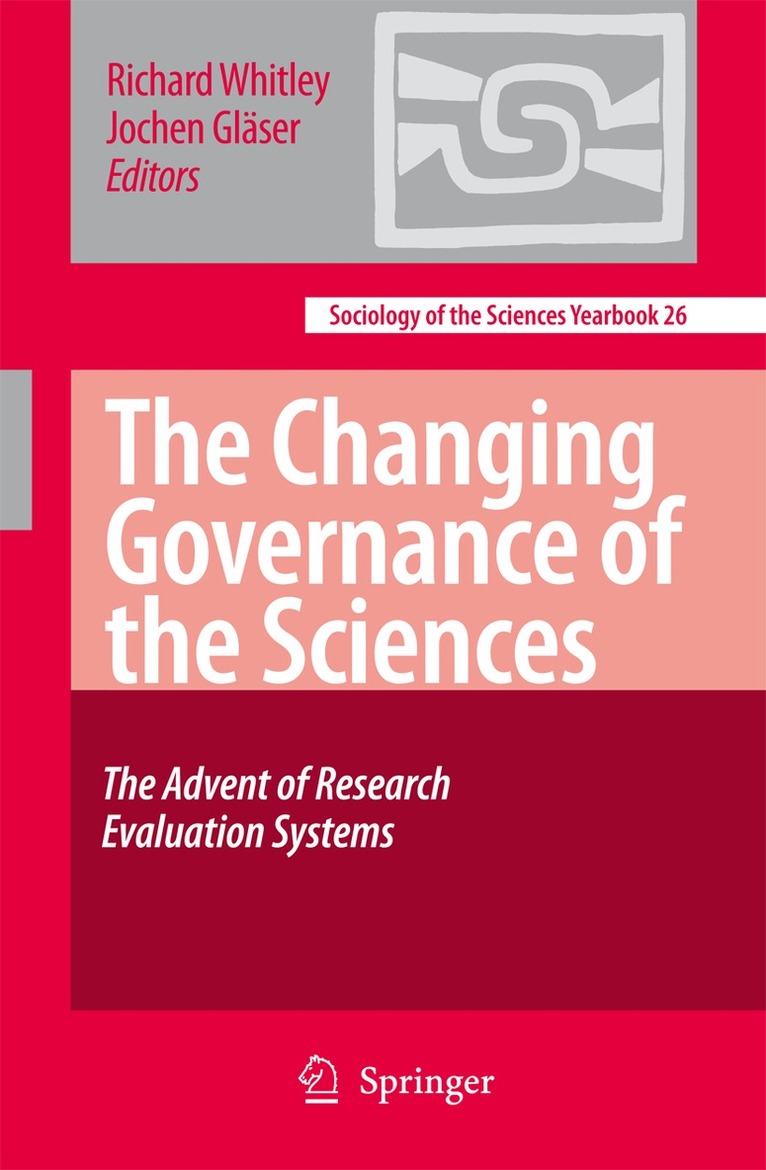
Changing Governance of the Sciences
The Advent of Research Evaluation Systems
Inbunden, Engelska, 2008
1 578 kr
Skickas inom 10-15 vardagar
This book arose from a conversation between Lars Engwall and Richard Whitley during the 2003 European Group for Organization Studies Colloquium in Copenhagen about important topics for future research. We agreed then, and this has been amply confirmed by subsequent events, that the proliferation of research eval- tion schemes, especially in Europe, was an important feature of the changing re- tionships between the state, universities and scientific research more generally, which needed systematic and comparative analysis. With the support of the Bank of Sweden Tercentenary Foundation, this discussion led to workshops in Uppsala and Manchester involving colleagues from Australia, Germany and the Netherlands at which the main framework for such an analysis was developed. This framework then formed the basis for the conference at Bielefeld in 2005 at which earlier versions of most of the papers in this volume were presented and extensively discussed. We are very grateful for the support of the PRIME network of the European Commission and the Max Planck Institute for the History of Science for this c- ference, as well as the invaluable efforts of Peter Weingart of the University of Bielefeld. We are also greatly indebted to the members of the Editorial Board who commented on various drafts of these papers as well as to Aant Elzinga, Stefan Kuhlmann, Philippe Laredo, Arie Rip and Nic Vonortas who acted as referees.
Innovations in the Modern Arts and Sciences
Explaining Lasting Change in Novelty-Driven Cultural Fields
Häftad, Engelska, 2026
726 kr
Kommande
This book explores how lasting forms of change take shape in the modern arts and sciences, which became organised as fields that valued originality and continual innovation between the 17th and 19th centuries. Using comparative case studies, the authors show how certain artistic and scientific contributions become established as innovations - shifting the aims, methods and everyday practices of creative practitioners over time.Bridging history and sociology, this book offers valuable insight into how innovations emerge, gain traction and ultimately reshape the fields in which they develop. It is an essential resource for scholars interested in the processes that drive long-term change in creative and knowledge-producing communities.
Experteninterviews und qualitative Inhaltsanalyse
als Instrumente rekonstruierender Untersuchungen
Häftad, Tyska, 2010
501 kr
Skickas inom 7-10 vardagar
Kooperation im Niemandsland
Neue Perspektiven auf Zusammenarbeit in Wissenschaft und Technik
Häftad, Tyska, 2003
550 kr
Skickas inom 10-15 vardagar
1 578 kr
Skickas inom 10-15 vardagar
This book arose from a conversation between Lars Engwall and Richard Whitley during the 2003 European Group for Organization Studies Colloquium in Copenhagen about important topics for future research. We agreed then, and this has been amply confirmed by subsequent events, that the proliferation of research eval- tion schemes, especially in Europe, was an important feature of the changing re- tionships between the state, universities and scientific research more generally, which needed systematic and comparative analysis. With the support of the Bank of Sweden Tercentenary Foundation, this discussion led to workshops in Uppsala and Manchester involving colleagues from Australia, Germany and the Netherlands at which the main framework for such an analysis was developed. This framework then formed the basis for the conference at Bielefeld in 2005 at which earlier versions of most of the papers in this volume were presented and extensively discussed. We are very grateful for the support of the PRIME network of the European Commission and the Max Planck Institute for the History of Science for this c- ference, as well as the invaluable efforts of Peter Weingart of the University of Bielefeld. We are also greatly indebted to the members of the Editorial Board who commented on various drafts of these papers as well as to Aant Elzinga, Stefan Kuhlmann, Philippe Laredo, Arie Rip and Nic Vonortas who acted as referees.