Joel Berger - Böcker
Visar alla böcker från författaren Joel Berger. Handla med fri frakt och snabb leverans.
7 produkter
7 produkter
294 kr
Skickas inom 5-8 vardagar
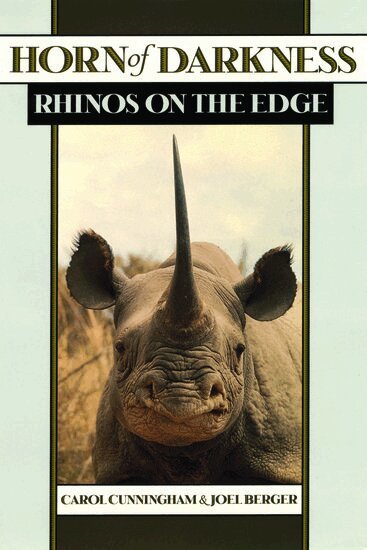
The worlds rhinoceroses face extinction because a part of their anatomy is valued too much. Poachers hunt and slaughter them because their horns are treasured. Once an estimated 100,000 black rhinos roamed from the Sahara to the Cape of Good Hope but now less than 3% remain. In all of Africa, there is but a single infenced population numbering more than 100 individuals, in the inhospitable barrens of the Namib Desert. The hunger for money has resulted in the deaths of more than 160 Zimbabwean poachers as they tried to kill fro the valuable horns, Few options remain to stop the deadly harvest, Although guarded sanctuaries may now be working in Kenya, elsewhere foot patrols, helicopters, and high tech solutions have been tried and most have failed. In 1989 a radical strategy has developed - cutting the horns, The rationale is simple. If a rhino has no horns, the incentive to kill it should disappear. What has since unfolded is a biological and political drama, Carol Cunningham and Joel Berger describe their passionate quest to help conserve Africa's black rhinos. Arriving with their 19 month old daughter in the fiercely independent country of Namibia, they undertook a fascinating study to understand how horns are involved in the social lives of this charismatic species. This book blends natural history and biology, adventure and adrenaline. Africans and local attitudes. It moves beyond the typical nature study by bringing in real world components of conservation - the delicate mix of western science, politics and economics, and personal despair and hope.
325 kr
Skickas inom 5-8 vardagar
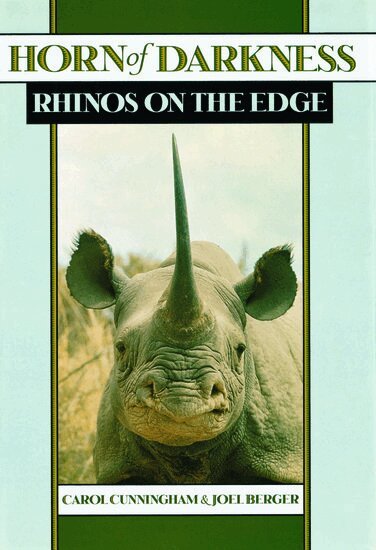
The world's rhinoceroses face extinction because a part of their anatomy is valued too much. Poachers hunt and slaughter them because their horns are treasured. Once an estimated 100,000 black rhinos roamed from the Sahara to the Cape of Good Hope but onw less than 3% remain. In all of Africa, there is but a single unfenced population numbering more than 100 individuals, in the inhospitable barrens of the Namib Desert. In 1989 a radical strategy was developed - cutting the horns. The rationale is simple. If a rhino has no horns, the incentive to kill it should disappear. What has since unfolded is a biological and political drama. Carol Cunningham and Joel Berger describe their quest to help conserve Africa's black rhinos in a book that is both an adventure story and virtual guidebook to the challenges and experience of field biology. The authors present such a multifaceted and rich account of the complicated mix of scientific, political, economic, social, and moral concerns affecting any effort to preserve an endangered species. It moves beyond the typical nature study by bringing in real world components of conservation - the delicate mix of western science, politics and economics, and personal despair and hope.
268 kr
Skickas inom 7-10 vardagar
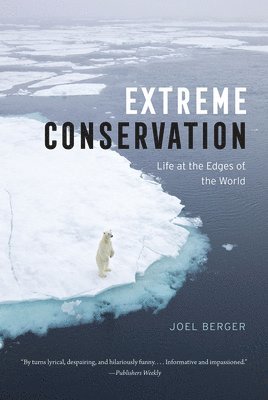
On the Tibetan Plateau, there are wild yaks with blood cells thinner than horses' by half, enabling the endangered yaks to survive at 40 below zero and in the lowest oxygen levels of the mountaintops. But climate change is causing the snow patterns here to shift, and with the snows, the entire ecosystem. Food and water are vaporizing in this warming environment, and these beasts of ice and thin air are extraordinarily ill-equipped. A journey into some of the most forbidding landscapes on earth, Joel Berger's Extreme Conservation is an eye-opening, steely look at what it takes for animals like these to live at the edges of existence. But more than this, it is a revealing exploration of how climate change and people are affecting even the most far-flung niches of our planet. Berger's quest to understand these creatures' struggles takes him to some of the most remote corners and peaks of the globe: across Arctic tundra and the frozen Chukchi Sea to study muskoxen, into the Bhutanese Himalayas to follow the rarely-sighted takin, and through the Gobi Desert to track the proboscis-swinging saiga. Known as much for his rigorous, scientific methods of developing solutions to conservation challenges as for his penchant for donning moose and polar bear costumes to understand the mindsets of his subjects more closely, Berger is a guide bar none. He is a scientist and storyteller who has made his life working with desert nomads, in zones that typically require Sherpas and oxygen canisters. Recounting animals as charismatic as their landscapes are extreme, Berger's unforgettable tale carries us with humor and expertise to the ends of the earth and back. But as his adventures show, the more adapted a species has become to its particular ecological niche, the more devastating climate change can be. Life at the extremes is more challenging than ever, and the need for action, for solutions, has never been greater.
1 250 kr
Skickas inom 3-6 vardagar
This examination of a depopulated species, the North American bison, provides insights into the past and present behaviour and ecology of what was once the continent's largest terrestrial mammal. The authors' research, conducted over a five-year period, attempts to resolve such questions as: what happens when only a small proportion of the male of a species mate?; why do animals in particular areas experience morphological malformations?; and how much genetic diversity has been lost since the 19th century? The study also discusses the consequences of mating failures, lineage differences in growth and birth synchrony. It explores behavioural ecology, mate choice, the conservation of ecosystems and the management of endangered species.
1 462 kr
Tillfälligt slut
Large Carnivores and the Conservation of Biodiversity brings together more than thirty leading scientists and conservation practitioners to consider a key question in environmental conservation: Is the conservation of large carnivores in ecosystems that evolved with their presence equivalent to the conservation of biological diversity within those systems? Building their discussions from empirical, long-term data sets, contributors including James A. Estes, David S. Maehr, Tim McClanahan, Andres J. Novaro, John Terborgh, and Rosie Woodroffe explore a variety of issues surrounding the link between predation and biodiversity: What is the evidence for or against the link? Is it stronger in marine systems? What are the implications for conservation strategies? Large Carnivores and the Conservation of Biodiversity is the first detailed, broad-scale examination of the empirical evidence regarding the role of large carnivores in biodiversity conservation in both marine and terrestrial ecosystems. It contributes to a much more precise and global understanding of when, where, and whether protecting and restoring top predators will directly contribute to the conservation of biodiversity.Everyone concerned with ecology, biodiversity, or large carnivores will find this volume a unique and thoughtprovoking analysis and synthesis.
666 kr
Skickas inom 3-6 vardagar
Large Carnivores and the Conservation of Biodiversity brings together more than thirty leading scientists and conservation practitioners to consider a key question in environmental conservation: Is the conservation of large carnivores in ecosystems that evolved with their presence equivalent to the conservation of biological diversity within those systems? Building their discussions from empirical, long-term data sets, contributors including James A. Estes, David S. Maehr, Tim McClanahan, Andres J. Novaro, John Terborgh, and Rosie Woodroffe explore a variety of issues surrounding the link between predation and biodiversity: What is the evidence for or against the link? Is it stronger in marine systems? What are the implications for conservation strategies? Large Carnivores and the Conservation of Biodiversity is the first detailed, broad-scale examination of the empirical evidence regarding the role of large carnivores in biodiversity conservation in both marine and terrestrial ecosystems. It contributes to a much more precise and global understanding of when, where, and whether protecting and restoring top predators will directly contribute to the conservation of biodiversity.Everyone concerned with ecology, biodiversity, or large carnivores will find this volume a unique and thoughtprovoking analysis and synthesis.
238 kr
Skickas inom 3-6 vardagar