John B. Watson - Böcker
Visar alla böcker från författaren John B. Watson. Handla med fri frakt och snabb leverans.
13 produkter
13 produkter
291 kr
Skickas inom 5-8 vardagar
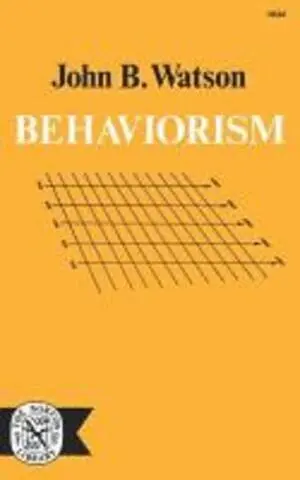
“Two opposed points of view,” John B. Watson wrote in 1925, “are still dominant in American psychological thinking: introspective or subjective psychology, and behaviorism or objective psychology.” His statement is still true today. Reacting against traditional psychology’s emphasis on feelings and introspection, and its lack of precise categories, Watson proposed a methodological approach to psychological problems that would be logical, precise, and scientific. Consciousness, he believed, was not a usable hypothesis: the proper subject of human psychology is the behavior of the human being. Behaviorism aimed to free psychology from elusive, vague concepts and establish it as a true natural science.
433 kr
Skickas inom 5-8 vardagar
308 kr
Skickas inom 5-8 vardagar
2 168 kr
Skickas inom 10-15 vardagar
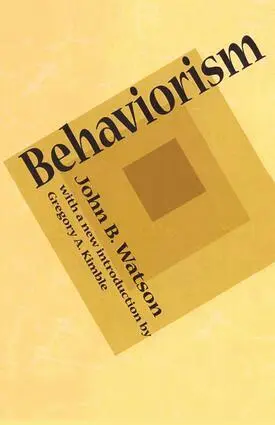
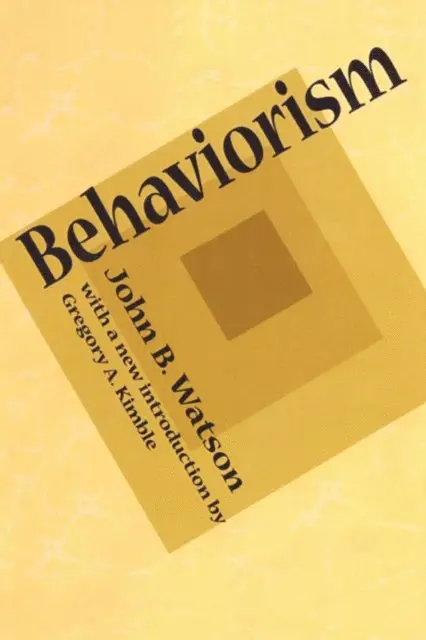
Watson was the father of behaviorism. His now-revered lectures on the subject defined behaviorism as a natural science that takes the whole field of human adjustment as its own. It is the business of behaviorist psychology to predict and control human activity. The field has as its aim to be able, given the stimulus, to predict the response, or seeing the reaction, to know the stimulus that produced it. Watson argued that psychology is as good as its observations: what the organism does or says in the general environment.Watson identified "laws" of learning, including frequency and recency. Kimble makes it perfectly clear that Watson's behaviorism, while deeply indebted to Ivan Pavlov, went beyond the Russian master in his treatment of cognition, language, and emotion. It becomes clear that Behaviorism is anything but the reductionist caricature it is often made out to be in the critical literature. For that reason alone, the work merits a wide reading.Behaviorism, as was typical of the psychology of the time, offered a wide array of applications all of which can be said to fall on the enlightened side of the ledger. At a time of mixed messages, Watson argued against child beating and abuse, for patterns of enlightened techniques of factory management, and for curing the sick and isolating the small cadre of criminals not subject to correction. And anticipating Thomas Szasz, he argued against a doctrine of strictly mental diseases, and for a close scrutiny of behavioral illness and disturbances. Kimble's brilliant introduction to Watson ends with a challenge to subjectivism to provide evidence that Watson's behaviorism cannot explain human actions without introspective notions of the mind. This genuine classic of social science hi our century remains relevant not just for the conduct of psychological research, but for studies in the philosophy of science and the sociology of knowledge.
657 kr
Skickas inom 3-6 vardagar
532 kr
Skickas inom 3-6 vardagar
396 kr
Skickas inom 5-8 vardagar
317 kr
Skickas inom 5-8 vardagar
475 kr
Skickas inom 5-8 vardagar
317 kr
Skickas inom 5-8 vardagar
415 kr
Skickas inom 3-6 vardagar
675 kr
Skickas inom 10-15 vardagar
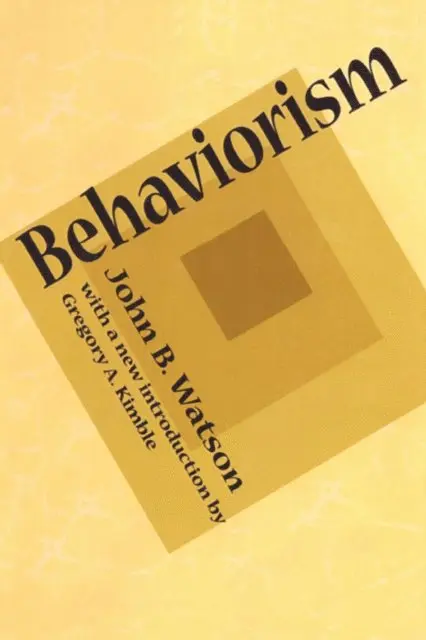
Watson was the father of behaviorism. His now-revered lectures on the subject defined behaviorism as a natural science that takes the whole field of human adjustment as its own. It is the business of behaviorist psychology to predict and control human activity. The field has as its aim to be able, given the stimulus, to predict the response, or seeing the reaction, to know the stimulus that produced it. Watson argued that psychology is as good as its observations: what the organism does or says in the general environment.Watson identified "laws" of learning, including frequency and recency. Kimble makes it perfectly clear that Watson's behaviorism, while deeply indebted to Ivan Pavlov, went beyond the Russian master in his treatment of cognition, language, and emotion. It becomes clear that Behaviorism is anything but the reductionist caricature it is often made out to be in the critical literature. For that reason alone, the work merits a wide reading.Behaviorism, as was typical of the psychology of the time, offered a wide array of applications—all of which can be said to fall on the enlightened side of the ledger. At a time of mixed messages, Watson argued against child beating and abuse, for patterns of enlightened techniques of factory management, and for curing the sick and isolating the small cadre of criminals not subject to correction. And anticipating Thomas Szasz, he argued against a doctrine of strictly mental diseases, and for a close scrutiny of behavioral illness and disturbances. Kimble's brilliant introduction to Watson ends with a challenge to subjectivism to provide evidence that Watson's behaviorism cannot explain human actions without introspective notions of the mind. This genuine classic of social science hi our century remains relevant not just for the conduct of psychological research, but for studies in the philosophy of science and the sociology of knowledge.
240 kr
Skickas inom 5-8 vardagar