John Brenkman - Böcker
Visar alla böcker från författaren John Brenkman. Handla med fri frakt och snabb leverans.
8 produkter
8 produkter
889 kr
Skickas inom 7-10 vardagar
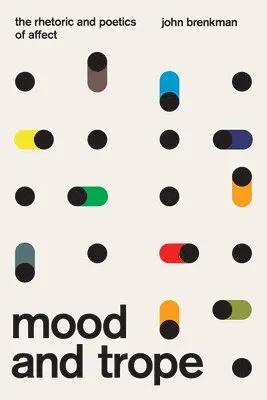
In Mood and Trope, John Brenkman introduces two provocative propositions to affect theory: that human emotion is intimately connected to persuasion and figurative language; and that literature, especially poetry, lends precision to studying affect because it resides there not in speaking about feelings, but in the way of speaking itself. Engaging a quartet of modern philosophers--Kant, Nietzsche, Heidegger, and Deleuze--Brenkman explores how they all approach the question of affect primarily through literature and art. He draws on the differences and dialogues among them, arguing that the vocation of criticism is incapable of systematicity and instead must be attuned to the singularity and plurality of literary and artistic creations. In addition, he confronts these four philosophers and their essential concepts with a wide array of authors and artists, including Pinter and Poe, Baudelaire, Jorie Graham and Li-Young Lee, Shakespeare, Tino Sehgal, and Francis Bacon. Filled with surprising insights, Mood and Trope provides a rich archive for rethinking the nature of affect and its aesthetic and rhetorical stakes.
299 kr
Skickas inom 7-10 vardagar
In Mood and Trope, John Brenkman introduces two provocative propositions to affect theory: that human emotion is intimately connected to persuasion and figurative language; and that literature, especially poetry, lends precision to studying affect because it resides there not in speaking about feelings, but in the way of speaking itself. Engaging a quartet of modern philosophers--Kant, Nietzsche, Heidegger, and Deleuze--Brenkman explores how they all approach the question of affect primarily through literature and art. He draws on the differences and dialogues among them, arguing that the vocation of criticism is incapable of systematicity and instead must be attuned to the singularity and plurality of literary and artistic creations. In addition, he confronts these four philosophers and their essential concepts with a wide array of authors and artists, including Pinter and Poe, Baudelaire, Jorie Graham and Li-Young Lee, Shakespeare, Tino Sehgal, and Francis Bacon. Filled with surprising insights, Mood and Trope provides a rich archive for rethinking the nature of affect and its aesthetic and rhetorical stakes.
1 544 kr
Kommande
An experiment in criticism that explores Henry James’s late works through the lens of minimalism. Henry James’s last completed novels—The Ambassadors, The Wings of the Dove, and The Golden Bowl—are among the greatest and most demanding achievements of modern fiction. The stories they tell are perverse: characters are compelling even at their most cruel, their actions often calculating and loving at the same time. The novels draw on deep-seated myths but end with an unsettling lack of finality. And their dense, involuted language tracks the movements of consciousness with uncompromising artistry—the ultimate flowering of the late James style.In this work of experimental criticism, John Brenkman is concerned with minimalism in two senses. First, with James’s own minimalism—his intense scrutiny of couples and their erotic energies to the exclusion of so much else. And second, through a kind of minimalization in literary critical reading, Brenkman cuts through James’s amplifications to find the essence that churns beneath the intricate prose of the late novels. Showing how James evokes not only protagonists’ subjectivity but more importantly what only exists in between—that is, between lovers, between spouses, between rivals—Brenkman reveals James’s transformation of the marriage novel and excavation of the couple form itself.
376 kr
Kommande
An experiment in criticism that explores Henry James’s late works through the lens of minimalism. Henry James’s last completed novels—The Ambassadors, The Wings of the Dove, and The Golden Bowl—are among the greatest and most demanding achievements of modern fiction. The stories they tell are perverse: characters are compelling even at their most cruel, their actions often calculating and loving at the same time. The novels draw on deep-seated myths but end with an unsettling lack of finality. And their dense, involuted language tracks the movements of consciousness with uncompromising artistry—the ultimate flowering of the late James style.In this work of experimental criticism, John Brenkman is concerned with minimalism in two senses. First, with James’s own minimalism—his intense scrutiny of couples and their erotic energies to the exclusion of so much else. And second, through a kind of minimalization in literary critical reading, Brenkman cuts through James’s amplifications to find the essence that churns beneath the intricate prose of the late novels. Showing how James evokes not only protagonists’ subjectivity but more importantly what only exists in between—that is, between lovers, between spouses, between rivals—Brenkman reveals James’s transformation of the marriage novel and excavation of the couple form itself.
502 kr
Skickas inom 7-10 vardagar
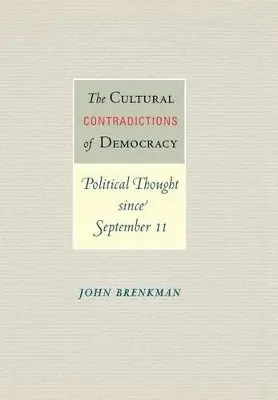
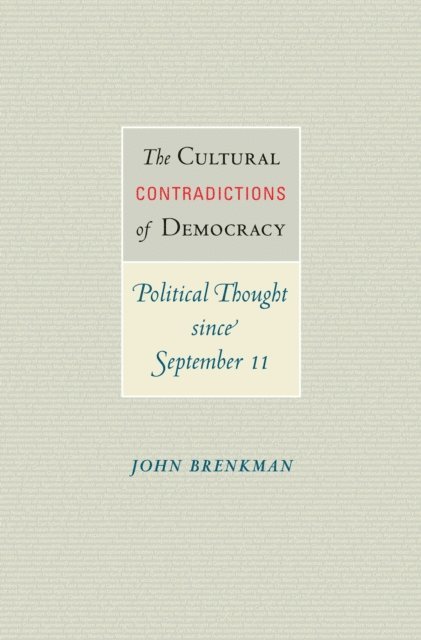
Since 9/11, American foreign policy has been guided by grand ideas like tyranny, democracy, and freedom. And yet the course of events has played havoc with the cherished assumptions of hawks and doves alike. The geo-civil war afflicting the Muslim world from Lebanon through Iraq and Afghanistan to Pakistan confronts the West with the need to articulate anew what its political ideas and ideals actually are. In The Cultural Contradictions of Democracy, John Brenkman dissects the rhetoric that has corrupted today's political discourse and abused the idea of freedom and democracy in foreign affairs. Looking back to the original assumptions and contradictions that animate democratic thought, he attempts to resuscitate the language of liberty and give political debate a fresh basis amid the present global turmoil.The Cultural Contradictions of Democracy picks apart the intellectual design and messianic ambitions of the neoconservative American foreign policy articulated by figures such as Robert Kagan and Paul Berman; it casts the same critical eye on a wide range of liberal and leftist thinkers, including Noam Chomsky and Jurgen Habermas, and probes the severe crisis that afflicts progressive political thought. Brenkman draws on the contrary visions of Hobbes, Kant, Max Weber, Hannah Arendt, and Isaiah Berlin in order to disclose the new contours of conflict in the age of geo-civil war, and to illuminate the challenges and risks of contemporary democracy.
282 kr
Skickas inom 7-10 vardagar
Since 9/11, American foreign policy has been guided by grand ideas like tyranny, democracy, and freedom. And yet the course of events has played havoc with the cherished assumptions of hawks and doves alike. The geo-civil war afflicting the Muslim world from Lebanon through Iraq and Afghanistan to Pakistan confronts the West with the need to articulate anew what its political ideas and ideals actually are. In The Cultural Contradictions of Democracy, John Brenkman dissects the rhetoric that has corrupted today's political discourse and abused the idea of freedom and democracy in foreign affairs. Looking back to the original assumptions and contradictions that animate democratic thought, he attempts to resuscitate the language of liberty and give political debate a fresh basis amid the present global turmoil.The Cultural Contradictions of Democracy picks apart the intellectual design and messianic ambitions of the neoconservative American foreign policy articulated by figures such as Robert Kagan and Paul Berman; it casts the same critical eye on a wide range of liberal and leftist thinkers, including Noam Chomsky and Jurgen Habermas, and probes the severe crisis that afflicts progressive political thought. Brenkman draws on the contrary visions of Hobbes, Kant, Max Weber, Hannah Arendt, and Isaiah Berlin in order to disclose the new contours of conflict in the age of geo-civil war, and to illuminate the challenges and risks of contemporary democracy.
1 908 kr
Skickas inom 10-15 vardagar
Major psychoanalytic thinkers from Freud to Ricoeur to Lacan considered the Oedipus complex the key to explaining the human psyche and human sexuality, even culture itself. But, in fact, they were merely theorizing males.In this title, originally published in 1993, the author reassesses the benchmark concepts of Freudian thought, building on feminist criticisms of psychoanalysis and the new history of sexuality. The psychoanalytic questions become political questions: How do the norms of heterosexuality and masculinity themselves emerge within modern society and culture? How do the institutions of compulsory heterosexuality and modern patriarchy shape identity and desire? What make heterosexuality compulsory in our society?Brenkman argues that the larger social world is part and parcel of the Oedipus complex. He challenges psychoanalysis to reinvent its cultural project, as a therapeutics and an ethics, by recovering the moral-political dimension in its approach to family, sexuality and gender. Straight Male Modern casts a new light on psychoanalysis’s contribution to modern life, revealing the richness of the Freudian tradition’s encounter with modern politics and culture, and the poverty of its response.
523 kr
Skickas inom 10-15 vardagar
Major psychoanalytic thinkers from Freud to Ricoeur to Lacan considered the Oedipus complex the key to explaining the human psyche and human sexuality, even culture itself. But, in fact, they were merely theorizing males.In this title, originally published in 1993, the author reassesses the benchmark concepts of Freudian thought, building on feminist criticisms of psychoanalysis and the new history of sexuality. The psychoanalytic questions become political questions: How do the norms of heterosexuality and masculinity themselves emerge within modern society and culture? How do the institutions of compulsory heterosexuality and modern patriarchy shape identity and desire? What make heterosexuality compulsory in our society?Brenkman argues that the larger social world is part and parcel of the Oedipus complex. He challenges psychoanalysis to reinvent its cultural project, as a therapeutics and an ethics, by recovering the moral-political dimension in its approach to family, sexuality and gender. Straight Male Modern casts a new light on psychoanalysis’s contribution to modern life, revealing the richness of the Freudian tradition’s encounter with modern politics and culture, and the poverty of its response.