John C. Moorhouse - Böcker
Visar alla böcker från författaren John C. Moorhouse. Handla med fri frakt och snabb leverans.
2 produkter
2 produkter
1 064 kr
Skickas inom 10-15 vardagar
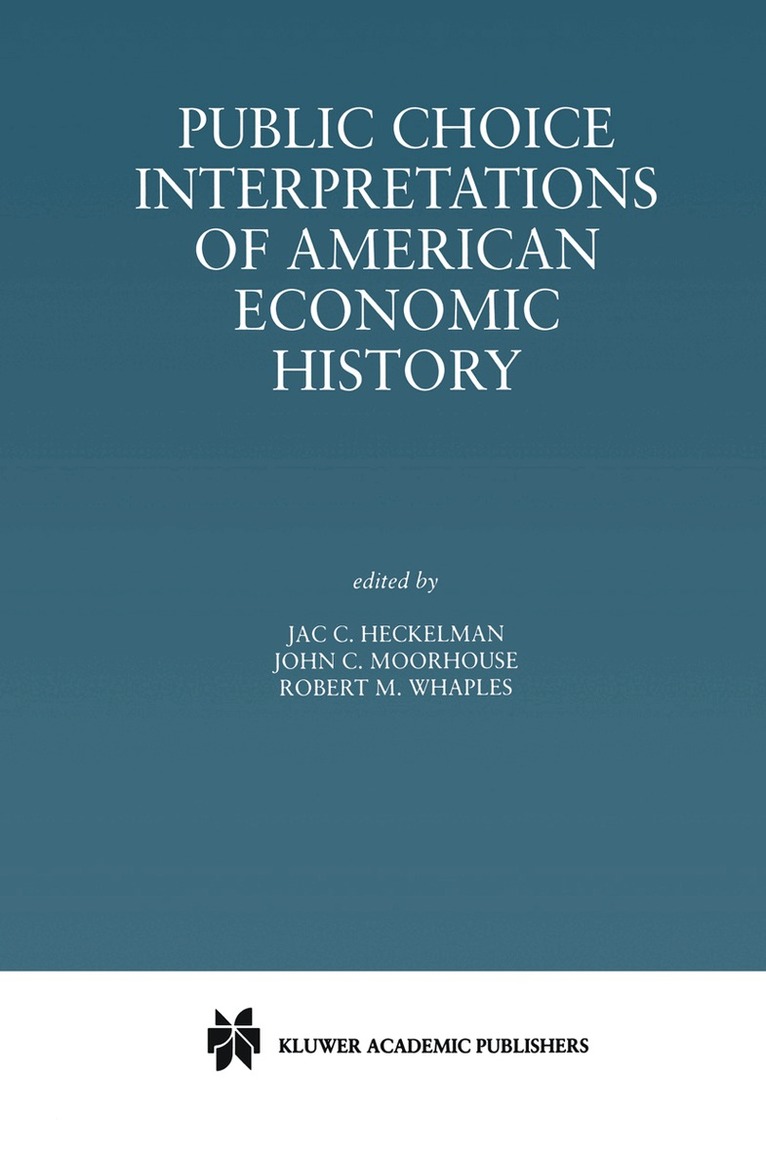
The chapters of this volume apply the tools of public choice theory to the types of questions which economic historians have traditionally addressed. By adding the insights of public choice economists to the traditional tools used to understand economic factors and institutions, the authors are able to provide insights about many important issues of American history. Each contribution analyzes an episode in American economic history within a public choice framework of rational maximization. Agents or interest groups are interpreted as either responding in predictable ways to economic incentives put in play by government policy or attempting to influence government policy.This text includes eight essays that examine: why states contributed to the national government under the Articles of Confederation; the major 19th century transitions in the source of state revenues away from fees and investments and toward the property tax, and from state to local government funding of infrastructure; three economic failures from the American West in the late 19th and early 20th century: overgrazing of the northern plains, despoliation of the Yellowstone Basin, and low productivity of Indian communal lands; the impact on trusts of state-level anti-trust activities and the passage of the Sherman Antitrust Act; the economic and political determinants of state-level WPA spending by the federal government during the New Deal; why New Deal agricultural policies under the AAA were politically successful, while industrial policies under the NRA were scrapped; the interaction between Fed policies and banks' decisions about membership in the Federal Reserve System in the period 1921-79; the influence of diversity among voters on states' decisions about how to regulate alcohol consumption in the decades after the end of prohibition.
1 064 kr
Skickas inom 10-15 vardagar
Jac C. Heckelman, John C. Moorhouse and Robert Whaples The eight chapters of this volume are revised versions of papers originally presented at the "Applications of Public Choice Theory to Economic History" conference held at Wake Forest University, April 9-10, 1999. They all apply the tools of public choice theory to the types of questions which economic historians have traditionally addressed. By adding the insights of public choice economics to the traditional tools used to understand economic actors and institutions, the authors are able to provide fresh insights about many important issues of American history. 1. DEVELOPMENTS IN PUBLIC CHOICE THEORY Economists have historically sought to develop policies to improve social welfare by correcting perceived market failures due to monopoly power, externalities, and other departures from the textbook case of the purely competitive model. An underlying assumption is that the public sector, upon recognizing the market failure, will act to correct it. Applied work often develops the conditions under which these policies will be optimal. The public choice movement has questioned the false dichotomy established by welfare economists. Economists of all persuasions assume traditional private market actors, such as entrepreneurs, managers, and consumers, are self-interested rational maximizers. Why should this not hold for all economic agents? The innovation of public choice analysis is to show what happens when public sector actors, such as politicians, bureaucrats, and voters, also behave as rational self-interested maximizers.