John D. Lee – författare
Visar alla böcker från författaren John D. Lee. Handla med fri frakt och snabb leverans.
15 produkter
15 produkter
Inbunden, Engelska, 2013
2 863 kr
Skickas inom 7-10 vardagar
Cognitive engineering is an interdisciplinary approach to the analysis, modeling, and design of engineered systems or workplaces in which humans and technologies jointly operate to achieve system goals. As individuals, teams, and organizations become increasingly reliant on information technology and automation, it is more important than ever for system and workplace design to be maximally informed by state-of-the-art cognitive engineering research.This volume is the first authoritative handbook to cover this recent and rapidly growing field. The handbook collects and organizes contemporary cognitive engineering research, drawing on the original research of more than 60 contributing experts. Coverage of human factors, human-computer interaction, and the conceptual foundations of cognitive engineering is extensive, addressing not only cognitive engineering in broader organizations and communities, but also focusing on individual cognition, addressing topics of attention, decision making, and multi-tasking. This thorough approach speaks to the broad scope of cognitive engineering, spanning the individual operator to teams and organizations, with a focus on how systems of people and technology, often in the form of automation, influences performance.By collecting the best of cognitive engineering research in one volume, this book serves as both a convenient reference guide and as a useful entry point to the large and diverse research literature. As such, this handbook will be a valuable resource for researchers, students, and practitioners in cognitive engineering and a variety of related fields in need of guidance for how to put their products, systems, and services into the hands of human users, performers, and customers.
Inbunden, Engelska, 2008
2 359 kr
Skickas inom 10-15 vardagar
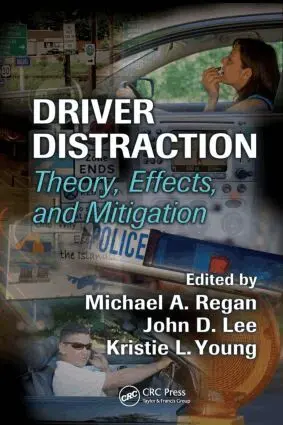
A Practical Resource for Understanding, Preventing, and Managing Driver Distraction It is estimated that up to 23 percent of crashes and near-crashes are caused by driver distraction, and these figures will likely increase as more and more distractions, both inside and outside the vehicle, compete for driver attention. Driver Distraction: Theory, Effects, and Mitigation gives a comprehensive overview of this issue, outlining the underlying theory of distraction, its effects on driving performance and safety, strategies for mitigating its effects, and directions for future research. It also brings together the wide array of literature on the topic into one, all-inclusive volume. Includes Recommendations for Managing Distractions in the Technological AgeThis comprehensive volume reviews the full range of distracting activities that occur while driving, and available ergonomic methods, guidelines, and checklists for the measurement and mitigation of driver distraction. It also recommends ways to manage distraction through enhanced data collection and analysis, driver education and training, driver licensing, legislation and enforcement, vehicle design, road design, company policies, and future research. Beneficial for a broad audience, including: Vehicle manufacturers Road transport authorities and safety agencies Traffic and transport engineers Automotive equipment manufacturers and suppliers Company safety managers Standards organizations Transport safety research agenciesThis work comes at a critical time when road safety authorities are just beginning to recognize the importance of driver distraction as a road safety issue. With balanced and practical guidance, it aims to prevent driver distraction from escalating into an even more significant problem.
Inbunden, Engelska, 2022
440 kr
Skickas inom 5-8 vardagar
Häftad, Engelska, 2022
313 kr
Skickas inom 5-8 vardagar
Inbunden, Engelska, 2020
2 428 kr
Skickas inom 10-15 vardagar
Handbook of Human Factors for Automated, Connected, and Intelligent VehiclesSubject Guide: Ergonomics & Human Factors Automobile crashes are the seventh leading cause of death worldwide, resulting in over 1.25 million deaths yearly. Automated, connected, and intelligent vehicles have the potential to reduce crashes significantly, while also reducing congestion, carbon emissions, and increasing accessibility. However, the transition could take decades. This new handbook serves a diverse community of stakeholders, including human factors researchers, transportation engineers, regulatory agencies, automobile manufacturers, fleet operators, driving instructors, vulnerable road users, and special populations. It provides information about the human driver, other road users, and human–automation interaction in a single, integrated compendium in order to ensure that automated, connected, and intelligent vehicles reach their full potential.Features Addresses four major transportation challenges—crashes, congestion, carbon emissions, and accessibility—from a human factors perspective Discusses the role of the human operator relevant to the design, regulation, and evaluation of automated, connected, and intelligent vehicles Offers a broad treatment of the critical issues and technological advances for the designing of transportation systems with the driver in mind Presents an understanding of the human factors issues that are central to the public acceptance of these automated, connected, and intelligent vehicles Leverages lessons from other domains in understanding human interactions with automation Sets the stage for future research by defining the space of unexplored questions
Häftad, Engelska, 2017
1 161 kr
Skickas inom 10-15 vardagar
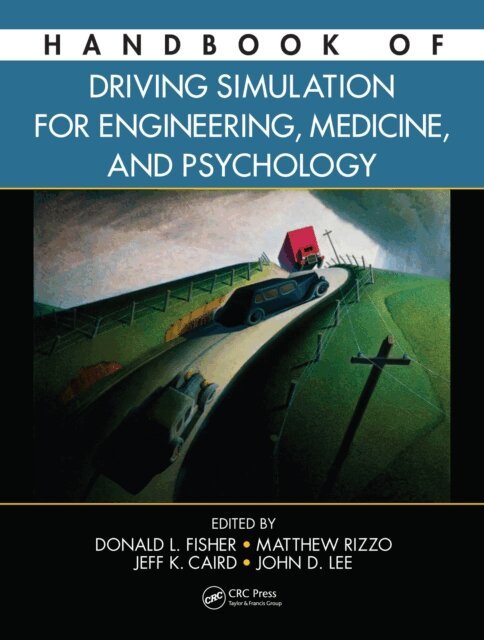
Effective use of driving simulators requires considerable technical and methodological skill along with considerable background knowledge. Acquiring the requisite knowledge and skills can be extraordinarily time consuming, yet there has been no single convenient and comprehensive source of information on the driving simulation research being conducted around the world. A how-to-do-it resource for researchers and professionals, Handbook of Driving Simulation for Engineering, Medicine, and Psychology brings together discussions of technical issues in driving simulation with broad areas in which driving simulation is now playing a role. The chapters explore technical considerations, methodological issues, special and impaired populations, evaluation of in-vehicle and nomadic devices, and infrastructure evaluations. It examines hardware and software selection, visual database and scenario development, independent subject variables and dependent vehicle, environmental, and psychological variables, statistical and biostatistical analysis, different types of drivers, existing and future key-in vehicle devises, and validation of research.A compilation of the research from more than 100 of the world's top thinkers and practitioners, the book covers basic and advanced technical topics and provides a comprehensive review of the issues related to driving simulation. It describes literally hundreds of different simulation scenarios, provides color photographs of those scenarios, and makes available select videos of the scenarios on an accompanying web site, all of which should prove essential for seasoned researchers and for individuals new to driving simulation.
Häftad, Engelska, 2017
851 kr
Skickas inom 10-15 vardagar
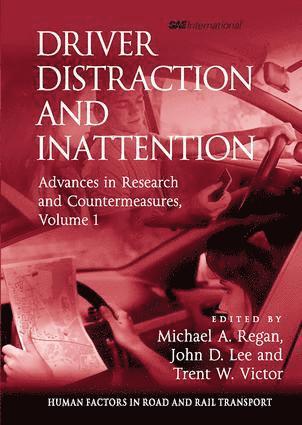
It is estimated that, in the United States, around 20 percent of all Police-reported road crashes involve driver distraction as a contributing factor. This figure increases if other forms of inattention are considered. Evidence (reviewed in this volume) suggests that the situation is similar in other countries and that driver distraction and inattention are even more dangerous as contributing factors in crashes than drug and alcohol intoxication. Having a solid evidence-base from which to develop injury countermeasures is a cornerstone of road-safety management. This book adds to the accumulating evidence-base on driver distraction and inattention. With 24 chapters by 52 authors from more than 10 countries, it provides important new perspectives on the definition and meaning of driver distraction and inattention, the mechanisms that characterize them, the measurement of their effects, strategies for mitigating their effects, and recommendations for further research. The goal of this book is to inspire further research and countermeasure development to prevent and mitigate the potentially adverse effects of driver distraction and driver inattention, and, in doing so, to save lives.
Inbunden, Engelska, 2018
431 kr
Skickas inom 5-8 vardagar
Häftad, Engelska, 2018
216 kr
Skickas inom 5-8 vardagar
Inbunden, Engelska, 2013
2 359 kr
Skickas inom 10-15 vardagar
It is estimated that, in the United States, around 20 percent of all Police-reported road crashes involve driver distraction as a contributing factor. This figure increases if other forms of inattention are considered. Evidence (reviewed in this volume) suggests that the situation is similar in other countries and that driver distraction and inattention are even more dangerous as contributing factors in crashes than drug and alcohol intoxication. Having a solid evidence-base from which to develop injury countermeasures is a cornerstone of road-safety management. This book adds to the accumulating evidence-base on driver distraction and inattention. With 24 chapters by 52 authors from more than 10 countries, it provides important new perspectives on the definition and meaning of driver distraction and inattention, the mechanisms that characterize them, the measurement of their effects, strategies for mitigating their effects, and recommendations for further research. The goal of this book is to inspire further research and countermeasure development to prevent and mitigate the potentially adverse effects of driver distraction and driver inattention, and, in doing so, to save lives.
Inbunden, Engelska, 2011
3 355 kr
Skickas inom 10-15 vardagar
Effective use of driving simulators requires considerable technical and methodological skill along with considerable background knowledge. Acquiring the requisite knowledge and skills can be extraordinarily time consuming, yet there has been no single convenient and comprehensive source of information on the driving simulation research being conducted around the world. A how-to-do-it resource for researchers and professionals, Handbook of Driving Simulation for Engineering, Medicine, and Psychology brings together discussions of technical issues in driving simulation with broad areas in which driving simulation is now playing a role. The chapters explore technical considerations, methodological issues, special and impaired populations, evaluation of in-vehicle and nomadic devices, and infrastructure evaluations. It examines hardware and software selection, visual database and scenario development, independent subject variables and dependent vehicle, environmental, and psychological variables, statistical and biostatistical analysis, different types of drivers, existing and future key-in vehicle devises, and validation of research.A compilation of the research from more than 100 of the world's top thinkers and practitioners, the book covers basic and advanced technical topics and provides a comprehensive review of the issues related to driving simulation. It describes literally hundreds of different simulation scenarios, provides color photographs of those scenarios, and makes available select videos of the scenarios on an accompanying web site, all of which should prove essential for seasoned researchers and for individuals new to driving simulation.
Inbunden, Engelska, 2015
2 224 kr
Skickas inom 5-8 vardagar
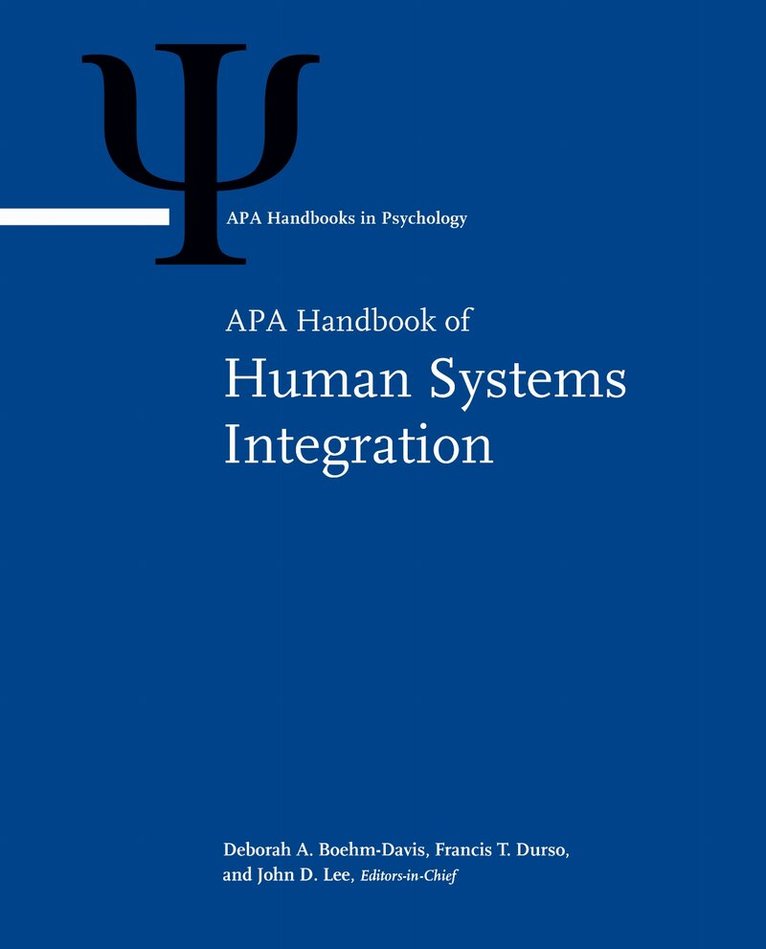
The APA Handbook of Human Systems Integration is a practical tool for both students and professionals who need specific knowledge about human considerations in systems design. It is intended to sensitize readers to basic design issues, enhance their understanding of the influence of these issues, and guide them in appropriately combining human performance with a system's numerous interacting components. A central tenet of this book is that it is not sufficient to examine items independently - one must go beyond a focus on individual workers, tools, tasks, or environments. Thus, the handbook is a amp quot how to amp quot resource that reflects the state-of-the-art on work in this enterprise. The book's opening chapters define what is meant by human systems integration, provide a historical overview of the field, and describe a set of case studies to which many chapter authors apply their expertise. Succeeding chapters reflect on the physical, physiological, perceptual, cognitive, and organizational considerations that affect human systems performance and discuss how the knowledge base of the field has been applied in various domains. The remaining chapters describe the trade-offs associated with integrating individual considerations and systems performance, discussing how a decision that optimizes performance in one area (e.g., display design) may entail a reduction of performance in another area (e.g., staffing or personnel selection).
Häftad, Engelska, 1876
207 kr
Skickas inom 5-8 vardagar
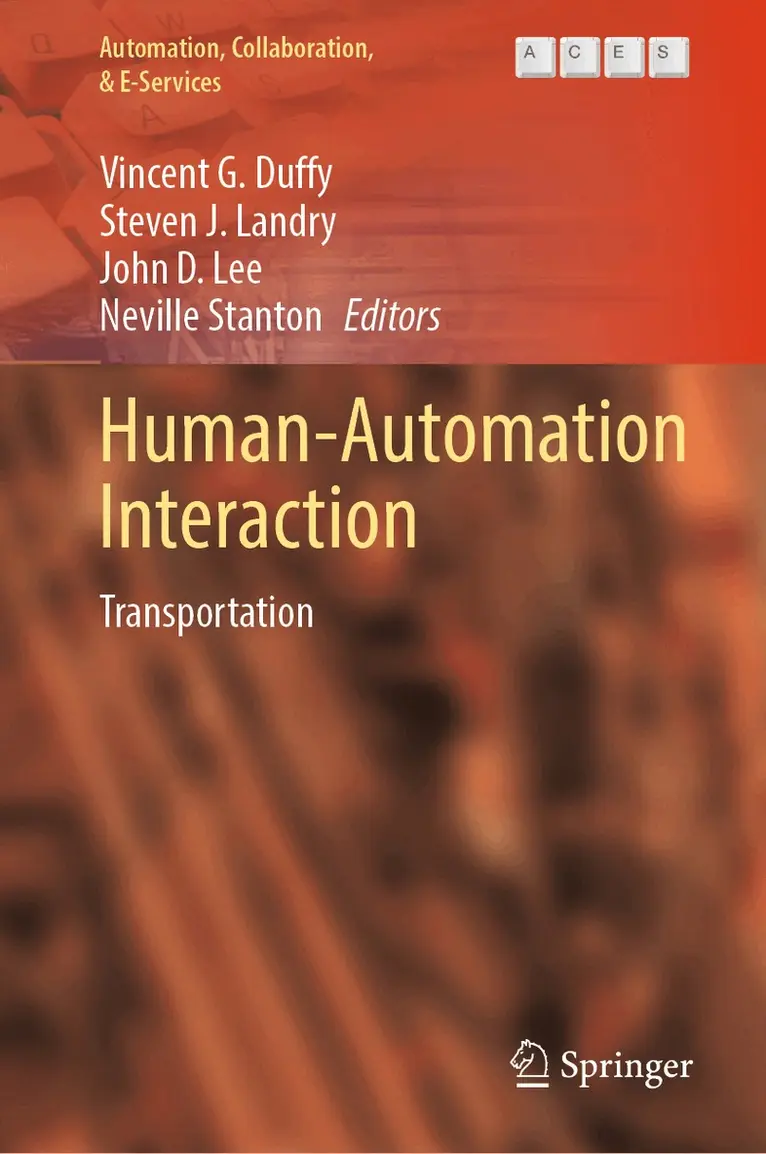
Del 11 - Automation, Collaboration, & E-Services
Human-Automation Interaction
Transportation
Inbunden, Engelska, 2022
1 834 kr
Skickas inom 10-15 vardagar
This book provides practical guidance and awareness for a growing body of knowledge developing across a variety of disciplines. Main areas of coverage include Section A: Interaction with Vehicle Automation;
Del 11 - Automation, Collaboration, & E-Services
Human-Automation Interaction
Transportation
Häftad, Engelska, 2023
1 834 kr
Skickas inom 10-15 vardagar
This book provides practical guidance and awareness for a growing body of knowledge developing across a variety of disciplines. Main areas of coverage include Section A: Interaction with Vehicle Automation;