
John J. Leonard – författare
Visar alla böcker från författaren John J. Leonard. Handla med fri frakt och snabb leverans.
2 produkter
2 produkter
1 589 kr
Skickas inom 10-15 vardagar
While many mobile robots come equipped with ultrasonic range sensing (sonar), accurate map building and position estimation using sonar has been elusive because of the difficulty in interpreting sonar data correctly. This book presents evidence that sonar can in fact fulfil the perception role for the provision of long-term autonomous navigation in a broad class of man-made environments. A new approach to mobile robot navigation is presented that unifies the problems of localization, obstacle detection and map building in a combined multi-target tracking framework. The primary tools of this approach are the Kalman filter and a physically based sonar sensing model. Experimental results with real sonar data demonstrate model-based localization using an a-priori hand-measured map and sub-centimetre accuracy map building for an uncluttered office scene. This book shoud be of particular interest to researchers on mobile robotics, especially potential users of sonar.The approach has greater significance, however, as the issues involved - the choice of representation, the problem of data association and the pursuit of long-tem autonomy - are central to many outstanding problems in robotics and artificial intelligence.
Del 175 - Springer International Series in Engineering and Computer Science
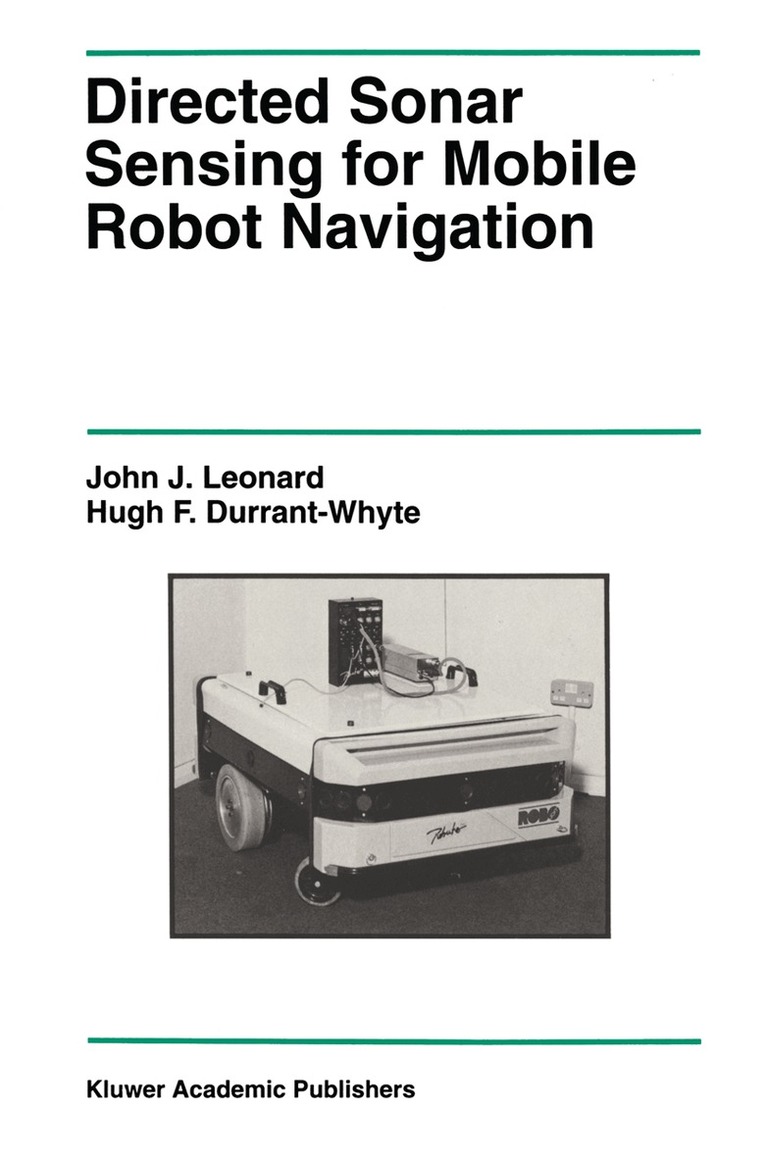
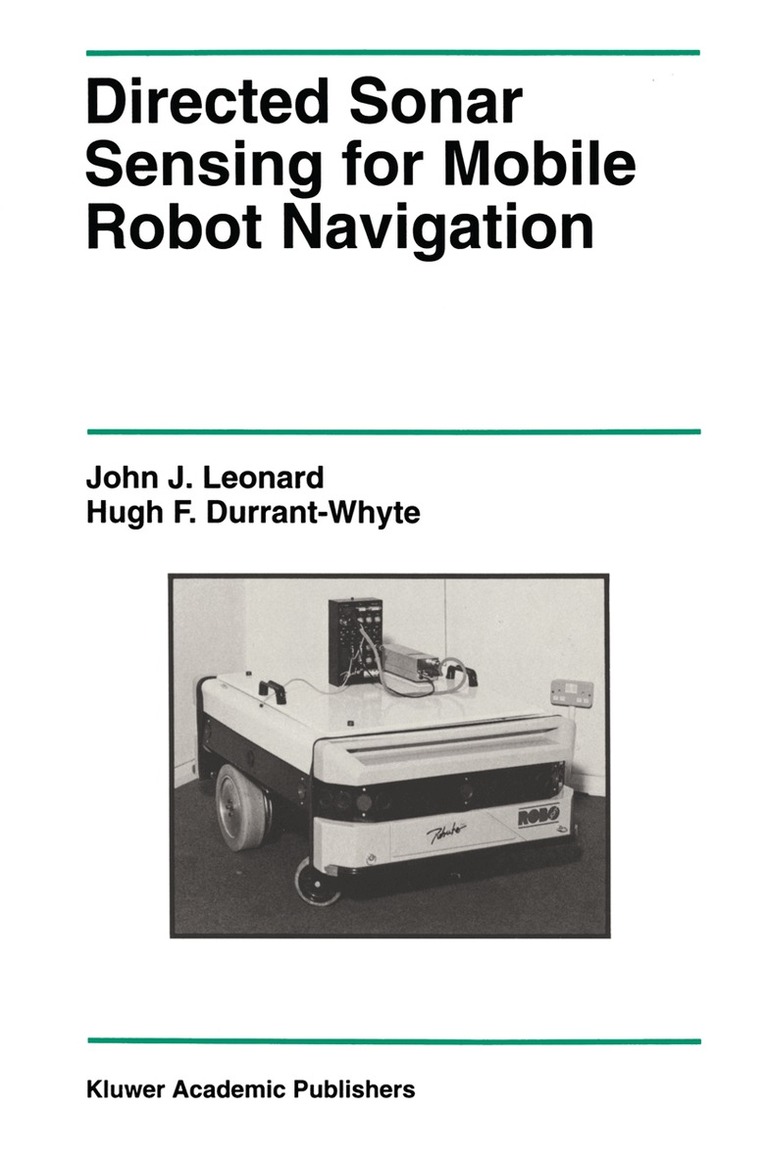
Directed Sonar Sensing for Mobile Robot Navigation
Häftad, Engelska, 2012
1 589 kr
Skickas inom 10-15 vardagar
This monograph is a revised version of the D.Phil. thesis of the first author, submitted in October 1990 to the University of Oxford. This work investigates the problem of mobile robot navigation using sonar. We view model-based navigation as a process of tracking naturally occurring environment features, which we refer to as "targets". Targets that have been predicted from the environment map are tracked to provide that are observed, but not predicted, vehicle position estimates. Targets represent unknown environment features or obstacles, and cause new tracks to be initiated, classified, and ultimately integrated into the map. Chapter 1 presents a brief definition of the problem and a discussion of the basic research issues involved. No attempt is made to survey ex haustively the mobile robot navigation literature-the reader is strongly encouraged to consult other sources. The recent collection edited by Cox and Wilfong [34] is an excellent starting point, as it contains many of the standard works of the field. Also, we assume familiarity with the Kalman filter. There are many well-known texts on the subject; our notation derives from Bar-Shalom and Fortmann [7]. Chapter 2 provides a detailed sonar sensor model. A good sensor model of our approach to navigation, and is used both for is a crucial component predicting expected observations and classifying unexpected observations.