John Leigh - Böcker
Visar alla böcker från författaren John Leigh. Handla med fri frakt och snabb leverans.
11 produkter
11 produkter
1 626 kr
Skickas inom 10-15 vardagar
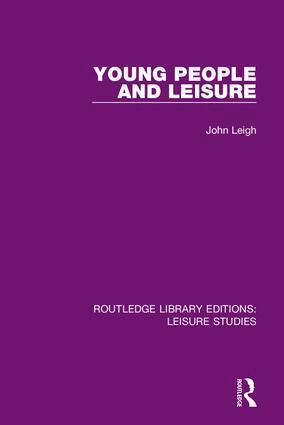
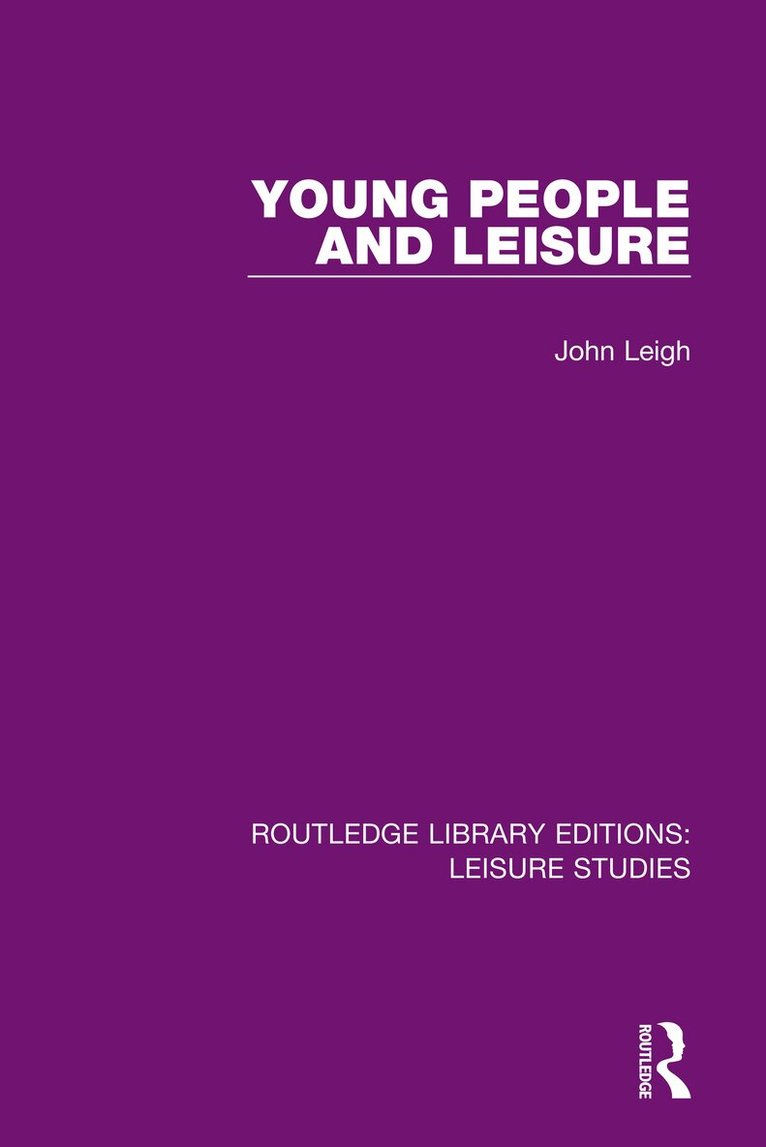
First published in 1971. The purpose of this study is to examine the relationship which exists between the education services and the leisure time of the people they attempt to serve. The author explores education and provision for leisure and the problems of schools, youth services and adult education in relation to this. The case study of the leisure lives of young adults in a small industrial village provides some illustration of the difficulties of providing for leisure in non-urban areas. This title will be of great interest to policy-makers and to students of Sociology and Leisure Studies.
484 kr
Skickas inom 10-15 vardagar
First published in 1971. The purpose of this study is to examine the relationship which exists between the education services and the leisure time of the people they attempt to serve. The author explores education and provision for leisure and the problems of schools, youth services and adult education in relation to this. The case study of the leisure lives of young adults in a small industrial village provides some illustration of the difficulties of providing for leisure in non-urban areas. This title will be of great interest to policy-makers and to students of Sociology and Leisure Studies.
456 kr
Skickas inom 10-15 vardagar
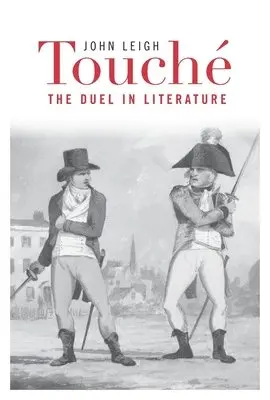
The monarchs of seventeenth-century Europe put a surprisingly high priority on the abolition of dueling, seeing its eradication as an important step from barbarism toward a rational state monopoly on justice. But it was one thing to ban dueling and another to stop it. Duelists continued to kill each other with swords or pistols in significant numbers deep into the nineteenth century. In 1883 Maupassant called dueling “the last of our unreasonable customs.” As a dramatic and forbidden ritual from another age, the duel retained a powerful hold on the public mind and, in particular, the literary imagination.Many of the greatest names in Western literature wrote about or even fought in duels, among them Corneille, Molière, Richardson, Rousseau, Pushkin, Dickens, Hugo, Dumas, Twain, Conrad, Chekhov, and Mann. As John Leigh explains, the duel was a gift as a plot device. But writers also sought to discover in duels something more fundamental about human conflict and how we face our fears of humiliation, pain, and death. The duel was, for some, a social cause, a scourge to be mocked or lamented; yet even its critics could be seduced by its risk and glamour. Some conservatives defended dueling by arguing that the man of noble bearing who cared less about living than living with honor was everything that the contemporary bourgeois was not. The literary history of the duel, as Touché makes clear, illuminates the tensions that attended the birth of the modern world.
1 457 kr
Skickas inom 7-10 vardagar
53 632 kr
Skickas inom 7-10 vardagar
1 779 kr
Skickas inom 7-10 vardagar
It was not only in his histories that Voltaire thought, worried and wrote about history. In fact, many of Voltaire’s most provocative and tantalising remarks on history lie outside the province of the so-called Œuvres historiques, in the vast expanses of his complete works, and historical events and historical figures elicit some of his most imaginative writing. Voltaire’s propensity to write about history in works that are not histories sheds new light on his historiographical thought and temper. The historian that emerges from these pages is, by turns, a feverish, bed-ridden man haunted by the St Bartholomew massacre (an overwhelming preoccupation of Voltaire’s, although it receives only cursory attention in the prose histories) an inspired poet mythologising Henri IV’s epic adventures, a bawdy satirist amused by Joan of Arc, a raconteur nourished by historical anecdotes, even a doting uncle winking at his niece as he elaborates a philosophy of history. In all these forms and at all these times, an interest in history is integral and abiding. Far from being marginal or oblique, these works yield important insights into a pervasive Voltairean sense of history which finds in these different forms both the freedoms and the traditions – and indeed often the readers – denied to the Œuvres historiques. Moreover, innovative works like the Henriade and Candide, which fall into this category, prove as influential to historians as Voltaire’s recognised histories. Voltaire’s prodigious energy and versatility in fields other than history have probably harmed his reputation as a historian when, already in the eighteenth century, historians were increasingly expected to be specialists. This study shows that Voltaire’s historiographical thought ranges across areas and texts artificially sundered by subsequent editorial compartmentalisations, and it reveals a restlessly complex, inventive writer confronting history in numerous different guises.
158 kr
Tillfälligt slut
In his Philosophical Letters, Voltaire provides a pungent and often satirical assessment of the religion, politics, science, and arts of the England he observed during his nearly three-year exile. In addition to the Letters, this edition provides a translation of Voltaire's Proposal for a Letter about the English, a general Introduction, chronology, notes, and bibliography.
601 kr
Skickas inom 11-20 vardagar
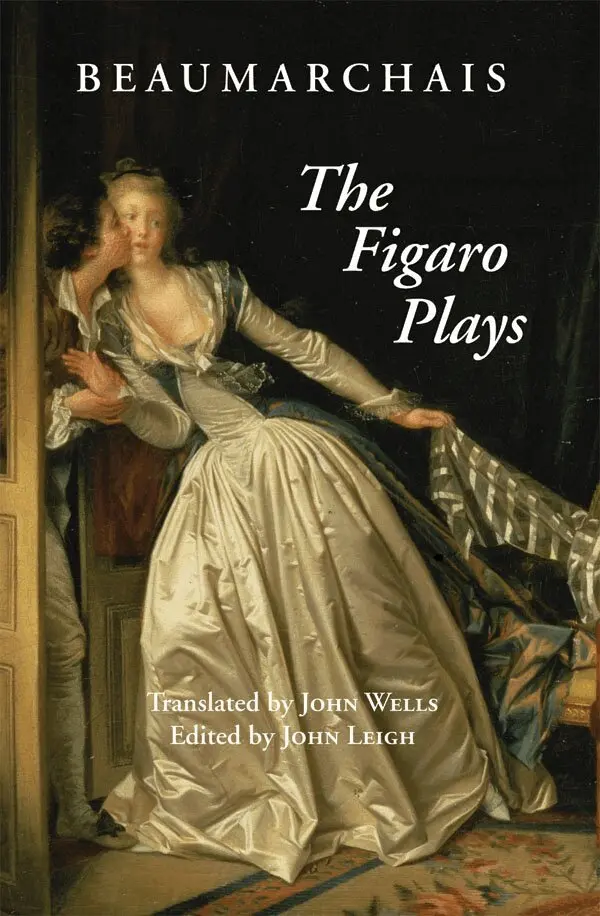
[Beaumarchais'] fame rests on Le Barbier de Seville (1775) and Le Mariage de Figaro (1784), the only French plays which his stage-struck century bequeathed to the international repertoire. But his achievement has been adulterated, for ‘Beaumarchais’ has long been the brand name of a product variously reprocessed by Mozart, Rossini, and the score or so librettists and musicians who have perpetuated his plots, his characters, and his name. The most intriguing question of all has centered on his role as catalyst of the Revolution. Was his impertinent barber the Sweeney Todd of the Ancien Régime, the true begetter of the guillotine? . . . Beaumarchais' plays have often seemed to need the same kind of shoring up as his reputation, as though they couldn't stand on their own without a scaffolding of good tunes. Yet, as John Wells' lively and splendidly speakable translations of the Barber, the Marriage, and A Mother's Guilt demonstrate, they need assistance from no one. [Beaumarchais] thought of the three plays as a trilogy. Taken together, they reflect, as John Leigh’s commentaries make clear, the Ancien Régime’s unstoppable slide into revolution. --David Coward in The London Review of Books
168 kr
Tillfälligt slut
460 kr
Skickas inom 5-8 vardagar
757 kr
Skickas inom 5-8 vardagar