John Maxwell Hamilton - Böcker
Visar alla böcker från författaren John Maxwell Hamilton. Handla med fri frakt och snabb leverans.
8 produkter
8 produkter
310 kr
Tillfälligt slut
From Pigeons to News Portals
Foreign Reporting and the Challenge of New Technology
Häftad, Engelska, 2007
475 kr
Skickas inom 3-6 vardagar
Ever since the invention of the telegraph, journalists have sought to remove the barriers of time and space. Today, we readily accept that reporters can jet quickly to a distant location and broadcast instantly from a satellite-connected, video-enabled cell phone hanging from their belts. But now that live news coverage is possible from virtually anywhere, is foreign correspondence better? And what are the implications of recent changes in journalistic technology for policy makers and their constituents? In From Pigeons to News Portals, edited by David D. Perlmutter and John Maxwell Hamilton, scholars and journalists survey, probe, and demystify the new foreign correspondence that has emerged from rapidly changing media technology. These distinguished authors challenge long-held beliefs about foreign news coverage, not the least of which is whether, in our interconnected world, such a thing as ""foreign news"" even exists anymore. Essays explore the ways people have used new media technology - from satellites and cell phones to the Internet - to affect content, delivery modes, and amount and style of coverage. They examine the ways in which speedy reporting conflicts with in-depth reporting, the pros and cons of ""parachute"" journalism, the declining dominance of mainstream media as a source of foreign news, and the implications of this new foreign correspondence for foreign policy. Entertainment media such as film, television, and video gaming form worldwide opinions about America, often in negative ways. Meanwhile, live reporting abroad is both a blessing and curse for foreign policy makers. Because foreign news is so vital to effective policy making and citizenship, we imperil our future by failing to understand the changes technology brings and how we can wrest the best practice out of those changes. This provocative volume offers valuable insights and analyses to help us better understand the evolving state of foreign news.
549 kr
Skickas inom 7-10 vardagar
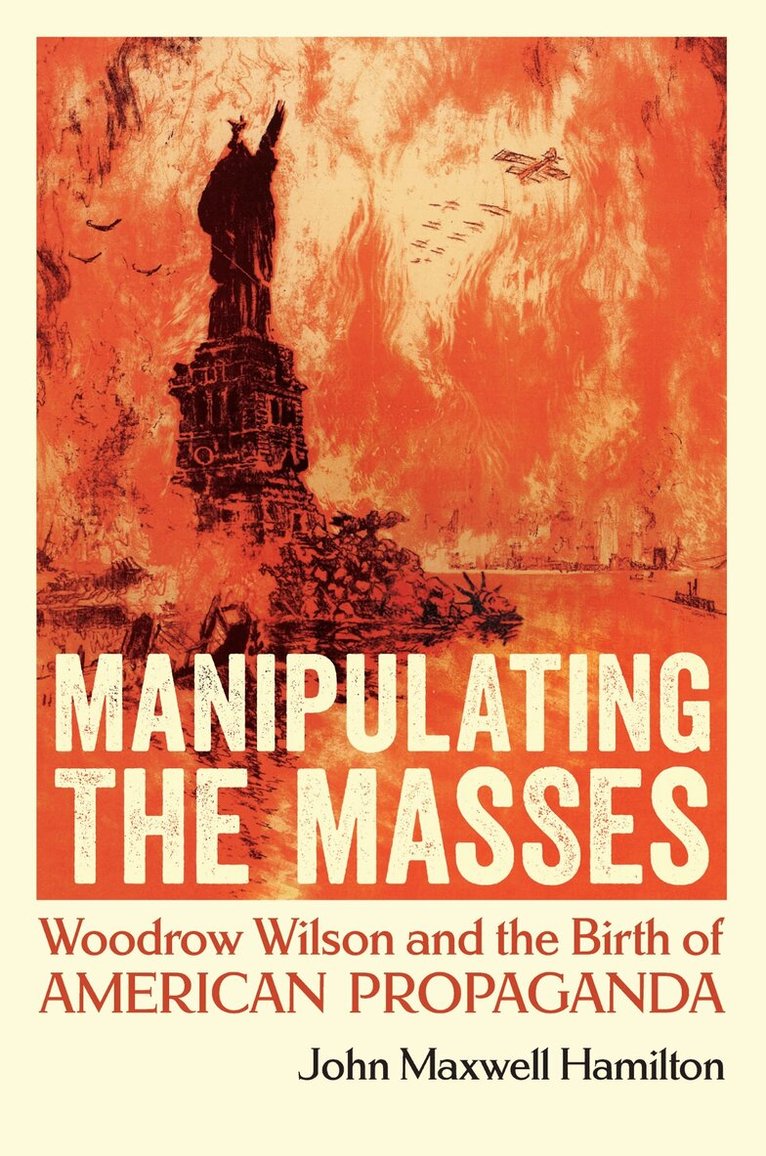
Manipulating the Masses tells the story of the enduring threat to American democracy that arose out of World War I: the establishment of pervasive, systematic propaganda as an instrument of the state. During the Great War, the federal government exercised unprecedented power to shape the views and attitudes of American citizens. Its agent for this was the Committee on Public Information (CPI), established by President Woodrow Wilson one week after the United States entered the war in April 1917.Driven by its fiery chief, George Creel, the CPI reached every crevice of the nation, every day, and extended widely abroad. It established the first national newspaper, made prepackaged news a quotidian aspect of governing, and pioneered the concept of public diplomacy. It spread the Wilson administration's messages through articles, cartoons, books, and advertisements in newspapers and magazines; through feature films and volunteer Four Minute Men who spoke during intermission; through posters plastered on buildings and along highways; and through pamphlets distributed by the millions. It enlisted the nation's leading progressive journalists, advertising executives, and artists. It harnessed American universities and their professors to create propaganda and add legitimacy to its mission.Even as Creel insisted that the CPI was a conduit for reliable, fact-based information, the office regularly sanitized news, distorted facts, and played on emotions. Creel extolled transparency but established front organizations. Overseas, the CPI secretly subsidized news organs and bribed journalists. At home, it challenged the loyalty of those who occasionally questioned its tactics. Working closely with federal intelligence agencies eager to sniff out subversives and stifle dissent, the CPI was an accomplice to the Wilson administration's trampling of civil liberties.Until now, the full story of the CPI has never been told. John Maxwell Hamilton consulted over 150 archival collections in the United States and Europe to write this revealing history, which shows the shortcuts to open, honest debate that even well-meaning propagandists take to bend others to their views. Every element of contemporary government propaganda has antecedents in the CPI. It is the ideal vehicle for understanding the rise of propaganda, its methods of operation, and the threat it poses to democracy.
Herbert Corey's Great War
A Memoir of World War I by the American Reporter Who Saw It All
Inbunden, Engelska, 2022
461 kr
Skickas inom 10-15 vardagar
In 1914, the Associated Newspapers sent correspondent Herbert Corey to Europe on the day Great Britain declared war on Germany. During the Great War that followed, Corey reported from France, Britain, and Germany, visiting the German lines on both the western and eastern fronts. He also reported from Greece, Italy, Switzerland, Holland, Belgium, and Serbia. When the Armistice was signed in November 1918, Corey defied the rules of the American Expeditionary Forces and crossed into Germany. He covered the Paris Peace Conference the following year. No other foreign correspondent matched the longevity of his reporting during World War I. Until recently, however, his unpublished memoir lay largely unnoticed among his papers in the Library of Congress.With publication of Herbert Corey's Great War, coeditors Peter Finn and John Maxwell Hamilton reestablish Corey's name in the annals of American war reporting. As a correspondent, he defies easy comparison. He approximates Ernie Pyle in his sympathetic interest in the American foot soldier, but he also told stories about troops on the other side and about noncombatants. He is especially illuminating on the obstacles reporters faced in conveying the story of the Great War to Americans. As his memoir makes clear, Corey didn't believe he was in Europe to serve the Allies. He viewed himself as an outsider, one who was deeply ambivalent about the entry of the United States into the war. His idiosyncratic, opinionated, and very American voice makes for compelling reading.
Herbert Corey's Great War
A Memoir of World War I by the American Reporter Who Saw It All
Häftad, Engelska, 2022
333 kr
Skickas inom 10-15 vardagar
In 1914, the Associated Newspapers sent correspondent Herbert Corey to Europe on the day Great Britain declared war on Germany. During the Great War that followed, Corey reported from France, Britain, and Germany, visiting the German lines on both the western and eastern fronts. He also reported from Greece, Italy, Switzerland, Holland, Belgium, and Serbia. When the Armistice was signed in November 1918, Corey defied the rules of the American Expeditionary Forces and crossed into Germany. He covered the Paris Peace Conference the following year. No other foreign correspondent matched the longevity of his reporting during World War I. Until recently, however, his unpublished memoir lay largely unnoticed among his papers in the Library of Congress.With publication of Herbert Corey's Great War, coeditors Peter Finn and John Maxwell Hamilton reestablish Corey's name in the annals of American war reporting. As a correspondent, he defies easy comparison. He approximates Ernie Pyle in his sympathetic interest in the American foot soldier, but he also told stories about troops on the other side and about noncombatants. He is especially illuminating on the obstacles reporters faced in conveying the story of the Great War to Americans. As his memoir makes clear, Corey didn't believe he was in Europe to serve the Allies. He viewed himself as an outsider, one who was deeply ambivalent about the entry of the United States into the war. His idiosyncratic, opinionated, and very American voice makes for compelling reading.
432 kr
Skickas inom 3-6 vardagar
Winner of the Goldsmith Book Prize by the Harvard Shorenstein Center on Media, Politics and Public PolicyManipulating the Masses tells the story of the enduring threat to American democracy that arose out of World War I: the establishment of pervasive, systematic propaganda as an instrument of the state. During the Great War, the federal government exercised unprecedented power to shape the views and attitudes of American citizens. Its agent for this was the Committee on Public Information (CPI), established by President Woodrow Wilson one week after the United States entered the war in April 1917.Driven by its fiery chief, George Creel, the CPI reached every crevice of the nation, every day, and extended widely abroad. It established the first national newspaper, made prepackaged news a quotidian aspect of governing, and pioneered the concept of public diplomacy. It spread the Wilson administration's messages through articles, cartoons, books, and advertisements in newspapers and magazines; through feature films and volunteer Four Minute Men who spoke during intermission; through posters plastered on buildings and along highways; and through pamphlets distributed by the millions. It enlisted the nation's leading progressive journalists, advertising executives, and artists. It harnessed American universities and their professors to create propaganda and add legitimacy to its mission.Even as Creel insisted that the CPI was a conduit for reliable, fact-based information, the office regularly sanitized news, distorted facts, and played on emotions. Creel extolled transparency but established front organizations. Overseas, the CPI secretly subsidized news organs and bribed journalists. At home, it challenged the loyalty of those who occasionally questioned its tactics. Working closely with federal intelligence agencies eager to sniff out subversives and stifle dissent, the CPI was an accomplice to the Wilson administration's trampling of civil liberties.Until now, the full story of the CPI has never been told. John Maxwell Hamilton consulted over 150 archival collections in the United States and Europe to write this revealing history, which shows the shortcuts to open, honest debate that even well-meaning propagandists take to bend others to their views. Every element of contemporary government propaganda has antecedents in the CPI. It is the ideal vehicle for understanding the rise of propaganda, its methods of operation, and the threat it poses to democracy.
278 kr
Skickas inom 7-10 vardagar
In The French 75, John Maxwell Hamilton tracks down the many lives of this protean cocktail. The drink, named by French propagandists during World War I, was said to pack a punch as powerful as that nation's celebrated 75 mm cannon. At the end of the century, the French 75 surfaced at Arnaud's Restaurant and became as entrenched in New Orleans as the famed second line. Hamilton explores the kaleidoscopic variety of the French 75 over the years and across continents.
295 kr
Skickas inom 7-10 vardagar
A lost literary relic of the First World War, Common Cause tells the story of Jeremy Robson, a crusading newspaper editor in the fictional midwestern town of Fenchester. The Guardian’s muckraking has led special interests to withhold advertising in order to drive Robson out of business. But he and local plutocrats put their differences aside when war is declared in 1917 in order to attack the German-American community for its supposed fealty to their Fatherland. Common Cause provides a vivid picture of the America-first fear and hate that gripped the midwestern United States during the Great War.