John Mraz - Böcker
Visar alla böcker från författaren John Mraz. Handla med fri frakt och snabb leverans.
5 produkter
5 produkter
494 kr
Skickas inom 7-10 vardagar
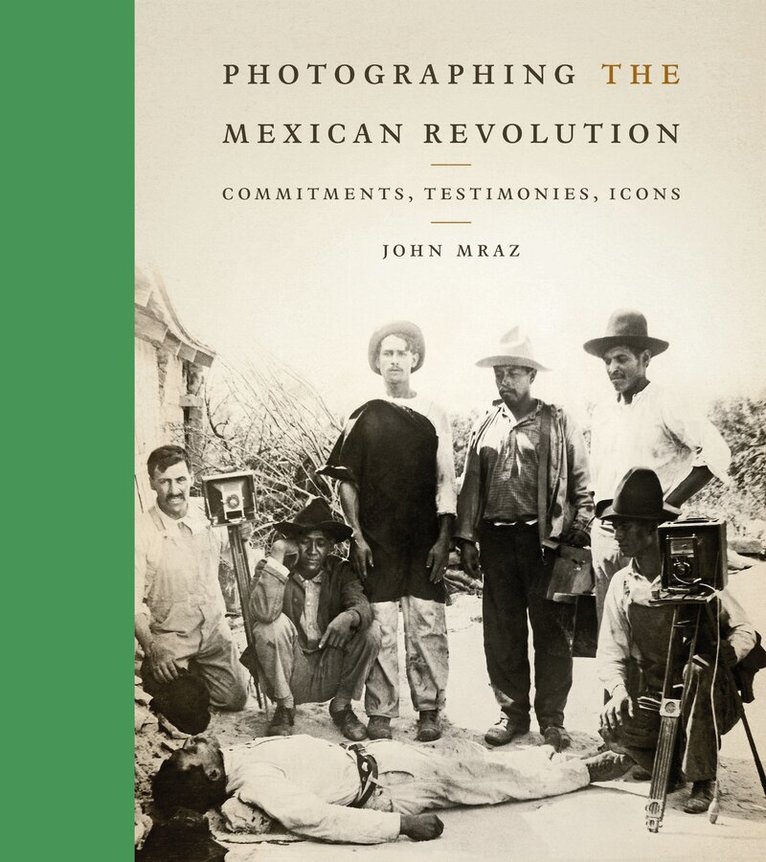
The Mexican Revolution of 1910–1920 is among the world’s most visually documented revolutions. Coinciding with the birth of filmmaking and the increased mobility offered by the reflex camera, it received extraordinary coverage by photographers and cineastes-commercial and amateur, national and international. Many images of the Revolution remain iconic to this day-Francisco Villa galloping toward the camera; Villa lolling in the presidential chair next to Emiliano Zapata; and Zapata standing stolidly in charro raiment with a carbine in one hand and the other hand on a sword, to mention only a few. But the identities of those who created the thousands of extant images of the Mexican Revolution, and what their purposes were, remain a huge puzzle because photographers constantly plagiarized each other’s images.In this pathfinding book, acclaimed photography historian John Mraz carries out a monumental analysis of photographs produced during the Mexican Revolution, focusing primarily on those made by Mexicans, in order to discover who took the images and why, to what ends, with what intentions, and for whom. He explores how photographers expressed their commitments visually, what aesthetic strategies they employed, and which identifications and identities they forged. Mraz demonstrates that, contrary to the myth that AgustÍn VÍctor Casasola was “the photographer of the Revolution,” there were many who covered the long civil war, including women. He shows that specific photographers can even be linked to the contending forces and reveals a pattern of commitment that has been little commented upon in previous studies (and completely unexplored in the photography of other revolutions).
624 kr
Skickas inom 3-6 vardagar
In Looking for Mexico, a leading historian of visual culture, John Mraz, provides a panoramic view of Mexico’s modern visual culture from the U.S. invasion of 1847 to the present. Along the way, he illuminates the powerful role of photographs, films, illustrated magazines, and image-filled history books in the construction of national identity, showing how Mexicans have both made themselves and been made with the webs of significance spun by modern media. Central to Mraz’s book is photography, which was distributed widely throughout Mexico in the form of cartes-de-visite, postcards, and illustrated magazines. Mraz analyzes the work of a broad range of photographers, including Guillermo Kahlo, Winfield Scott, Hugo Brehme, AgustÍn VÍctor Casasola, Tina Modotti, Manuel Álvarez Bravo, HÉctor GarcÍa, Pedro Meyer, and the New Photojournalists. He also examines representations of Mexico’s past in the country’s influential picture histories: popular, large-format, multivolume series replete with thousands of photographs and an assortment of texts.Turning to film, Mraz compares portrayals of the Mexican Revolution by Fernando de Fuentes to the later movies of Emilio FernÁndez and Gabriel Figueroa. He considers major stars of Golden Age cinema as gender archetypes for mexicanidad, juxtaposing the charros (hacienda cowboys) embodied by Pedro Infante, Pedro ArmendÁriz, and Jorge Negrete with the effacing women: the mother, Indian, and shrew as played by Sara GarcÍa, Dolores del RÍo, and MarÍa FÉlix. Mraz also analyzes the leading comedians of the Mexican screen, representations of the 1968 student revolt, and depictions of Frida Kahlo in films made by Paul Leduc and Julie Taymor. Filled with more than fifty illustrations, Looking for Mexico is an exuberant plunge into Mexico’s national identity, its visual culture, and the connections between the two.
609 kr
Skickas inom 3-6 vardagar
In History and Modern Media, John Mraz largely focuses on Mexican photography and his innovative methodology that examines historical photographs by employing the concepts of genre and functions. He developed this method in extensive work on photojournalism; it is here tested through examining two genres: Indianist imagery as an expression of imperial, neo-colonializing and decolonizing photography, and progressive photography as embodied in worker and laborist imagery, as well as feminist and decolonizing visuality.The book interweaves an autobiographical narrative with concrete research. Mraz describes the resistance he encountered in U.S. academia to this new way of showing and describing the past, as well as some illuminating experiences as a visiting professor at several U.S. universities. More importantly, he reflects on what it has meant to move to Mexico and become a Mexican. Mexico is home to a thriving school of photohistorians perhaps unequaled in the world. Some were trained in Art History, and a few continue to pursue that discipline. However, the great majority work from the discipline we have here defined as 'photohistory,' which focuses on vernacular photographs, those made outside of artistic intentions, and which constitute some 98% of all photographic images.A central premise of the book is that knowing past and other cultures is crucial in societies dominated by short-term and parochial thinking, and that today's hyper-audiovisuality requires historians to use modern media to offer their knowledge as alternatives to the 'perpetual present' in which we live.
1 451 kr
Skickas inom 5-8 vardagar
In History and Modern Media, John Mraz largely focuses on Mexican photography and his innovative methodology that examines historical photographs by employing the concepts of genre and functions. He developed this method in extensive work on photojournalism; it is here tested through examining two genres: Indianist imagery as an expression of imperial, neo-colonializing and decolonizing photography, and progressive photography as embodied in worker and laborist imagery, as well as feminist and decolonizing visuality.The book interweaves an autobiographical narrative with concrete research. Mraz describes the resistance he encountered in U.S. academia to this new way of showing and describing the past, as well as some illuminating experiences as a visiting professor at several U.S. universities. More importantly, he reflects on what it has meant to move to Mexico and become a Mexican. Mexico is home to a thriving school of photohistorians perhaps unequaled in the world. Some were trained in Art History, and a few continue to pursue that discipline. However, the great majority work from the discipline we have here defined as 'photohistory,' which focuses on vernacular photographs, those made outside of artistic intentions, and which constitute some 98% of all photographic images.A central premise of the book is that knowing past and other cultures is crucial in societies dominated by short-term and parochial thinking, and that today's hyper-audiovisuality requires historians to use modern media to offer their knowledge as alternatives to the 'perpetual present' in which we live.
1 845 kr
Kommande
An unparalleled in-depth study of Cuban revolutionary cinema.From 1968 to 1976, energized by a postrevolutionary cultural effervescence of which cinema was the prime expression, the Cuban Film Institute made a unique, concerted effort to produce history films and to reflect on the genre. The result was twofold—a number of formally experimental, historically informed, and internationally recognized movies along with an extended discussion among the institute's cineastes about the aesthetics and ideology of their works. In Film and History in Revolutionary Cuba, world-renowned historian of visual culture John Mraz approaches these films from a dual perspective. Mraz sheds light on the context of ebullition that marked cinema of the period while analyzing fictional works such as Memories of Underdevelopment, Lucía, The Other Francisco, and The Last Supper as representations of history in both their form and their content. Such films not only offer important, powerful explorations of the past but are also deeply embedded in the history of that moment.