John Norbury – författare
Visar alla böcker från författaren John Norbury. Handla med fri frakt och snabb leverans.
7 produkter
7 produkter
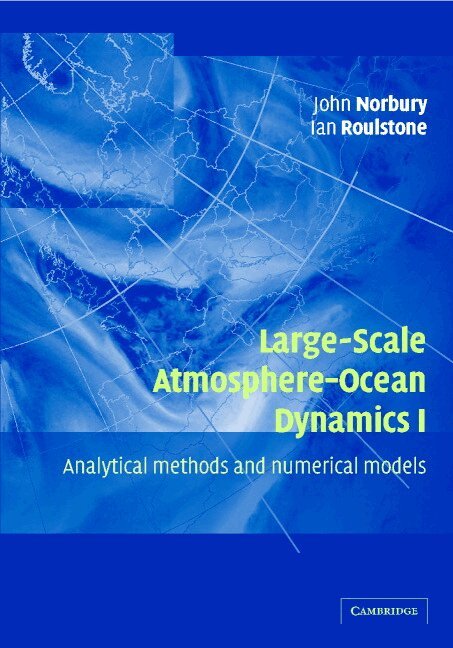
Large-Scale Atmosphere-Ocean Dynamics: Volume 1
Analytical Methods and Numerical Models
Inbunden, Engelska, 2002
1 853 kr
Skickas inom 7-10 vardagar
Numerical weather prediction is a problem of mathematical physics. The complex flows in the atmosphere and oceans are believed to be accurately modelled by the Navier-Stokes equations of fluid mechanics together with classical thermodynamics. However, due to the enormous complexity of these equations, meteorologists and oceanographers have constructed approximate models of the dominant, large-scale flows that control the evolution of weather systems and that describe, for example, the dynamics of cyclones and ocean eddies. The simplifications often result in models that are amenable to solution both analytically and numerically. The lectures in these volumes examine and explain why such simplifications to Newton's second law produce accurate, useful models and, just as the meteorologist seeks patterns in the weather, mathematicians seek structure in the governing equations, such as groups of transformations, Hamiltonian structure and stability. This 2002 book and its companion show how geometry and analysis facilitate solution strategies.
1 853 kr
Skickas inom 7-10 vardagar
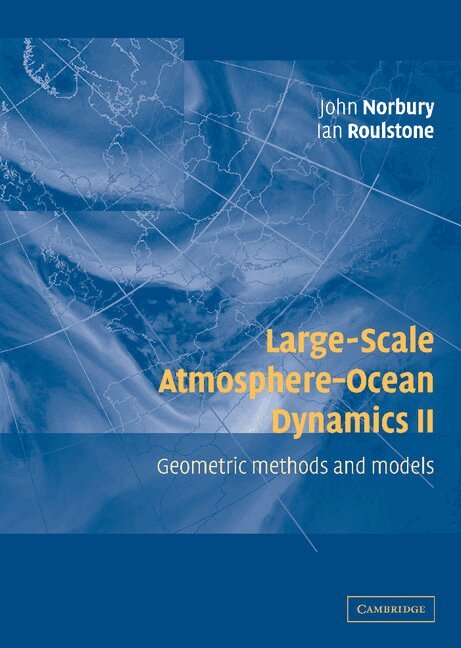
Numerical weather prediction is a problem of mathematical physics. The complex flows in the atmosphere and oceans are believed to be accurately modelled by the Navier-Stokes equations of fluid mechanics together with classical thermodynamics. However, due to the enormous complexity of these equations, meteorologists and oceanographers have constructed approximate models of the dominant, large-scale flows that control the evolution of weather systems and that describe, for example, the dynamics of cyclones and ocean eddies. The simplifications often result in models that are amenable to solution both analytically and numerically. The lectures in this volume, first published in 2002, examine and explain why such simplifications to Newton's second law produce accurate, useful models and, just as the meteorologist seeks patterns in the weather, mathematicians seek structure in the governing equations, such as groups of transformations, Hamiltonian structure and stability. This book and its companion show how geometry and analysis facilitate solution strategies.
409 kr
Skickas inom 5-8 vardagar
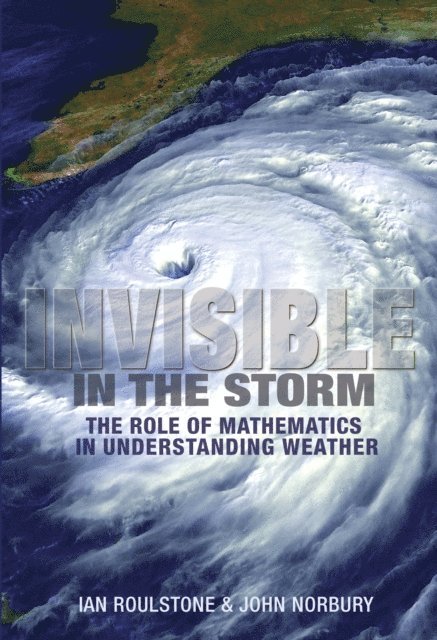
Invisible in the Storm is the first book to recount the history, personalities, and ideas behind one of the greatest scientific successes of modern times--the use of mathematics in weather prediction. Although humans have tried to forecast weather for millennia, mathematical principles were used in meteorology only after the turn of the twentieth century. From the first proposal for using mathematics to predict weather, to the supercomputers that now process meteorological information gathered from satellites and weather stations, Ian Roulstone and John Norbury narrate the groundbreaking evolution of modern forecasting. The authors begin with Vilhelm Bjerknes, a Norwegian physicist and meteorologist who in 1904 came up with a method now known as numerical weather prediction. Although his proposed calculations could not be implemented without computers, his early attempts, along with those of Lewis Fry Richardson, marked a turning point in atmospheric science.Roulstone and Norbury describe the discovery of chaos theory's butterfly effect, in which tiny variations in initial conditions produce large variations in the long-term behavior of a system--dashing the hopes of perfect predictability for weather patterns. They explore how weather forecasters today formulate their ideas through state-of-the-art mathematics, taking into account limitations to predictability. Millions of variables--known, unknown, and approximate--as well as billions of calculations, are involved in every forecast, producing informative and fascinating modern computer simulations of the Earth system. Accessible and timely, Invisible in the Storm explains the crucial role of mathematics in understanding the ever-changing weather.
Box of Whistles
an illustrated book on organ cases - with notes on organs at home and abroad
Häftad, Engelska, 2021
251 kr
Skickas inom 5-8 vardagar
260 kr
Skickas inom 5-8 vardagar
385 kr
Skickas inom 10-15 vardagar
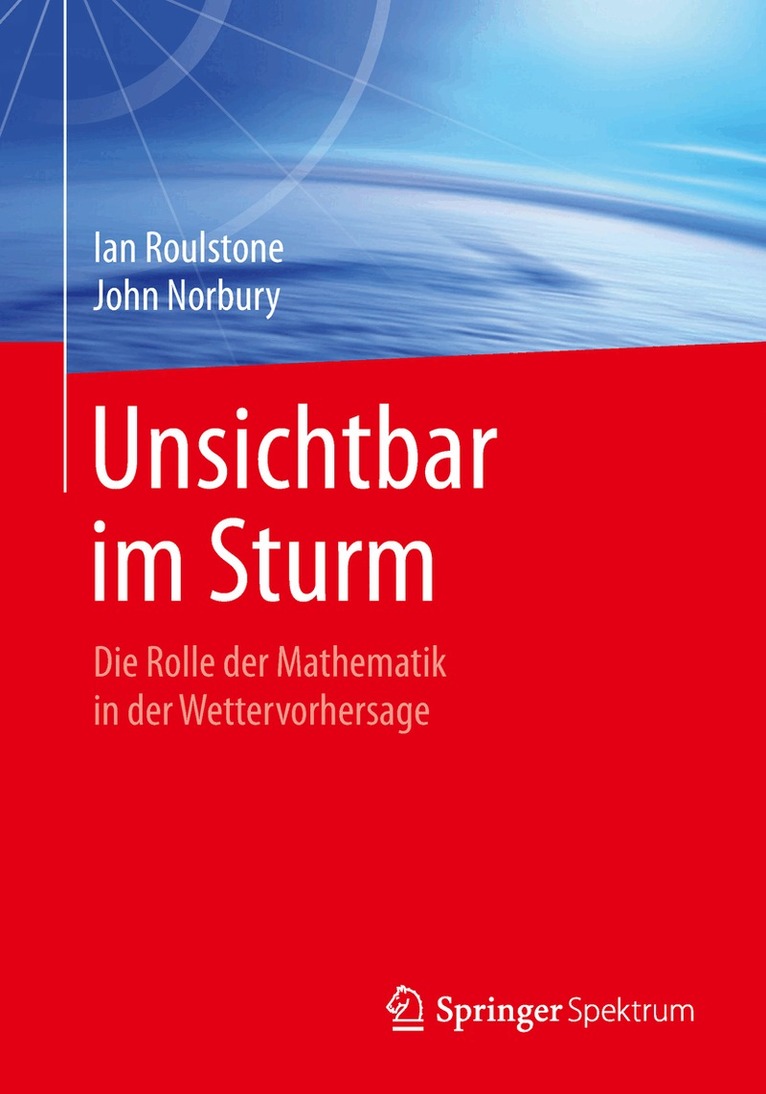
Die Verwendung von Mathematik bei der Vorhersage von Wetter, und damit einer der größten Erfolge moderner Wissenschaft, wird in diesem Werk erstmalig anschaulich dargestellt. Obwohl Menschen schon immer versucht haben, Wetter vorherzusagen, wurden mathematische Prinzipien erst mit Beginn des 20. Jahrhunderts regelmäßig dabei eingesetzt. In diesem Buch schildern Ian Roulstone und John Norbury die grundlegenden Veränderungen in der modernen Meteorologie - vom ersten Versuch an, Mathematik in der Wettervorhersage zu verwenden, bis hin zum Einsatz der heutigen Supercomputer, die meteorologische Informationen von Satelliten und Wetterstationen systematisch auswerten. Bereits 1904 führte der norwegische Physiker und Meteorologe Vilhelm Bjerknes eine Methode ein, die unter dem Begriff "Numerische Wettervorhersage" Eingang in die Wissenschaft gefunden hat. Obwohl die von ihm vorgeschlagenen Berechnungen nicht ohne Computer durchgeführt werden konnten, stellten seine mathematischen Überlegungen, ebenso wie die von Lewis Fry Richardson, einen Wendepunkt in der atmosphärischen Wissenschaft dar. Roulstone und Norbury beschreiben die Entdeckung des Schmetterlingseffekts in der Chaostheorie, nach der selbst kleinste Veränderungen der Ausgangskonditionen erhebliche Variationen auf lange Sicht im System verursachen - eine Entdeckung, die die Hoffnung auf eine perfekte Vorhersehbarkeit des Wetters zunichtemachte. Die Autoren stellen dar, wie Meteorologen heute modernste Mathematik einsetzen, dabei aber doch den Grenzen der Vorhersagbarkeit unterliegen. Millionen von Variablen - bekannt, unbekannt und geschätzt - sowie Milliarden von Berechnungen sind heute Grundlage jeder Vorhersage und ermöglichen interessante und faszinierende moderne Computersimulationen des atmosphärischen Systems. Dieses Werk erläutert auf leicht verständliche Weise die unverzichtbare Rolle von Mathematik bei der Vorhersage des sich immer wandelnden Wetters.
2 171 kr
Tillfälligt slut
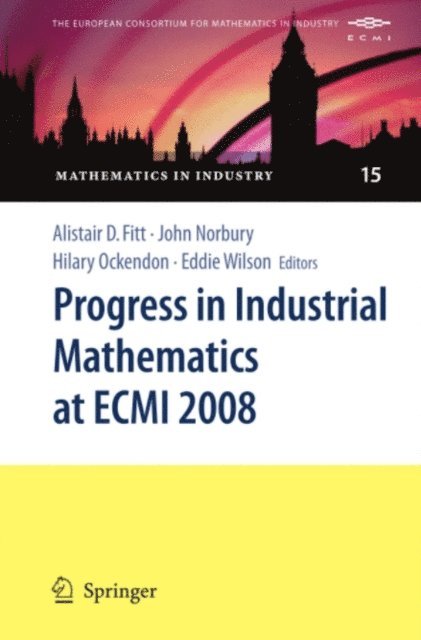
The 15th European Conference on Mathematics for Industry was held in the agreeable surroundings of University College London, just 5 minutes walk from the British Museum in the heart of London, over the ?ve warm, sunny days from 30 June to 4 July 2008. Participants from all over the world met with the commonaimofreinforcingthe roleofmathematics asanoverarching resource for industry and business. The conference attracted over 300 participants from 30 countries, most of them participating with either a contributed talk, a minisymposium pres- tation or a plenary lecture. ‘Mathematics in Industry’ was interpreted in its widest sense as can be seen from the range of applications and techniques described in this volume. We mention just two examples. The Alan Tayler Lecture was given by Mario Primicerio on a problem arising from moving oil through pipelines when temperature variations a?ect the shearing properties of wax and thus modify the ?ow. The Wacker Prize winner, Master’s student Lauri Harhanen from the Helsinki University of Technology, showed how a novel piece of mathematics allowed new software to capture real-time images of teeth from the data supplied by present day dental machinery (see ECMI Newsletter 44). The meeting was attended by leading ?gures from government, bu- ness and science who all shared the same aim – to promote the application of innovative mathematics to industry, and identify industrial sectors that o?er the most exciting opportunities for mathematicians to provide new insight and new ideas.