
John O. McGinnis – författare
Visar alla böcker från författaren John O. McGinnis. Handla med fri frakt och snabb leverans.
4 produkter
4 produkter
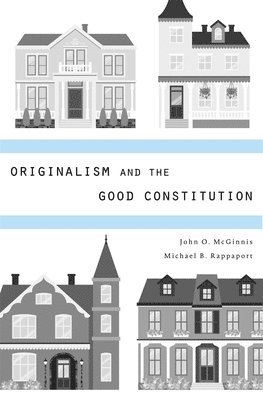
Inbunden, Engelska, 2013
458 kr
Skickas inom 10-15 vardagar
Originalism holds that the U.S. Constitution should be interpreted according to its meaning at the time it was enacted. In their innovative defense of originalism, John McGinnis and Michael Rappaport maintain that the text of the Constitution should be adhered to by the Supreme Court because it was enacted by supermajorities—both its original enactment under Article VII and subsequent Amendments under Article V. A text approved by supermajorities has special value in a democracy because it has unusually wide support and thus tends to maximize the welfare of the greatest number.The authors recognize and respond to many possible objections. Does originalism perpetuate the dead hand of the past? How can following the original meaning be justified, given that African Americans and women were excluded from the enactment of the Constitution in 1787 and many of its subsequent Amendments? What is originalism’s place in interpretation of the Constitution, when after two hundred years there is so much non-originalist precedent?A fascinating counterfactual they pose is this: had the Supreme Court not interpreted the Constitution so freely, perhaps the nation would have resorted to the Article V amendment process more often and with greater effect. Their book will be an important contribution to the literature on originalism, which is now the most prominent theory of constitutional interpretation.
Inbunden, Engelska, 2012
387 kr
Skickas inom 5-8 vardagar
Successful democracies throughout history--from ancient Athens to Britain on the cusp of the industrial age--have used the technology of their time to gather information for better governance. Our challenge is no different today, but it is more urgent because the accelerating pace of technological change creates potentially enormous dangers as well as benefits. Accelerating Democracy shows how to adapt democracy to new information technologies that can enhance political decision making and enable us to navigate the social rapids ahead. John O. McGinnis demonstrates how these new technologies combine to address a problem as old as democracy itself--how to help citizens better evaluate the consequences of their political choices. As society became more complex in the nineteenth century, social planning became a top-down enterprise delegated to experts and bureaucrats. Today, technology increasingly permits information to bubble up from below and filter through more dispersed and competitive sources.McGinnis explains how to use fast-evolving information technologies to more effectively analyze past public policy, bring unprecedented intensity of scrutiny to current policy proposals, and more accurately predict the results of future policy. But he argues that we can do so only if government keeps pace with technological change. For instance, it must revive federalism to permit different jurisdictions to test different policies so that their results can be evaluated, and it must legalize information markets to permit people to bet on what the consequences of a policy will be even before that policy is implemented. Accelerating Democracy reveals how we can achieve a democracy that is informed by expertise and social-scientific knowledge while shedding the arrogance and insularity of a technocracy.
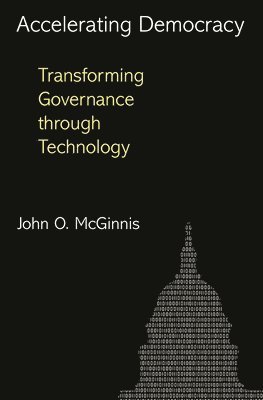
Häftad, Engelska, 2015
418 kr
Skickas inom 3-6 vardagar
Successful democracies throughout history--from ancient Athens to Britain on the cusp of the industrial age--have used the technology of their time to gather information for better governance. Our challenge is no different today, but it is more urgent because the accelerating pace of technological change creates potentially enormous dangers as well as benefits. Accelerating Democracy shows how to adapt democracy to new information technologies that can enhance political decision making and enable us to navigate the social rapids ahead. John O. McGinnis demonstrates how these new technologies combine to address a problem as old as democracy itself--how to help citizens better evaluate the consequences of their political choices. As society became more complex in the nineteenth century, social planning became a top-down enterprise delegated to experts and bureaucrats. Today, technology increasingly permits information to bubble up from below and filter through more dispersed and competitive sources.McGinnis explains how to use fast-evolving information technologies to more effectively analyze past public policy, bring unprecedented intensity of scrutiny to current policy proposals, and more accurately predict the results of future policy. But he argues that we can do so only if government keeps pace with technological change. For instance, it must revive federalism to permit different jurisdictions to test different policies so that their results can be evaluated, and it must legalize information markets to permit people to bet on what the consequences of a policy will be even before that policy is implemented. Accelerating Democracy reveals how we can achieve a democracy that is informed by expertise and social-scientific knowledge while shedding the arrogance and insularity of a technocracy.
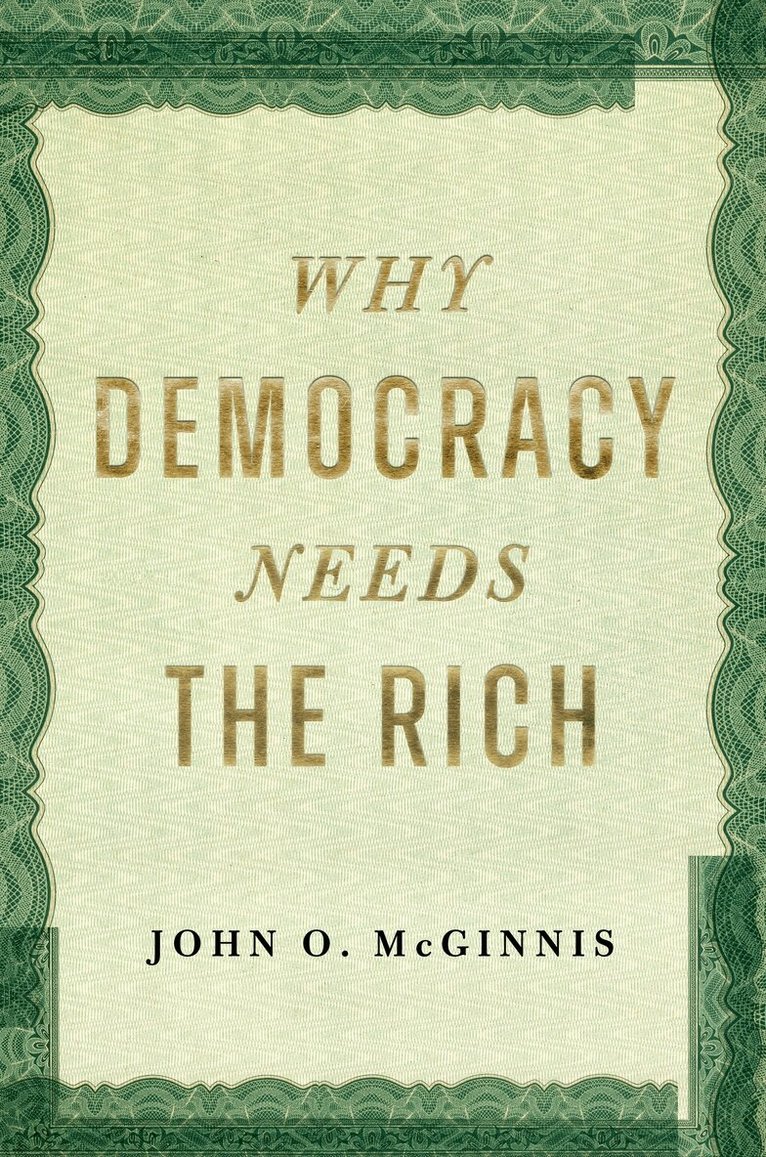
Inbunden, Engelska, 2026
352 kr
Skickas inom 3-6 vardagar
Why Democracy Needs the Rich challenges the prevailing belief that wealth undermines democracy, offering instead a bracing, thought-provoking claim that the rich play an essential role in sustaining and improving democratic institutions. At a moment when billionaires are often vilified as symbols of inequality and unchecked power, John O. McGinnis reframes the debate, arguing that the wealthy are not just vital contributors to innovation and economic growth but also indispensable counterbalances to the power of journalists, academics, and entertainers, who shape opinion and policy without facing the voters.Drawing on history, economics, and political philosophy, McGinnis illustrates how the rich stabilize democracies by funding civic institutions, championing diverse ideas, and driving the technological progress that itself prevents entrenched gatekeepers from monopolizing the public square. He shows how wealth can act as a check on the power of special interests and bureaucracies.With sharp analysis and compelling examples, this book explores the distinct role of the wealthy in preserving the balance and dynamism of a free society. It highlights how their financial independence fosters ideological diversity and their investments fuel innovations that benefit citizens at all socioeconomic levels. Far from defending inequality , Why Democracy Needs the Rich is a clear-eyed argument for how wealth, under the proper constraints, strengthens the foundations of representative democracy and fosters a more resilient, prosperous society.