John P. Wolf - Böcker
Visar alla böcker från författaren John P. Wolf. Handla med fri frakt och snabb leverans.
2 produkter
2 produkter
1 884 kr
Skickas inom 5-8 vardagar
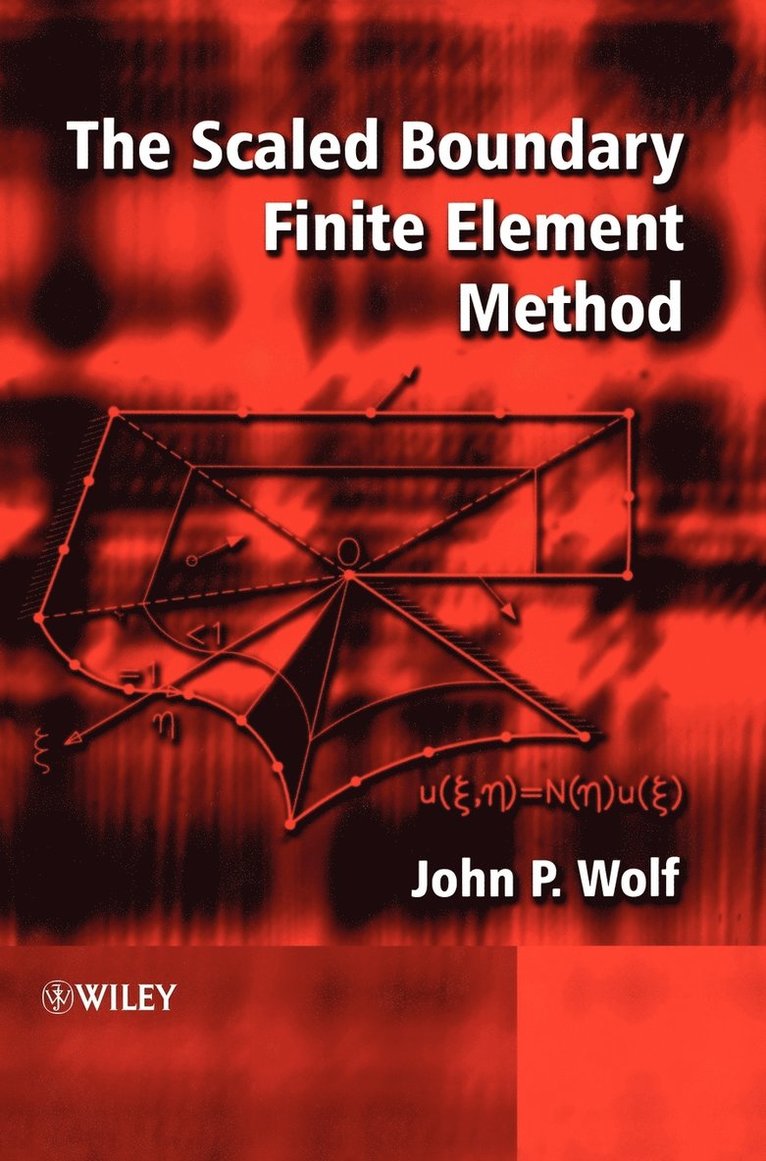
A novel computational procedure called the scaled boundary finite-element method is described which combines the advantages of the finite-element and boundary-element methods : Of the finite-element method that no fundamental solution is required and thus expanding the scope of application, for instance to anisotropic material without an increase in complexity and that singular integrals are avoided and that symmetry of the results is automatically satisfied. Of the boundary-element method that the spatial dimension is reduced by one as only the boundary is discretized with surface finite elements, reducing the data preparation and computational efforts, that the boundary conditions at infinity are satisfied exactly and that no approximation other than that of the surface finite elements on the boundary is introduced. In addition, the scaled boundary finite-element method presents appealing features of its own : an analytical solution inside the domain is achieved, permitting for instance accurate stress intensity factors to be determined directly and no spatial discretization of certain free and fixed boundaries and interfaces between different materials is required. In addition, the scaled boundary finite-element method combines the advantages of the analytical and numerical approaches. In the directions parallel to the boundary, where the behaviour is, in general, smooth, the weighted-residual approximation of finite elements applies, leading to convergence in the finite-element sense. In the third (radial) direction, the procedure is analytical, permitting e.g. stress-intensity factors to be determined directly based on their definition or the boundary conditions at infinity to be satisfied exactly.In a nutshell, the scaled boundary finite-element method is a semi-analytical fundamental-solution-less boundary-element method based on finite elements. The best of both worlds is achieved in two ways: with respect to the analytical and numerical methods and with respect to the finite-element and boundary-element methods within the numerical procedures.The book serves two goals: Part I is an elementary text, without any prerequisites, a primer, but which using a simple model problem still covers all aspects of the method and Part II presents a detailed derivation of the general case of statics, elastodynamics and diffusion.
3 414 kr
Skickas inom 7-10 vardagar
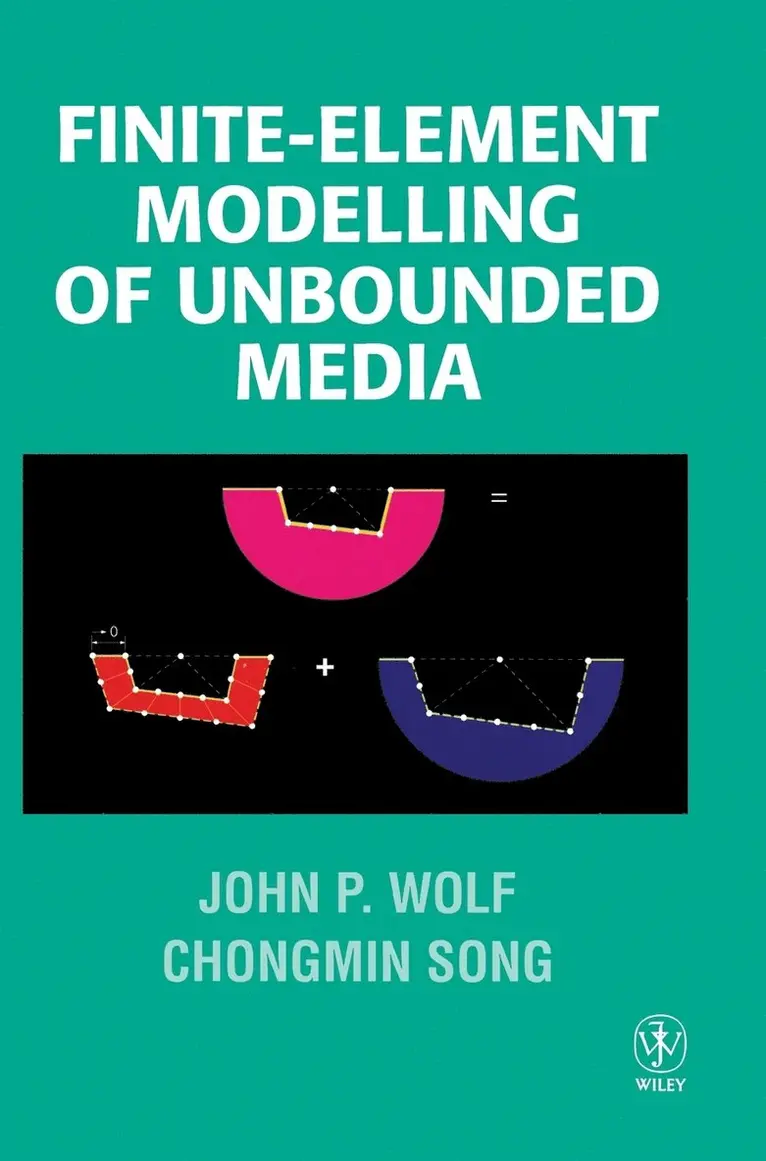
Dynamic unbounded medium-structure interactions occur in manyfields of engineering and physical science, such as wavepropagation in soil-structure and fluid-structure interactions,acoustics and electromagnetism and as diffusion in heat conductionand consolidation. This book presents three novel concepts, basedon the finite-element methodology, to model the unboundedmedium:* The consistent infinitesimal finite-element cell method, aboundary finite-element procedure, requires the discretization ofthe structure-medium interface only and is exact in thefinite-element sense. It is applied to unbounded media governed bythe hyperbolic, parabolic and elliptic differentialequations.* The damping-solvent extraction method permits the analysis of abounded medium only.* The doubly-asymptotic multi-directional transmitting boundary isexact for the low- and high-frequency limits at preselected wavepropagation directions.All concepts are explained using simple examples that the readercan follow step by step. A computer program of the consistentinfinitesimal finite-element cell method available on disk analysestwo- and three-dimensional unbounded and bounded media for thescalar and vector wave equations and the diffusion equation in thefrequency and time domains.