John S. Galbraith - Böcker
Visar alla böcker från författaren John S. Galbraith. Handla med fri frakt och snabb leverans.
5 produkter
5 produkter
911 kr
Skickas inom 3-6 vardagar
The Hudson's Bay Company as an Imperial Factor: 1821-1869 explores the rise, consolidation, and eventual decline of the Hudson's Bay Company's fur trade monopoly in British North America. Beginning in 1821, with the company's amalgamation with the North West Company, and ending in 1869 with the sale of its proprietary rights in Rupert's Land to Canada, the book examines the company's transition from a dominant fur-trading enterprise to an organization unable to sustain its monopoly amidst increasing settlement pressures. The study delves into the company’s strategies along trade frontiers, its adaptations to changing societal dynamics, and its ultimate acceptance of the inevitable shift from a fur-trade economy to settlement-driven development.The narrative also highlights the Hudson's Bay Company's complex role in the international relations of Great Britain, Russia, the United States, and Canada. It details the company's influence on diplomatic negotiations, acting at times as a key force or an obstacle to national agendas. By analyzing the company's policies and their broader implications, the book provides a detailed account of its significant yet challenging position as both an economic and political entity during a transformative period in North American history.This title is part of UC Press's Voices Revived program, which commemorates University of California Press’s mission to seek out and cultivate the brightest minds and give them voice, reach, and impact. Drawing on a backlist dating to 1893, Voices Revived makes high-quality, peer-reviewed scholarship accessible once again using print-on-demand technology. This title was originally published in 1957.
Del 14 - Perspectives on Southern Africa
Crown and Charter
The Early Years of the British South Africa Company
Häftad, Engelska, 2021
835 kr
Skickas inom 3-6 vardagar
Crown and Charter: The Early Years of the British South Africa Company delves into the complex origins and operations of one of the most controversial enterprises of European expansion in Africa. This meticulously researched volume examines the British South Africa Company, a chartered venture driven by Cecil John Rhodes' ambition and the permissive stance of the imperial government. While Rhodes' dominance shaped much of the company’s direction, the book illuminates the broader dynamics, including the interactions between the London board, imperial policymakers, and local contexts in Central Africa. Through vivid detail, the narrative explores the bold ambitions, ethical ambiguities, and far-reaching consequences of the company's early activities, including its ties to stock market speculation and its impact on indigenous populations.The book balances a critical lens with historical analysis, capturing the contradictions between the company's stated ideals of promoting Christianity, commerce, and civilization and its often self-serving pursuits. With nuanced discussions on Rhodes' character, the moral implications of colonial endeavors, and the passive complicity of other stakeholders, the text provides a comprehensive view of this pivotal chapter in British imperial history. A compelling read for scholars and history enthusiasts alike, Crown and Charter offers both a detailed study of the British South Africa Company and a broader reflection on the ethics and realities of colonialism.This title is part of UC Press's Voices Revived program, which commemorates University of California Press’s mission to seek out and cultivate the brightest minds and give them voice, reach, and impact. Drawing on a backlist dating to 1893, Voices Revived makes high-quality, peer-reviewed scholarship accessible once again using print-on-demand technology. This title was originally published in 1974.
777 kr
Skickas inom 7-10 vardagar
The Hudson's Bay Company as an Imperial Factor: 1821-1869 explores the rise, consolidation, and eventual decline of the Hudson's Bay Company's fur trade monopoly in British North America. Beginning in 1821, with the company's amalgamation with the North West Company, and ending in 1869 with the sale of its proprietary rights in Rupert's Land to Canada, the book examines the company's transition from a dominant fur-trading enterprise to an organization unable to sustain its monopoly amidst increasing settlement pressures. The study delves into the company’s strategies along trade frontiers, its adaptations to changing societal dynamics, and its ultimate acceptance of the inevitable shift from a fur-trade economy to settlement-driven development.The narrative also highlights the Hudson's Bay Company's complex role in the international relations of Great Britain, Russia, the United States, and Canada. It details the company's influence on diplomatic negotiations, acting at times as a key force or an obstacle to national agendas. By analyzing the company's policies and their broader implications, the book provides a detailed account of its significant yet challenging position as both an economic and political entity during a transformative period in North American history.This title is part of UC Press's Voices Revived program, which commemorates University of California Press’s mission to seek out and cultivate the brightest minds and give them voice, reach, and impact. Drawing on a backlist dating to 1893, Voices Revived makes high-quality, peer-reviewed scholarship accessible once again using print-on-demand technology. This title was originally published in 1957.
Del 14 - Perspectives on Southern Africa
Crown and Charter
The Early Years of the British South Africa Company
Inbunden, Engelska, 2021
1 513 kr
Skickas inom 3-6 vardagar
Crown and Charter: The Early Years of the British South Africa Company delves into the complex origins and operations of one of the most controversial enterprises of European expansion in Africa. This meticulously researched volume examines the British South Africa Company, a chartered venture driven by Cecil John Rhodes' ambition and the permissive stance of the imperial government. While Rhodes' dominance shaped much of the company’s direction, the book illuminates the broader dynamics, including the interactions between the London board, imperial policymakers, and local contexts in Central Africa. Through vivid detail, the narrative explores the bold ambitions, ethical ambiguities, and far-reaching consequences of the company's early activities, including its ties to stock market speculation and its impact on indigenous populations.The book balances a critical lens with historical analysis, capturing the contradictions between the company's stated ideals of promoting Christianity, commerce, and civilization and its often self-serving pursuits. With nuanced discussions on Rhodes' character, the moral implications of colonial endeavors, and the passive complicity of other stakeholders, the text provides a comprehensive view of this pivotal chapter in British imperial history. A compelling read for scholars and history enthusiasts alike, Crown and Charter offers both a detailed study of the British South Africa Company and a broader reflection on the ethics and realities of colonialism.This title is part of UC Press's Voices Revived program, which commemorates University of California Press’s mission to seek out and cultivate the brightest minds and give them voice, reach, and impact. Drawing on a backlist dating to 1893, Voices Revived makes high-quality, peer-reviewed scholarship accessible once again using print-on-demand technology. This title was originally published in 1974.
468 kr
Skickas inom 7-10 vardagar
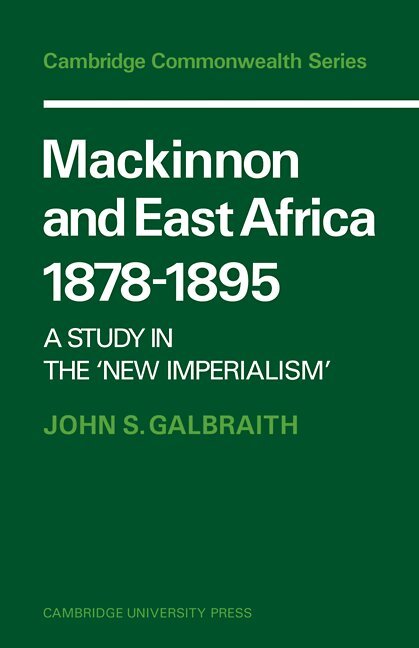
In the 1870s Britain dominated the coast of east Africa by informal influence exerted from Zanzibar through the renowned consul-general, Sir John Kirk. This unchallenged position ended with the decision of Bismarck to back Carl Peters in his treaty-making activities and the mainland opposite Zanzibar was partitioned in 1886 into British and German spheres. The British government was not willing to assume the responsibility and expense involved in administration of its area of influence and it assigned control to the Imperial British East Africa Company headed by William Mackinnon. The company's life was short and inglorious. The government attributed its failure to the ineffectuality of Mackinnon and the Company's directors blamed the government for using the Company to advance political objects and not providing it with proper support. Professor Galbraith's book considers this episode in British Imperial History, the factors involved and Mackinnon's part in it. The book considers the interaction of Mackinnon and the government from the 1870s when his first efforts in east Africa were frustrated by Salisbury to the liquidation of the Company in the mid-1890s.