John W. Tyler - Böcker
Visar alla böcker från författaren John W. Tyler. Handla med fri frakt och snabb leverans.
6 produkter
6 produkter
587 kr
Skickas
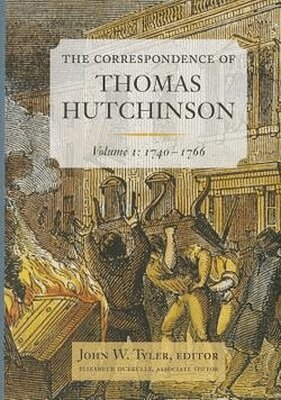
Thomas Hutchinson was the leading spokesman in colonial America for opposition to the Revolutionary movement. His logical and cogent prose as well as the stature he gained through his long and varied public service to Massachusetts gave weight to his arguments and insured a wide audience for his ideas in both England and the colonies. Because of his Loyalist sympathies, however, his letters have until now languished unpublished in the Massachusetts Archives.This first volume of the only fully annotated edition of his correspondence begins with his emergence on the political stage in 1740 and covers the events of the French and Indian War, his controversial appointments as lieutenant-governor and chief justice, and the Stamp Act riots (including the looting of his own home).Distributed for the Colonial Society of Massachusetts.
549 kr
Skickas inom 7-10 vardagar
The second volume of Thomas Hutchinson's correspondence covers the years 1767 through 1769. In 1767, Charles Townshend's new taxes, in addition to his ambitious plans to improve customs enforcement and render crown officials in the colonies more independent of local assemblies, caused increasing resentment in Boston. To force Parliament to repeal the new legislation, Boston merchants adopted a comprehensive nonimportation agreement, which Hutchinson, in his position as lieutenant governor, regarded as an illegal confederacy devoid of any constitutional authority. Nevertheless, he and other royal officials proved powerless to stop its spread. To make matters worse, in October 1768, British troops arrived in Boston, at the instigation of Hutchinson's superior, Governor Francis Bernard. Hutchinson correctly foresaw that soldiers could be only an irritant and would be ineffective at preventing civil disorder. In August 1769, Bernard sailed for England, leaving Hutchinson as acting governor, with the unenviable challenge of dealing with mounting anger against the occupying troops and growing street violence designed to coerce unwilling importers into compliance with the merchants' agreement.Hutchinson's papers have always been among the most basic sources for historians writing about Boston in the 1760s and 1770s, and the publication of this volume is a valuable step toward making this content widely accessible.
568 kr
Skickas inom 3-6 vardagar
566 kr
Skickas inom 11-20 vardagar
The Boston Massacre occasioned a flurry of letter writing for Thomas Hutchinson, the royal governor of Massachusetts. So frequent was the correspondence to and from Hutchinson that this volume covers only the first ten months of 1770, beginning with the rising tide of violence in January and February as patriot leaders began to use increasingly coercive methods to enforce compliance with the nonimportation agreement. Prior to this edition, Hutchinson's letters, one of the best sources for Boston history in the decade and a half leading up to the Revolution, had never been published. Readers can now read a firsthand account of these tumultuous events from the rarely heard Loyalist viewpoint.
552 kr
Skickas inom 7-10 vardagar
The fourth volume of The Correspondence of Thomas Hutchinson covers a twenty-month period extending from the acquittal of the soldiers standing trial for the Boston Massacre in November 1770 through the return of the General Court from Cambridge to its traditional meeting place at the Town House in Boston in June 1772. Some historians refer to this interval as the "quiet period" in the events leading up to the Revolution, but one would have had trouble convincing Thomas Hutchinson of the accuracy of that phrase. He continued to butt heads with Samuel Adams. No longer acting governor after March 1771, but governor-in-chief in his own right, Hutchinson was now free to use the patronage at his disposal to reward his political adherents and divide the opposition. Even though John Hancock ultimately declined the offer, Hutchinson attempted to separate him from the political tutelage of Samuel Adams, by dangling the prospect of a socially prestigious seat on the Governor's Council before the young merchant. At the same time, the Hutchinson also sought to sow seeds of suspicion and resentment between the Massachusetts House of Representatives and their new agent, Benjamin Franklin. Adams had long resisted Hutchinson's claim to summon the General Court to meet anywhere he chose, but in the spring of 1772, cooperation with Hancock enabled Hutchinson to end a long-standing impasse and return the Court to Boston without surrendering any his gubernatorial prerogative. Despite this seeming success, Hutchinson could have no idea of the crises that lay ahead in 1773 (the publication of his private letters and Parliament's efforts to aid the financially troubled East India Company) that would effectively end his governorship.Distributed for the Colonial Society of Massachusetts
515 kr
Skickas inom 3-6 vardagar
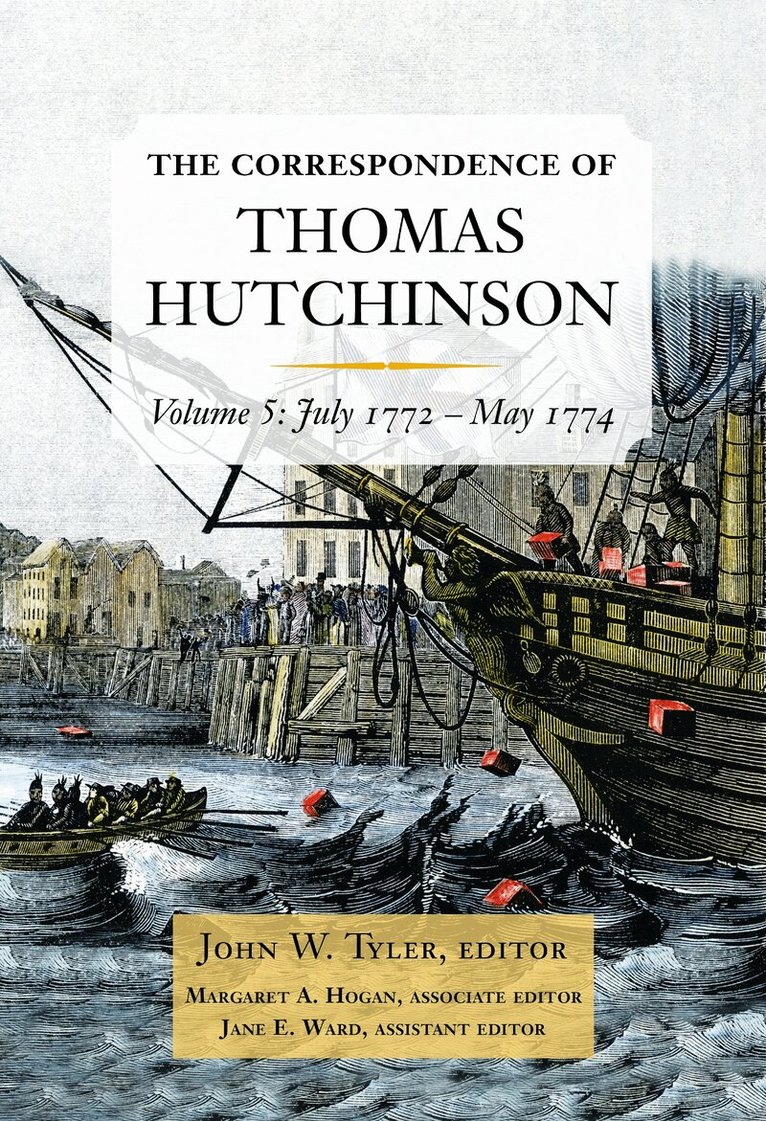
Volume Five covers the last years of Hutchinson’s governorship. The proliferation of committees of correspondence throughout the province in late 1772 prompted Hutchinson to make a major speech at the opening of the General Court in January 1773, laying out his understanding of the relationship between the colonies and Parliament. The speech prompted a series of rejoinders and counter rejoinders that dragged on throughout the winter. No sooner had the matter died down, then Samuel Adams announced he had in his possession “letters of an extraordinary nature” written by Hutchinson and others who sought to undermine the liberties of the citizens of Massachusetts. When eventually published, the letters, which appeared to have been stolen from the files of a highly-placed English official after his death, did not support the wild rumors Adams and others had promulgated, yet the damage was done and the legislature petitioned the crown for his removal. Hutchinson asked for leave to go to England to defend himself, but before permission arrived, news of the Tea Act reached Boston, precipitating a new controversy. Hutchinson’s refusal to allow the tea to be returned to England led directly to the Boston Tea Party and, in turn, to the passage of Coercive Acts by Parliament. Hutchinson felt powerless before the storm of controversy he had aroused and left Massachusetts on June 1, 1774, ostensibly to report on American affairs in London, but, in reality never, to return.