John Y. Campbell - Böcker
Visar alla böcker från författaren John Y. Campbell. Handla med fri frakt och snabb leverans.
8 produkter
8 produkter
881 kr
Skickas inom 7-10 vardagar
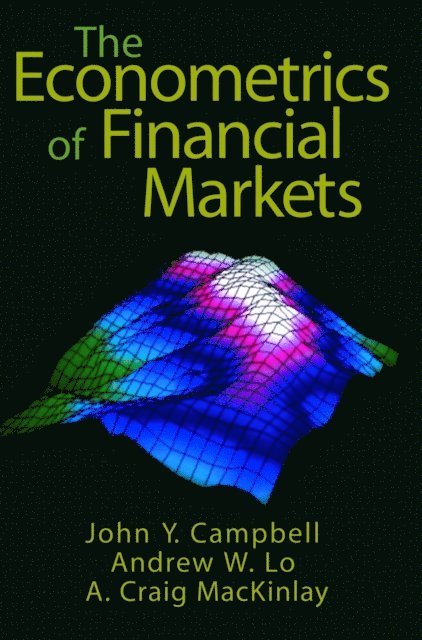
The past twenty years have seen an extraordinary growth in the use of quantitative methods in financial markets. Finance professionals now routinely use sophisticated statistical techniques in portfolio management, proprietary trading, risk management, financial consulting, and securities regulation. This graduate-level textbook is intended for PhD students, advanced MBA students, and industry professionals interested in the econometrics of financial modeling. The book covers the entire spectrum of empirical finance, including: the predictability of asset returns, tests of the Random Walk Hypothesis, the microstructure of securities markets, event analysis, the Capital Asset Pricing Model and the Arbitrage Pricing Theory, the term structure of interest rates, dynamic models of economic equilibrium, and nonlinear financial models such as ARCH, neural networks, statistical fractals, and chaos theory. Each chapter develops statistical techniques within the context of a particular financial application. This exciting new text contains a unique and accessible combination of theory and practice, bringing state-of-the-art statistical techniques to the forefront of financial applications.Each chapter also includes a discussion of recent empirical evidence, for example, the rejection of the Random Walk Hypothesis, as well as problems designed to help readers incorporate what they have read into their own applications
1 146 kr
Skickas inom 5-8 vardagar
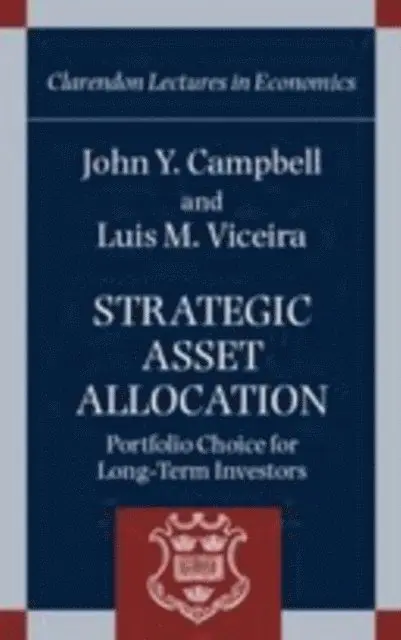
Academic finance has had a remarkable impact on many financial services. Yet long-term investors have received curiously little guidance from academic financial economists.Mean-variance analysis, developed almost fifty years ago, has provided a basic paradigm for portfolio choice. This approach usefully emphasizes the ability of diversification to reduce risk, but it ignores several critically important factors. Most notably, the analysis is static; it assumes that investors care only about risks to wealth one period ahead. However, many investors---both individuals and institutions such as charitable foundations or universities---seek to finance a stream of consumption over a long lifetime. In addition, mean-variance analysis treats financial wealth in isolation from income. Long-term investors typically receive a stream of income and use it, along with financial wealth, to support their consumption.At the theoretical level, it is well understood that the solution to a long-term portfolio choice problem can be very different from the solution to a short-term problem. Long-term investors care about intertemporal shocks to investment opportunities and labor income as well as shocks to wealth itself, and they may use financial assets to hedge their intertemporal risks. This should be important in practice because there is a great deal of empirical evidence that investment opportunities---both interest rates and risk premia on bonds and stocks---vary through time. Yet this insight has had little influence on investment practice because it is hard to solve for optimal portfolios in intertemporal models. This book seeks to develop the intertemporal approach into an empirical paradigm that can compete with the standard mean-variance analysis. The book shows that long-term inflation-indexed bonds are the riskless asset for long-term investors, it explains the conditions under which stocks are safer assets for long-term than for short-term investors, and it shows how labor income influences portfolio choice. These results shed new light on the rules of thumb used by financial planners. The book explains recent advances in both analytical and numerical methods, and shows how they can be used to understand the portfolio choice problems of long-term investors.
968 kr
Skickas inom 7-10 vardagar
Economic growth, low inflation, and financial stability are among the most important goals of policy makers, and central banks such as the Federal Reserve are key institutions for achieving these goals. In "Asset Prices and Monetary Policy", leading scholars and practitioners probe the interaction of central banks, asset markets, and the general economy to forge a new understanding of the challenges facing policy makers as they manage an increasingly complex economic system.The contributors examine how central bankers determine their policy prescriptions with reference to the fluctuating housing market, the balance of debt and credit, changing beliefs of investors, the level of commodity prices, and other factors. At a time when the public has never been more involved in stocks, retirement funds, and real estate investment, this insightful book will be useful to all those concerned with the current state of the economy.
2 330 kr
Skickas
Our current social security system operates on a pay-as-you-go basis; benefits are paid almost entirely out of current revenues. As the ratio of retirees to taxpayers increases, concern about the high costs of providing benefits in a pay-as-you-go system has led economists to explore other options. One involves "prefunding", in which a person's withholdings are invested in financial instruments, such as stocks and bonds, the eventual returns from which would fund his or her retirement. The risks such a system would introduce - such as the volatility in the market prices of investment assets - are the focus of this offering from the NBER. Exploring the issues involved in measuring risk and developing models to reflect the risks of various investment-based systems, economists evaluate the magnitude of the risks that both retirees and taxpayers would assume. The insights that emerge show that the risk is actually moderate relative to the improved return, as well as being balanced by the ability of an investment-balanced system to adapt to differences in individual preferences and conditions.
1 700 kr
Skickas
An insightful, wide-ranging analysis of the economic hurdles facing America’s higher education system.The US higher education sector faces numerous economic challenges, including the stagnating number of college-age domestic students, geographic mismatch between population growth and the location of colleges and universities, financial pressures, including cutbacks in government support, growing student debt burdens, sticker prices that deter prospective applicants, and the risk of low capital market returns on endowment portfolios. This volume analyzes the responses of students, families, and the financial managers of higher education institutions to these challenges. It presents new insights into the substantial disparities in the financial structure of, and the financial challenges facing, different types of institutions. The volume draws together contributions from financial economics, public finance, and industrial organization, as well as the economics of education.
170 kr
Skickas inom 7-10 vardagar
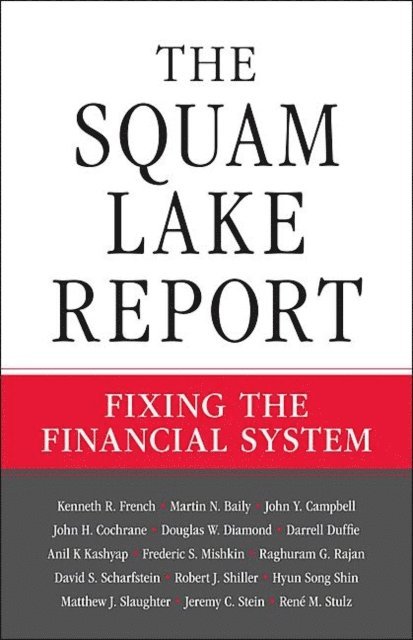
In the fall of 2008, fifteen of the world's leading economists--representing the broadest spectrum of economic opinion--gathered at New Hampshire's Squam Lake. Their goal: the mapping of a long-term plan for financial regulation reform. The Squam Lake Report distills the wealth of insights from the ongoing collaboration that began at these meetings and provides a revelatory, unified, and coherent voice for fixing our troubled and damaged financial markets. As an alternative to the patchwork solutions and ideologically charged proposals that have dominated other discussions, the Squam Lake group sets forth a clear nonpartisan plan of action to transform the regulation of financial markets--not just for the current climate--but for generations to come. Arguing that there has been a conflict between financial institutions and society, these diverse experts present sound and transparent prescriptions to reduce this divide. They look at the critical holes in the existing regulatory framework for handling complex financial institutions, retirement savings, and credit default swaps. They offer ideas for new financial instruments designed to recapitalize banks without burdening taxpayers.To lower the risk that large banks will fail, the authors call for higher capital requirements as well as a systemic regulator who is part of the central bank. They collectively analyze where the financial system has failed, and how these weak points should be overhauled. Combining an immense depth of academic, private sector, and public policy experience, The Squam Lake Report contains urgent recommendations that will positively influence everyone's financial well-being--all who care about the world's economic health need to pay attention.
821 kr
Skickas inom 7-10 vardagar
From the field's leading authority, the most authoritative and comprehensive advanced-level textbook on asset pricing Financial Decisions and Markets is a graduate-level textbook that provides a broad overview of the field of asset pricing. John Campbell, one of the field's most respected authorities, introduces students to leading theories of portfolio choice, their implications for asset prices, and empirical patterns of risk and return in financial markets. Campbell emphasizes the interplay of theory and evidence, as theorists respond to empirical puzzles by developing models with new testable implications. Increasingly these models make predictions not only about asset prices but also about investors' financial positions, and they often draw on insights from behavioral economics. After a careful introduction to single-period models, Campbell develops multiperiod models with time-varying discount rates, reviews the leading approaches to consumption-based asset pricing, and integrates the study of equities and fixed-income securities.He discusses models with heterogeneous agents who use financial markets to share their risks, but also may speculate against one another on the basis of different beliefs or private information. Campbell takes a broad view of the field, linking asset pricing to related areas, including financial econometrics, household finance, and macroeconomics. The textbook works in discrete time throughout, and does not require stochastic calculus. Problems are provided at the end of each chapter to challenge students to develop their understanding of the main issues in financial economics. The most comprehensive and balanced textbook on asset pricing available, Financial Decisions and Marketswill be an essential resource for all graduate students in finance and related fields. * Integrated treatment of asset pricing theory and empirical evidence* Emphasis on investors' decisions* Broad view linking the field to areas including financial econometrics, household finance, and macroeconomics* Topics treated in discrete time, with no requirement for stochastic calculus* Solutions manual for problems available to professors
299 kr
Skickas inom 7-10 vardagar
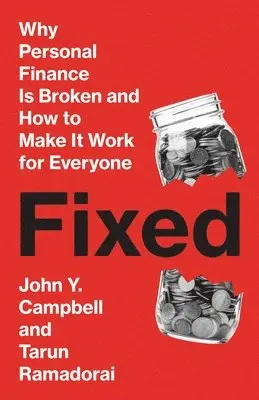
Two leading economists reveal why today’s personal finance markets are rigged against us and offer practical steps to fix themWe interact with the financial system every day, whether taking out or paying off loans, making insurance claims, or simply depositing money into our bank accounts. Fixed exposes how this system has been corrupted to serve the interests of financial services providers and their cleverest customers—at the expense of ordinary people.John Campbell and Tarun Ramadorai diagnose the ills of today’s personal finance markets in the United States and across the globe, looking at everything from short-term saving and borrowing to loans for education and housing, financial products for retirement, and insurance. They show how the system is “fixed” to benefit those who are wealthy and more educated while encouraging financial mistakes by those who are aren’t, making it difficult for regular consumers to make sound financial decisions and disadvantaging them in some of the most consequential economic transactions of their lives. Campbell and Ramadorai describe how some even opt out of the financial system altogether, relying on unregulated and often shady mechanisms to implement necessary financial functions, with dire consequences for individuals, families, and the economy more broadly.With the explosive growth of the global middle class, longer lifespans, and greater numbers of seniors managing their money alone, the pitfalls of personal finance now affect billions of people around the world. Fixed proposes concrete solutions that harness the expertise of economists, the power of government, and the speed of technology to restore fairness and trust in our broken system and make it work better for ordinary people.