Jolyon Agar – författare
Visar alla böcker från författaren Jolyon Agar. Handla med fri frakt och snabb leverans.
16 produkter
Rethinking Marxism
January, Vol: 17.2
Av Jolyon Agar
Häftad, 2005
527 kr
Lägg i varukorg
Rethinking Marxism focuses on two intersecting works of contemporary left literary and cultural thought: Amitava Kumar's Bombay-London-New York and Warren Montag's Louis Althusser, which represent divergent conceptions of the nature.
Rethinking Marxism
18.2
Av Rethinking Marxism Editoria He, Jolyon Agar
Häftad, 2006
648 kr
Lägg i varukorg
This issue invites readers to consider the results of an original and provocative theoretical project that has taken place in a seminar on subjects of economy at the University of Massachusetts in Amherst. It provides some insight into the micropolitical process of class transformation.
Rethinking Marxism
From Kant and Hegel to Marx and Engels
Av Jolyon Agar
Inbunden, 2006
2706 kr
Lägg i varukorg
This clear and accessible book will be of use to social theorists and politcal scholars, to all those looking for a new understanding of the complex relationship between Kant, Hegel, Marx and Engels and to those who seek an introduction to dialectical critical realism in general and its …
Rethinking Marxism
From Kant and Hegel to Marx and Engels
Av Jolyon Agar
Häftad, 2006
822 kr
Lägg i varukorg
This clear and accessible book will be of use to social theorists and politcal scholars, to all those looking for a new understanding of the complex relationship between Kant, Hegel, Marx and Engels and to those who seek an introduction to dialectical critical realism in general and its …
Rethinking Marxism
19.1
Häftad, 2007
531 kr
Lägg i varukorg
This book presents a final symposium, of the program for Rethinking Marxism 2006, comprising a set of commentaries on the categories and critical modes of analysis elaborated in Transition and Development in India by Anjan Chakrabarti and Stephen Cullenberg.
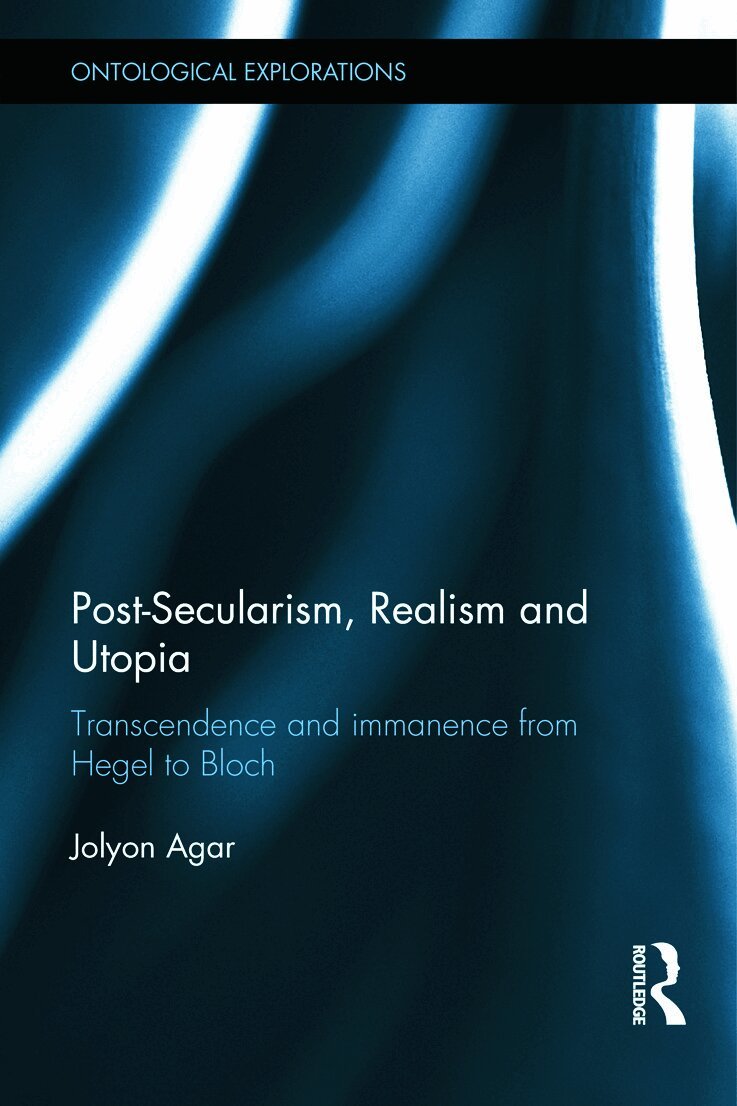
Post-Secularism, Realism and Utopia
Transcendence and Immanence from Hegel to Bloch
Av Jolyon Agar
Inbunden, 2013
2504 kr
Lägg i varukorg
This book explores the contribution to recent developments in post-secularism, philosophical realism and utopianism made by key thinkers in the Hegelian tradition. It challenges dominant assumptions about what the relationship between religion and our so-called "secular age" should be that have …
Rethinking Marxism
18.2
Av Jolyon Agar
E-bok, 2020
762 kr
Lägg i varukorg
This issue invites readers to consider the results of an original and provocative theoretical project that has taken place in a seminar on "subjects of economy" at the University of Massachusetts in Amherst. It provides some insight into the micropolitical process of class transformation.
Rethinking Marxism
19.1
Av Jolyon Agar
E-bok, 2020
624 kr
Lägg i varukorg
This book presents a final symposium, of the program for Rethinking Marxism 2006, comprising a set of commentaries on the categories and critical modes of analysis elaborated in Transition and Development in India by Anjan Chakrabarti and Stephen Cullenberg.
Rethinking Marxism
January, Vol: 17.2
Av Jolyon Agar
E-bok, 2020
604 kr
Lägg i varukorg
Rethinking Marxism focuses on two intersecting works of contemporary left literary and cultural thought: Amitava Kumar''s Bombay-London-New York and Warren Montag''s Louis Althusser , which represent divergent conceptions of the nature.
Rethinking Marxism
19.1
Av Jolyon Agar
E-bok, 2020
624 kr
Lägg i varukorg
This book presents a final symposium, of the program for Rethinking Marxism 2006, comprising a set of commentaries on the categories and critical modes of analysis elaborated in Transition and Development in India by Anjan Chakrabarti and Stephen Cullenberg.
Rethinking Marxism
January, Vol: 17.2
Av Jolyon Agar
E-bok, 2020
618 kr
Lägg i varukorg
Rethinking Marxism focuses on two intersecting works of contemporary left literary and cultural thought: Amitava Kumar''s Bombay-London-New York and Warren Montag''s Louis Althusser , which represent divergent conceptions of the nature.
Rethinking Marxism
18.2
Av Jolyon Agar
E-bok, 2020
762 kr
Lägg i varukorg
This issue invites readers to consider the results of an original and provocative theoretical project that has taken place in a seminar on "subjects of economy" at the University of Massachusetts in Amherst. It provides some insight into the micropolitical process of class transformation.
Post-Secularism, Realism and Utopia
Transcendence and Immanence from Hegel to Bloch
Av Jolyon Agar
Häftad, 2016
718 kr
Lägg i varukorg
This book explores the contribution to recent developments in post-secularism, philosophical realism and utopianism made by key thinkers in the Hegelian tradition. It challenges dominant assumptions about what the relationship between religion and our so-called "secular age" should be that have …
Post-Secularism, Realism and Utopia
Transcendence and Immanence from Hegel to Bloch
Av Jolyon Agar
E-bok, 2013
849 kr
Lägg i varukorg
This book explores the contribution to recent developments in post-secularism, philosophical realism and utopianism made by key thinkers in the Hegelian tradition. It challenges dominant assumptions about what the relationship between religion and our so-called "secular age" should be that have …
Post-Secularism, Realism and Utopia
Transcendence and Immanence from Hegel to Bloch
Av Jolyon Agar
E-bok, 2013
830 kr
Lägg i varukorg
This book explores the contribution to recent developments in post-secularism, philosophical realism and utopianism made by key thinkers in the Hegelian tradition. It challenges dominant assumptions about what the relationship between religion and our so-called "secular age" should be that have …
Post-Secularism, Realism & Utopia
Transcendence & Immanence from Hegel to Bloch
Av Jolyon Agar
Häftad, 2013
1221 kr
Tillfälligt slut
This project addresses the recent rise in post-secularism in the humanities and social sciences. Post-secularism is the proposition that the secular project begun by the Enlightenment has come to an end. If we define secularism as the historical process of increasing marginalisation of the …