Jonathan Duquette – författare
Visar alla böcker från författaren Jonathan Duquette. Handla med fri frakt och snabb leverans.
4 produkter
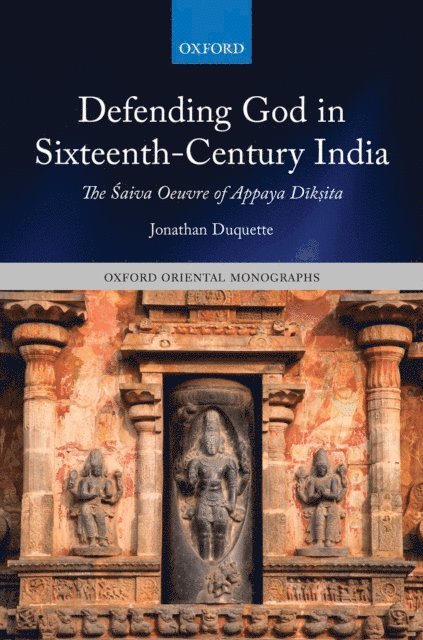
Defending God in Sixteenth-Century India
The Saiva Oeuvre of Appaya Diksita
E-bok, 2021
1368 kr
Lägg i varukorg
This book is the first in-depth study of the Åšaiva oeuvre of the celebrated polymath Appaya DÄ«ká¹£ita (1520-1593). Jonathan Duquette documents the rise to prominence and scholarly reception of ÅšivÄdvaita VedÄnta, a Sanskrit-language school of philosophical theology which Appaya single-handedly …
Defending God in Sixteenth-Century India
The Saiva Oeuvre of Appaya Diksita
E-bok, 2021
1368 kr
Lägg i varukorg
This book is the first in-depth study of the Åšaiva oeuvre of the celebrated polymath Appaya DÄ«ká¹£ita (1520-1593). Jonathan Duquette documents the rise to prominence and scholarly reception of ÅšivÄdvaita VedÄnta, a Sanskrit-language school of philosophical theology which Appaya single-handedly …
Defending God in Sixteenth-Century India
The Śaiva Oeuvre of Appaya Dīkṣita
Inbunden, 2021
2077 kr
Lägg i varukorg
This book is the first in-depth study of the Śaiva oeuvre of the celebrated polymath Appaya Dīkṣita (1520-1593). Jonathan Duquette documents the rise to prominence and scholarly reception of Śivādvaita Vedānta, a Sanskrit-language school of philosophical theology which Appaya single-handedly …
Bloomsbury Research Handbook of Non-Duality in Indian Philosophy
Av James Madaio, Jonathan Duquette
Inbunden, 2027
1960 kr
Kommande
While the concept of non-duality is central to many religious and philosophical traditions, it has found some of its most sophisticated and diverse expressions in South Asia. Drawing on a rich body of sources across multiple languages, communities, and traditions, this handbook maps, for the first …