Jordan Howard Sobel - Böcker
Visar alla böcker från författaren Jordan Howard Sobel. Handla med fri frakt och snabb leverans.
4 produkter
4 produkter
679 kr
Skickas inom 7-10 vardagar
J. Howard Sobel has long been recognized as an important figure in philosophical discussions of rational decision. He has done much to help formulate the concept of causal decision theory. In this volume of essays Sobel explores the Bayesian idea that rational actions maximize expected values, where an action's expected value is a weighted average of its agent's values for its possible total outcomes. Newcomb's Problem and The Prisoner's Dilemma are discussed, and Allais-type puzzles are viewed from the perspective of causal world Bayesianism. The author establishes principles for distinguishing options in decision problems, and studies ways in which perfectly rational causal maximizers can be capable of resolute choices. Sobel also views critically Gauthier's revisionist ideas about maximizing rationality. This collection will be a desideratum for anyone working in the field of rational choice theory, whether in philosophy, economics, political science, psychology or statistics. Howard Sobel's work in decision theory is certainly among the most important, interesting and challenging that is being done by philosophers.
600 kr
Skickas inom 7-10 vardagar
This is a wide-ranging 2004 book about arguments for and against beliefs in God. The arguments for the belief are analysed in the first six chapters and include ontological arguments from Anselm to Gödel, the cosmological arguments of Aquinas and Leibniz, and arguments from evidence for design and miracles. The next two chapters consider arguments against belief. The last chapter examines Pascalian arguments for and against belief in God. There are discussions of Cantorian problems for omniscience, of challenges to divine omnipotence, and of the compatibility of everlasting complete knowledge of the world with free-will. There are appendices that present formal proofs in a system for quantified modal logic, a theory of possible worlds, notes on Cantorian set theory, and remarks concerning non-standard hyperreal numbers. This book will be a valuable resource for philosophers of religion and theologians and will interest logicians and mathematicians as well.
1 390 kr
Skickas inom 7-10 vardagar
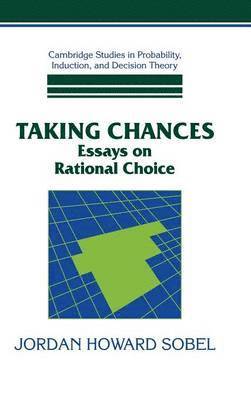
J. Howard Sobel has long been recognized as an important figure in philosophical discussions of rational decision. He has done much to help formulate the concept of causal decision theory. In this volume of essays Sobel explores the Bayesian idea that rational actions maximize expected values, where an action's expected value is a weighted average of its agent's values for its possible total outcomes. Newcomb's Problem and The Prisoner's Dilemma are discussed, and Allais-type puzzles are viewed from the perspective of causal world Bayesianism. The author establishes principles for distinguishing options in decision problems, and studies ways in which perfectly rational causal maximizers can be capable of resolute choices. Sobel also views critically Gauthier's revisionist ideas about maximizing rationality. This collection will be a desideratum for anyone working in the field of rational choice theory, whether in philosophy, economics, political science, psychology or statistics. Howard Sobel's work in decision theory is certainly among the most important, interesting and challenging that is being done by philosophers.
1 087 kr
Skickas inom 7-10 vardagar
This is a wide-ranging 2004 book about arguments for and against beliefs in God. The arguments for the belief are analysed in the first six chapters and include ontological arguments from Anselm to Gödel, the cosmological arguments of Aquinas and Leibniz, and arguments from evidence for design and miracles. The next two chapters consider arguments against belief. The last chapter examines Pascalian arguments for and against belief in God. There are discussions of Cantorian problems for omniscience, of challenges to divine omnipotence, and of the compatibility of everlasting complete knowledge of the world with free-will. There are appendices that present formal proofs in a system for quantified modal logic, a theory of possible worlds, notes on Cantorian set theory, and remarks concerning non-standard hyperreal numbers. This book will be a valuable resource for philosophers of religion and theologians and will interest logicians and mathematicians as well.