Jose Chabas – författare
Visar alla böcker från författaren Jose Chabas. Handla med fri frakt och snabb leverans.
7 produkter
Astronomy in the Iberian Peninsula
Abraham Zacut and the Transition from Manuscript to Print Transactions, American Philosophical Society (vol. 90. Part 2)
Av Bernard R. Goldstein, Jose Chabas
Häftad, 2000
503 kr
Lägg i varukorg
Alfonsine Tables of Toledo
Av José Chabás, B.R. Goldstein
Inbunden, 2003
1688 kr
Lägg i varukorg
The Alfonsine Tables of Toledo is for historians working in the fields of astronomy, science, the Middle Ages, Spanish and other Romance languages. It is also of interest to scholars interested in the history of Castile, in Castilian-French relations in the Middle Ages and in the history of …
Alfonsine Astronomy: Computational Practices
Av Mathieu Husson, Jose Chabas
Inbunden
1796 kr
Lägg i varukorg
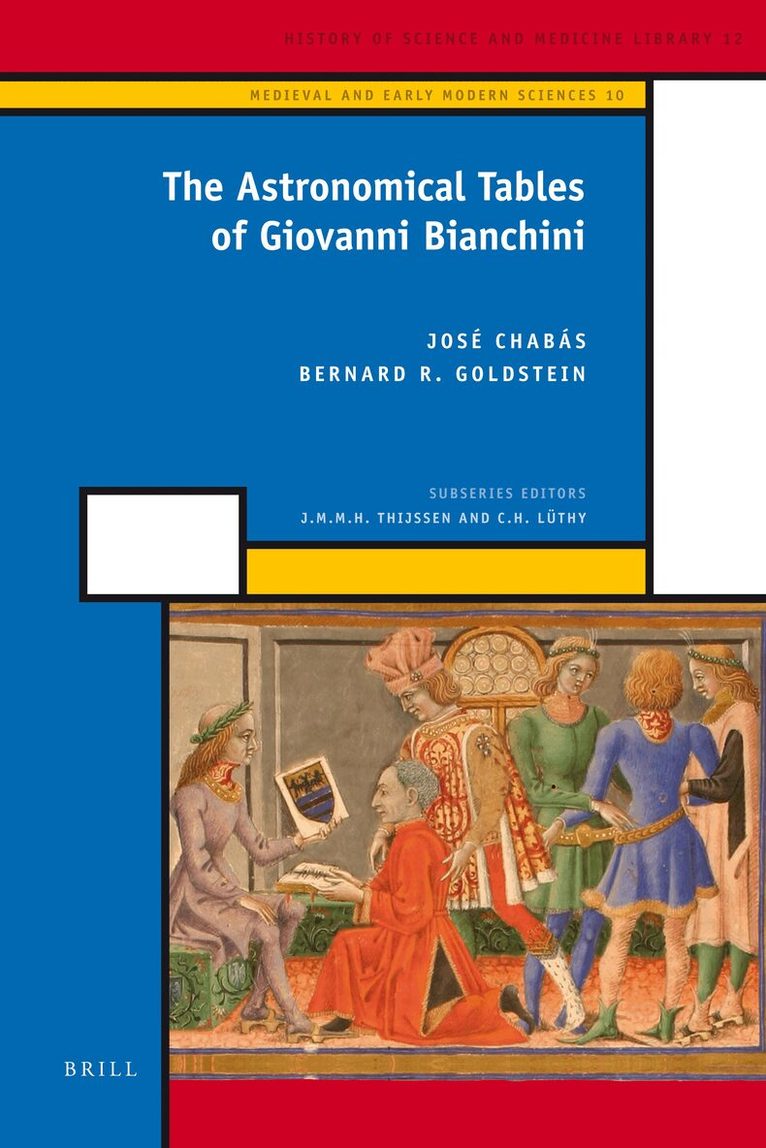
Astronomical Tables of Giovanni Bianchini
Av José Chabás, Bernard Goldstein
Inbunden, 2009
2029 kr
Lägg i varukorg
The Alfonsine Tables became the main computing tool for astronomers for about 250 years, from their compilation in Toledo ca. 1272 to the edition in 1551 of new tables based on Copernicus’s astronomical models. It consisted of a set of astronomical tables which, over time, was presented in many …
Alfonsine Tables of Toledo
Av José Chabás, B.R. Goldstein
Häftad, 2011
1688 kr
Lägg i varukorg
The Alfonsine Tables of Toledo is for historians working in the fields of astronomy, science, the Middle Ages, Spanish and other Romance languages. It is also of interest to scholars interested in the history of Castile, in Castilian-French relations in the Middle Ages and in the history of …
Alfonsine Tables of Toledo
Av B.R. Goldstein, Jose Chabas
E-bok, 2013
2174 kr
Lägg i varukorg
The Alfonsine Tables of Toledo is for historians working in the fields of astronomy, science, the Middle Ages, Spanish and other Romance languages. It is also of interest to scholars interested in the history of Castile, in Castilian-French relations in the Middle Ages and in the history of …
Survey of European Astronomical Tables in the Late Middle Ages
Av José Chabás, Bernard R. Goldstein
Inbunden, 2012
2553 kr
Tillfälligt slut
A Survey of European Astronomical Tables in the Late Middle Ages is a first attempt to classify and illustrate the numerous astronomical tables compiled from about the 10th century to the early 16th century in the Latin West. The compilation of astronomical tables was a major and dynamic …