José Pineda de Gyvez - Böcker
Visar alla böcker från författaren José Pineda de Gyvez. Handla med fri frakt och snabb leverans.
7 produkter
7 produkter
2 111 kr
Skickas inom 10-15 vardagar
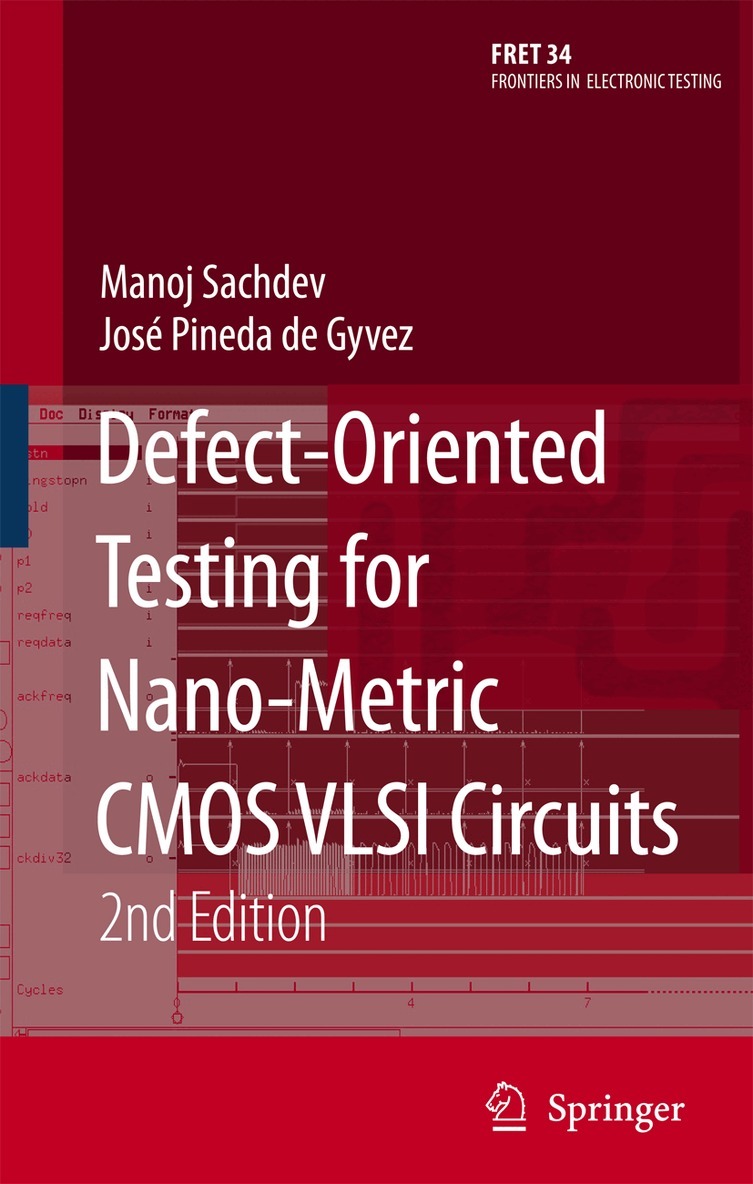
Defect-oriented testing methods have come a long way from a mere interesting academic exercise to a hard industrial reality. Many factors have contributed to its industrial acceptance. Traditional approaches of testing modern integrated circuits have been found to be inadequate in terms of quality and economics of test. In a globally competitive semiconductor market place, overall product quality and economics have become very important objectives. In addition, electronic systems are becoming increasingly complex and demand components of the highest possible quality. Testing in general and defect-oriented testing in particular help in realizing these objectives. For contemporary System on Chip (SoC) VLSI circuits, testing is an activity associated with every level of integration. However, special emphasis is placed for wafer-level test, and final test. Wafer-level test consists primarily of dc or slow-speed tests with current/voltage checks per pin under most operating conditions and with test limits properly adjusted. Basic digital tests are applied and in some cases low-frequency tests to ensure analog/RF functionality are exercised as well. Final test consists of checking device functionality by exercising RF tests and by applying a comprehensive suite of digital test methods such as I , delay fault testing, DDQ stuck-at testing, low-voltage testing, etc. This partitioning choice is actually application dependent.
Integrated Circuit Manufacturability
The Art of Process and Design Integration
Inbunden, Engelska, 1998
2 607 kr
Skickas inom 7-10 vardagar
"INTEGRATED CIRCUIT MANUFACTURABILITY provides comprehensive coverage of the process and design variables that determine the ease and feasibility of fabrication (or manufacturability) of contemporary VLSI systems and circuits. This book progresses from semiconductor processing to electrical design to system architecture. The material provides a theoretical background as well as case studies, examining the entire design for the manufacturing path from circuit to silicon. Each chapter includes tutorial and practical applications coverage. INTEGRATED CIRCUIT MANUFACTURABILITY illustrates the implications of manufacturability at every level of abstraction, including the effects of defects on the layout, their mapping to electrical faults, and the corresponding approaches to detect such faults. The reader will be introduced to key practical issues normally applied in industry and usually required by quality, product, and design engineering departments in today's design practices: * Yield management strategies* Effects of spot defects* Inductive fault analysis and testing* Fault-tolerant architectures and MCM testing strategies. This book will serve design and product engineers both from academia and industry. It can also be used as a reference or textbook for introductory graduate-level courses on manufacturing."
1 059 kr
Skickas inom 10-15 vardagar
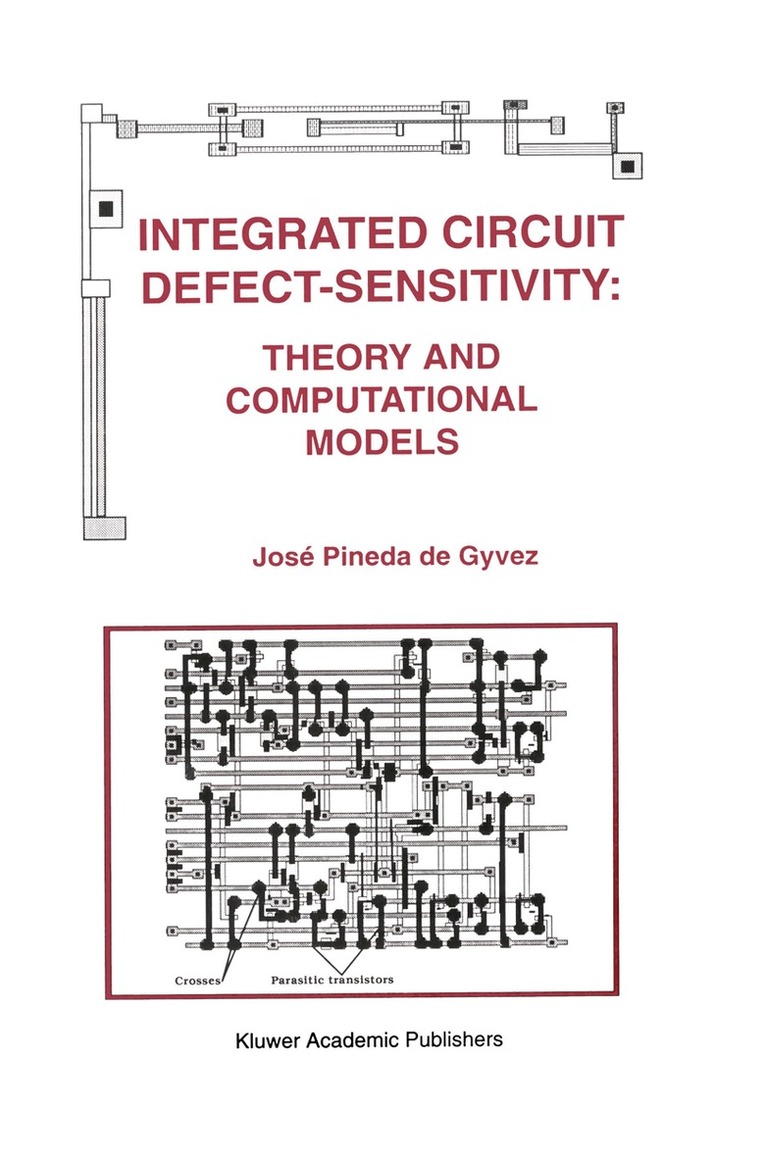
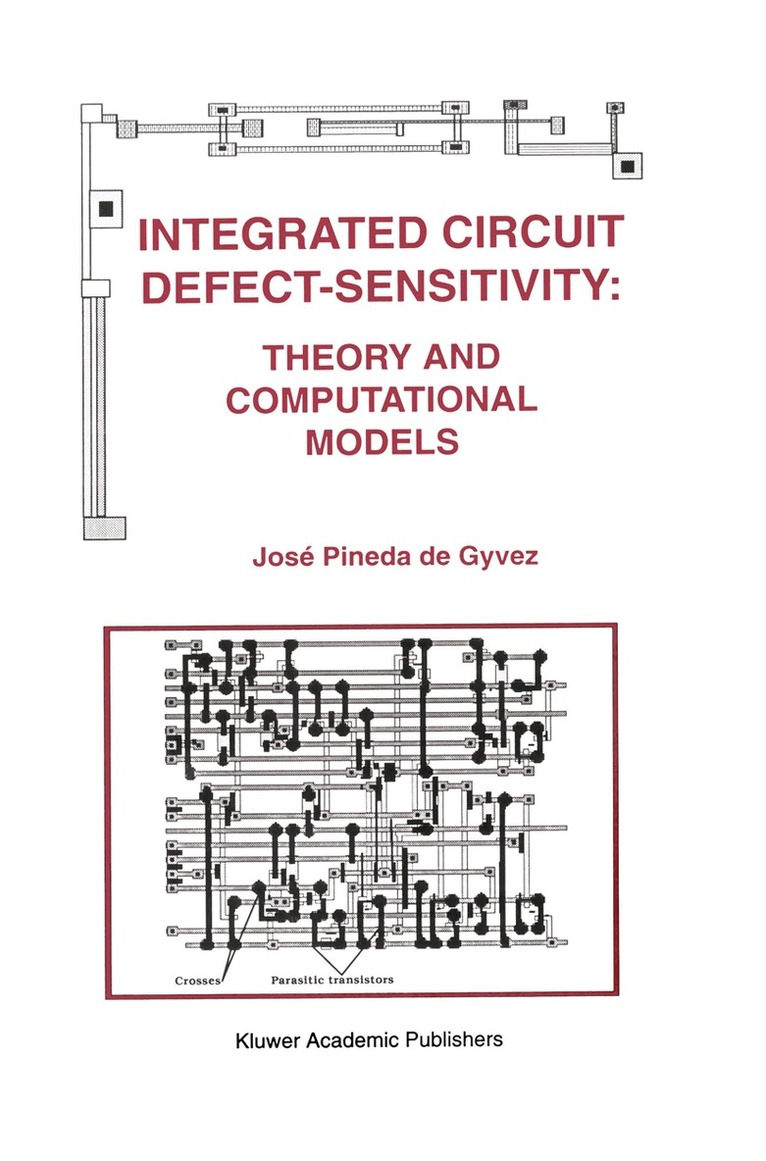
Spot defects are random phenomena present in every fabrication line. As technological processes mature towards submicron features, the effect of these defects on the functional and parametric behaviour of the IC becomes crucial. This work reviews the importance of a defect-sensitivity analysis in contemporary VLSI design processes. The modelling of defects in microelectronics technologies is revised from a set theoretical approach as well as from a practical point of view. This way of handling the material introduces the reader step by step to critical area analysis through the construction of formal mathematical models. The rigorous formalism developed in the book is necessary to study the construction of deterministic algorithms for layout defect exploration. Without this basis, it would be impossible to scan layouts in the order of 1,000,000 objects, or more, in a reasonable time. The theoretical component of this book is complemented with a set of practical case studies for fault extraction, yield prediction and IC defect-sensitivity evaluation.These case studies emphasize the fact that by suing appropriate formulae combining statistical data with the computed defect-sensitivity, an estimate of the IC's defect tolerance can be obtained at the end of the respective production line. The case studies include a vast range of illustrations depicting critical areas. Examples range from highlighting their geometical nature as a function of the defect size to more specific situations highlighting layout regions where faults may occur. In addition to the visualization of critical areas, numerical data in the form of tables, graphs and histograms are provided for quantification purposes. More than that, ever smarter, defect-tolerant design strategies have to be devised to attain high yields. Obviously, the work presented in the book is not definitive, and more research will always be useful to advance the field of CAD for manufacturability. This is, of course, one of the challenges imposed by the ever-changing nature of microelectronic technologies. CAD developers and yield practitioners from academia and industry should find that this book lays the foundations for further pioneering work.
2 028 kr
Skickas inom 5-8 vardagar
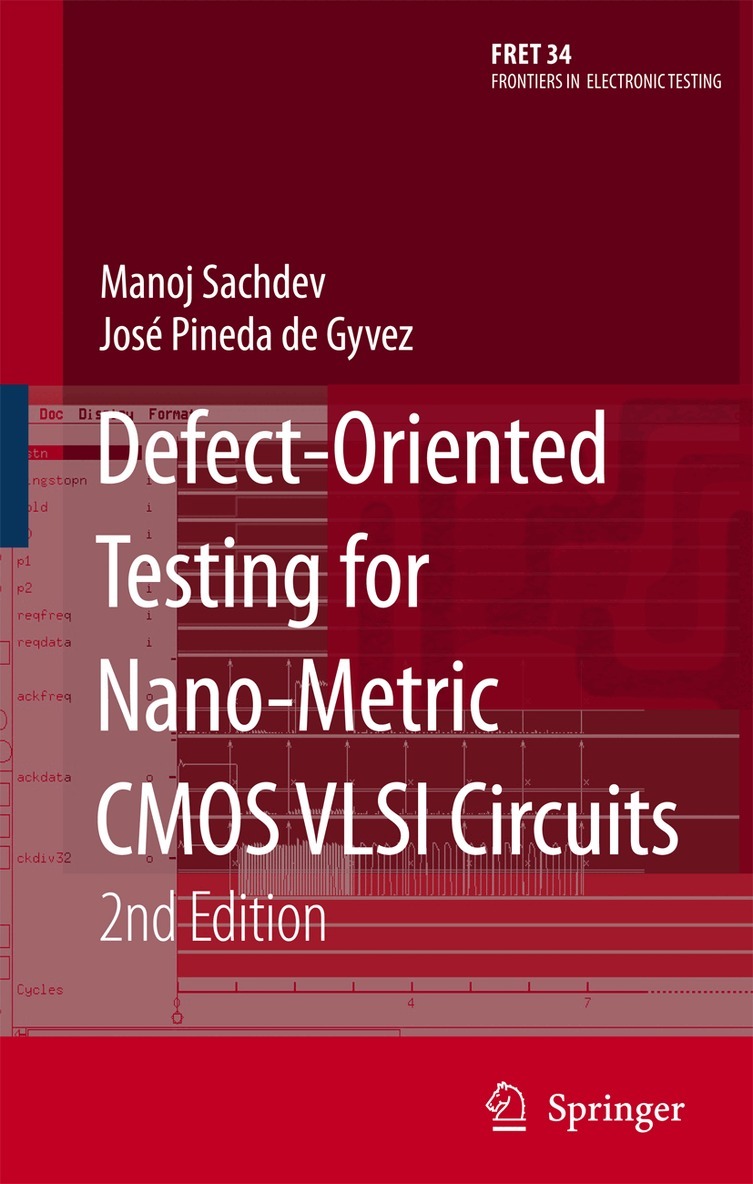
Defect-oriented testing methods have come a long way from a mere interesting academic exercise to a hard industrial reality. Many factors have contributed to its industrial acceptance. Traditional approaches of testing modern integrated circuits have been found to be inadequate in terms of quality and economics of test. In a globally competitive semiconductor market place, overall product quality and economics have become very important objectives. In addition, electronic systems are becoming increasingly complex and demand components of the highest possible quality. Testing in general and defect-oriented testing in particular help in realizing these objectives. For contemporary System on Chip (SoC) VLSI circuits, testing is an activity associated with every level of integration. However, special emphasis is placed for wafer-level test, and final test. Wafer-level test consists primarily of dc or slow-speed tests with current/voltage checks per pin under most operating conditions and with test limits properly adjusted. Basic digital tests are applied and in some cases low-frequency tests to ensure analog/RF functionality are exercised as well. Final test consists of checking device functionality by exercising RF tests and by applying a comprehensive suite of digital test methods such as I , delay fault testing, DDQ stuck-at testing, low-voltage testing, etc. This partitioning choice is actually application dependent.
1 059 kr
Skickas inom 10-15 vardagar
The history of this book begins way back in 1982. At that time a research proposal was filed with the Dutch Foundation for Fundamental Research on Matter concerning research to model defects in the layer structure of integrated circuits. It was projected that the results may be useful for yield estimates, fault statistics and for the design of fault tolerant structures. The reviewers were not in favor of this proposal and it disappeared in the drawers. Shortly afterwards some microelectronics industries realized that their survival may depend on a better integration between technology-and design-laboratories. For years the "silicon foundry" concept had suggested a fairly rigorous separation between the two areas. The expectation was that many small design companies would share the investment into the extremely costful Silicon fabrication plants while designing large lots of application-specific integrated circuits (ASIC's). Those fabrication plants would be concentrated with only a few market leaders.
Low-Power High-Resolution Analog to Digital Converters
Design, Test and Calibration
Inbunden, Engelska, 2010
533 kr
Skickas inom 10-15 vardagar
With the fast advancement of CMOS fabrication technology, more and more signal-processing functions are implemented in the digital domain for a lower cost, lower power consumption, higher yield, and higher re-configurability. This has recently generated a great demand for low-power, low-voltage A/D converters that can be realized in a mainstream deep-submicron CMOS technology. However, the discrepancies between lithography wavelengths and circuit feature sizes are increasing. Lower power supply voltages significantly reduce noise margins and increase variations in process, device and design parameters. Consequently, it is steadily more difficult to control the fabrication process precisely enough to maintain uniformity. The inherent randomness of materials used in fabrication at nanoscopic scales means that performance will be increasingly variable, not only from die-to-die but also within each individual die. Parametric variability will be compounded by degradation in nanoscale integrated circuits resulting in instability of parameters over time, eventually leading to the development of faults. Process variation cannot be solved by improving manufacturing tolerances; variability must be reduced by new device technology or managed by design in order for scaling to continue. Similarly, within-die performance variation also imposes new challenges for test methods.In an attempt to address these issues, Low-Power High-Resolution Analog-to-Digital Converters specifically focus on: i) improving the power efficiency for the high-speed, and low spurious spectral A/D conversion performance by exploring the potential of low-voltage analog design and calibration techniques, respectively, and ii) development of circuit techniques and algorithms to enhance testing and debugging potential to detect errors dynamically, to isolate and confine faults, and to recover errors continuously. The feasibility of the described methods has been verified by measurementsfrom the silicon prototypes fabricated in standard 180nm, 90nm and 65nm CMOS technology.
Low-Power High-Resolution Analog to Digital Converters
Design, Test and Calibration
Häftad, Engelska, 2016
533 kr
Skickas inom 10-15 vardagar
With the fast advancement of CMOS fabrication technology, more and more signal-processing functions are implemented in the digital domain for a lower cost, lower power consumption, higher yield, and higher re-configurability. This has recently generated a great demand for low-power, low-voltage A/D converters that can be realized in a mainstream deep-submicron CMOS technology. However, the discrepancies between lithography wavelengths and circuit feature sizes are increasing. Lower power supply voltages significantly reduce noise margins and increase variations in process, device and design parameters. Consequently, it is steadily more difficult to control the fabrication process precisely enough to maintain uniformity. The inherent randomness of materials used in fabrication at nanoscopic scales means that performance will be increasingly variable, not only from die-to-die but also within each individual die. Parametric variability will be compounded by degradation in nanoscale integrated circuits resulting in instability of parameters over time, eventually leading to the development of faults. Process variation cannot be solved by improving manufacturing tolerances; variability must be reduced by new device technology or managed by design in order for scaling to continue. Similarly, within-die performance variation also imposes new challenges for test methods.In an attempt to address these issues, Low-Power High-Resolution Analog-to-Digital Converters specifically focus on: i) improving the power efficiency for the high-speed, and low spurious spectral A/D conversion performance by exploring the potential of low-voltage analog design and calibration techniques, respectively, and ii) development of circuit techniques and algorithms to enhance testing and debugging potential to detect errors dynamically, to isolate and confine faults, and to recover errors continuously. The feasibility of the described methods has been verified by measurementsfrom the silicon prototypes fabricated in standard 180nm, 90nm and 65nm CMOS technology.