Josef Stern - Böcker
Visar alla böcker från författaren Josef Stern. Handla med fri frakt och snabb leverans.
6 produkter
6 produkter
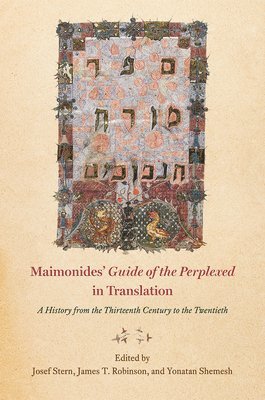
Maimonides' "guide of the Perplexed" in Translation
A History from the Thirteenth Century to the Twentieth
Inbunden, Engelska, 2019
471 kr
Skickas inom 7-10 vardagar
Moses Maimonides's Guide of the Perplexed is the greatest philosophical text in the history of Jewish thought and a major work of the Middle Ages. For almost all of its history, however, the Guide has been read and commented upon in translation--in Hebrew, Latin, Spanish, French, English, and other modern languages--rather than in its original Judeo-Arabic. This volume is the first to tell the story of the translations and translators of Maimonides' Guide and its impact in translation on philosophy from the Middle Ages to the present day. A collection of essays by scholars from a range of disciplines, the book unfolds in two parts. The first traces the history of the translations of the Guide, from medieval to modern renditions. The second surveys its influence in translation on Latin scholastic, early modern, and contemporary Anglo-American philosophy, as well as its impact in translation on current scholarship. Interdisciplinary in approach, this book will be essential reading for philosophers, historians, and religious studies scholars alike.
723 kr
Tillfälligt slut
535 kr
Skickas inom 3-6 vardagar
836 kr
Tillfälligt slut
588 kr
Skickas inom 10-15 vardagar
Maimonides’ Guide of the Perplexed has traditionally been read as an attempt to harmonize reason and revelation. Another, more recent interpretation takes the contradiction between philosophy and religion to be irreconcilable, and concludes that the Guide prescribes religion for the masses and philosophy for the elite. Moving beyond these familiar debates, Josef Stern argues that the perplexity addressed in this famously enigmatic work is not the conflict between Athens and Jerusalem but the tension between human matter and form, between the body and the intellect.Maimonides’ philosophical tradition takes the perfect life to be intellectual: pure, undivided contemplation of all possible truths, from physics and cosmology to metaphysics and God. According to the Guide, this ideal cannot be realized by humans. Their embodied minds cannot achieve scientific knowledge of metaphysics, and their bodily impulses interfere with exclusive contemplation. Closely analyzing the arguments in the Guide and its original use of the parable as a medium of philosophical writing, Stern articulates Maimonides’ skepticism about human knowledge of metaphysics and his heterodox interpretations of scriptural and rabbinic parables. Stern shows how, in order to accommodate the conflicting demands of the intellect and the body, Maimonides creates a repertoire of spiritual exercises, reconceiving the Mosaic commandments as training for the life of the embodied mind. By focusing on the philosophical notions of matter and form, and the interplay between its literary form and subject matter, Stern succeeds in developing a unified, novel interpretation of the Guide.
Problems and Parables of Law
Maimonides and Nahmanides on Reasons for the Commandments (Ta’amei Ha-Mitzvot)
Häftad, Engelska, 1998
382 kr
Tillfälligt slut
A rigorous analysis of Maimonides' and Nahmanides' explanations of the Mosaic commandments that challenges received notions of the relation between these two seminal thinkers.A central topic in medieval Jewish philosophy and thought was the explanation of the Mosaic commandments. From Philo and Saadiah on, thinkers sought to uncover "reasons for the commandments" (ta'amei ha-mitzvot) both to demonstrate the rationality of divine legislation and to motivate performance of the commandments. Like many received topics, this enterprise was radically transformed in the hands of Maimonides.In this first book-length treatment of a subject that has been relatively overlooked by scholars since Isaac Heinemann's classic work in the 1950s, Josef Stern offers an original analysis of two major themes in Maimonides' explanation of the Law and its impact on Nahmanides. The first theme is Maimonides' reconceptualization of the huqqim, those commandments that were traditionally asserted either to have no reason or a reason that is unknown or unknowable. The second theme is Maimonides' application of his method of multi-leveled interpretation that treats texts as parables with "external" and "internal" meaning to the explanation of commandments with multiple reasons. Both of these innovative modes of explanation are adopted by Nahmanides, who refined and adapted Maimonides' structures of interpretation to express diametrically opposed contents. From this perspective there emerges a picture of the relation between these two seminal figures of medieval Judaism that is much more subtle than the received opinion that bluntly opposes them, the radical arch rationalist against the mystical traditionalist.Inquiry into ta'amei ha-mitzvot served as a locus for discussion of a broad range of philosophical topics: the attributes of God, the grounds of law and legal obligation, the structure of explanation and interpretation, idolatry, friendship and love, the status of astrology and magic, and attitudes toward the body. Stern demonstrates both the philosophical importance of these topics in Maimonides' and Nahmanides' thought and the relevance of their writings to contemporary philosophical discussions.