Joseph A. Kahl - Böcker
Visar alla böcker från författaren Joseph A. Kahl. Handla med fri frakt och snabb leverans.
3 produkter
3 produkter
269 kr
Skickas inom 10-15 vardagar
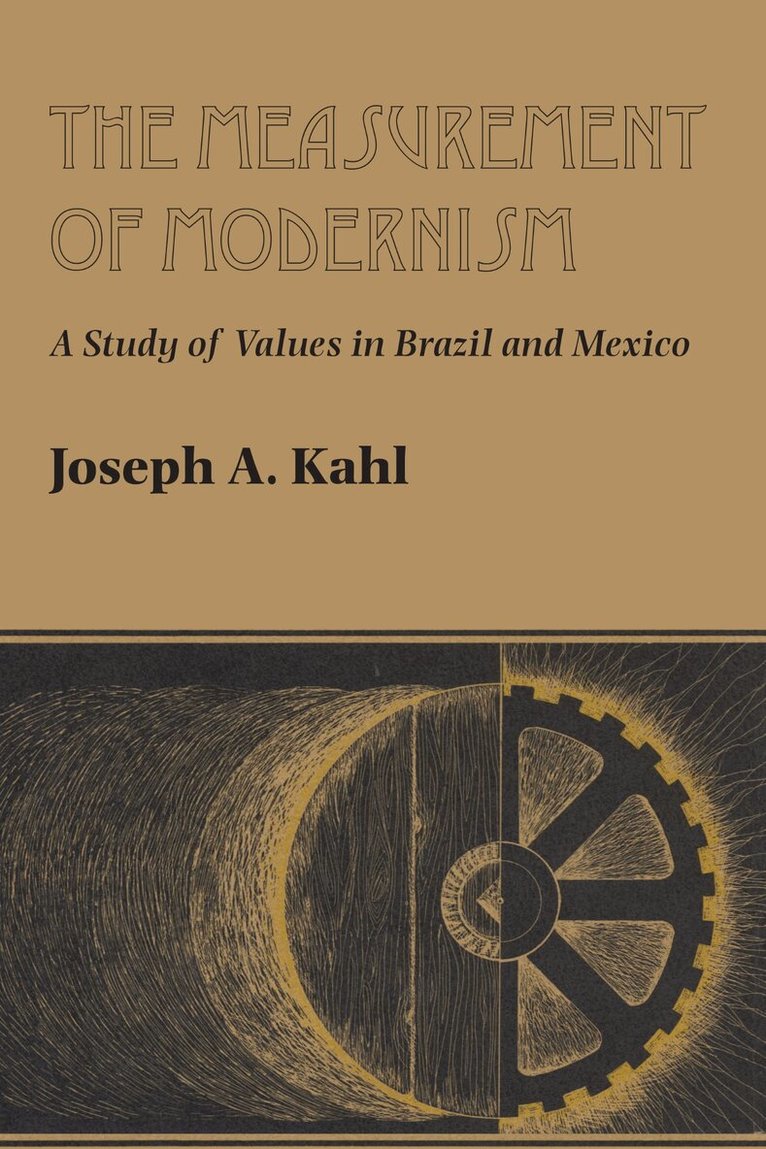
One of the most interesting questions that can be raised about the twentieth century world concerns the degree to which industrialization created a common culture for all peoples. Reported here are the results of an empirical investigation designed to produce instruments to measure those personal values that have been central variables in the theory of modernization of societies.The purpose of Joseph Kahl’s research is primarily methodological: to advance the description and measurement of those value orientations used by men to organize their occupational careers. It seeks to delineate and measure a set of values that represents a “modern” view of work and life.The working laboratory was Brazil and Mexico, two countries undergoing rapid industrialization. More than six hundred men in Brazil and more than seven hundred in Mexico responded to questionnaires. In addition, over twenty-five men in each country were asked to sit beside a tape recorder and talk freely of their worldviews. The respondents were divided between inhabitants of the cities of Rio de Janeiro and Mexico City and those who lived in provincial towns of fewer than ten thousand inhabitants. The samples included manual and nonmanual employees.The results showed that the main variable predicting whether or not a man would tend toward modernism was his social-class position. Middle-class men were much more modern in outlook than working-class men. Residence in a metropolis rather than in a small town also increased modernism, though to a lesser extent. Differences between Brazil and Mexico (and, indeed, the United States) were found to be surprisingly small, of considerably less weight than position in the social structure in predicting value orientations.The author addresses himself primarily to sociologists and their students who are themselves studying aspects of socio-economic development. His findings, however, cannot fail to be of interest and benefit to social scientists of various disciplines and to all who are concerned with the process of development-planners at the national and local levels, demographers, and businesspeople.
Three Latin American Sociologists
Gino Germani, Pablo Gonzales Casanova, Fernando Henrique Cardosa
Inbunden, Engelska, 2024
1 148 kr
Skickas inom 10-15 vardagar
Originally published in 1976 under the title Modernization, Exploitation and Dependency in Latin America, and again in 1988 under the current title, the author describes, examines and introduces the life and work of three of the most important figures in the development of comparative politics and political sociology: Gino Germani (Argentina), Pablo Gonzales Casanova (Mexico) and Fernando Henrique Cardoso (Brazil). At the time of its first publication, the book introduced those three Latin American sociologists to the North American social and political science community. However, as Peter Evans points out in his introduction, the book had not lost its importance in the intervening years. Rather, the subsequent developments in comparative scholarship have only highlighted the influence of the three Latin Americans. The developments in comparative and political social science can virtually only be understood in the light of the influence that the thought of Germani, Gonzales Casanova and Cardoso had on the discussions in North America.
Three Latin American Sociologists
Gino Germani, Pablo Gonzales Casanova, Fernando Henrique Cardosa
Häftad, Engelska, 2026
442 kr
Skickas inom 10-15 vardagar
Originally published in 1976 under the title Modernization, Exploitation and Dependency in Latin America, and again in 1988 under the current title, the author describes, examines and introduces the life and work of three of the most important figures in the development of comparative politics and political sociology: Gino Germani (Argentina), Pablo Gonzales Casanova (Mexico) and Fernando Henrique Cardoso (Brazil). At the time of its first publication, the book introduced those three Latin American sociologists to the North American social and political science community. However, as Peter Evans points out in his introduction, the book had not lost its importance in the intervening years. Rather, the subsequent developments in comparative scholarship have only highlighted the influence of the three Latin Americans. The developments in comparative and political social science can virtually only be understood in the light of the influence that the thought of Germani, Gonzales Casanova and Cardoso had on the discussions in North America.