Joseph A. McCahery - Böcker
Visar alla böcker från författaren Joseph A. McCahery. Handla med fri frakt och snabb leverans.
9 produkter
9 produkter
Institutional Investor Activism
Hedge Funds and Private Equity, Economics and Regulation
Inbunden, Engelska, 2015
1 440 kr
Skickas inom 7-10 vardagar
The past two decades has witnessed unprecedented changes in the corporate governance landscape in Europe, the US and Asia. Across many countries, activist investors have pursued engagements with management of target companies. More recently, the role of the hostile activist shareholder has been taken up by a set of hedge funds. Hedge fund activism is characterized by mergers and corporate restructuring, replacement of management and board members, proxy voting, and lobbying of management. These investors target and research companies, take large positions in `their stock, criticize their business plans and governance practices, and confront their managers, demanding action enhancing shareholder value. This book analyses the impact of activists on the companies that they invest, the effects on shareholders and on activists funds themselves. Chapters examine such topic as investors' strategic approaches, the financial returns they produce, and the regulatory frameworks within which they operate. The chapters also provide historical context, both of activist investment and institutional shareholder passivity. The volume facilitates a comparison between the US and the EU, juxtaposing not only regulatory patterns but investment styles.
Institutional Investor Activism
Hedge Funds and Private Equity, Economics and Regulation
Häftad, Engelska, 2015
1 125 kr
Skickas inom 7-10 vardagar
The past two decades has witnessed unprecedented changes in the corporate governance landscape in Europe, the US and Asia. Across many countries, activist investors have pursued engagements with management of target companies. More recently, the role of the hostile activist shareholder has been taken up by a set of hedge funds. Hedge fund activism is characterized by mergers and corporate restructuring, replacement of management and board members, proxy voting, and lobbying of management. These investors target and research companies, take large positions in `their stock, criticize their business plans and governance practices, and confront their managers, demanding action enhancing shareholder value. This book analyses the impact of activists on the companies that they invest, the effects on shareholders and on activists funds themselves. Chapters examine such topic as investors' strategic approaches, the financial returns they produce, and the regulatory frameworks within which they operate. The chapters also provide historical context, both of activist investment and institutional shareholder passivity. The volume facilitates a comparison between the US and the EU, juxtaposing not only regulatory patterns but investment styles.
2 138 kr
Skickas inom 5-8 vardagar
Studies of corporate governance traditionally focus on the governance problems of large publicly held firms, and policymakers'recommendations often focus on such firms. However most small firms, and in many countries, even many large companies, are closely held. This book provides a comprehensive account of closely held businesses and their particular governance problems. It explores current discussions and reforms in Europe, the United States, and Asia providing a state of the art account of the law and the economics. .Closely held firms encompass a vast range, from corporations with the potential to go public through family-owned firms, group-owned firms, private equity and hedge funds, to joint ventures and unlisted mass-privatized corporations with a relatively high number of shareholders.The governance of closely held companies has traditionally been concerned with protecting investors and creditors from managerial opportunism. However, the virtual elimination of the distinction between partnerships and corporations means that an effective legal governance framework must also offer mechanisms to protect shareholders from the misconduct of other shareholders.This volume examines policy and economic measurements to develop a framework for understanding what constitutes good governance in closely held companies. The authors examine how control is gained in the various types of closely held firms and explore the mechanisms that contribute to the development of a modern and efficient governance framework for these companies. The book concludes with an exploration of how the closely held firm is likely to stimulate growth and extend innovation and development.
4 061 kr
Skickas inom 5-8 vardagar
Corporate Governance Regimes addresses corporate law's leading question: whether one or another corporate law regime possesses relative competitive advantage. To this end, the editors have brought together an international team of scholars in economics and law to critically assess the new theories of ownership and control which seek to explain the important efficiency advantages of dispersed ownership and the inevitable limitations of control-oriented systems of governance. Contributors describe and analyse the relative strength of the forces that shape the evolution of corporate law rules and practice. They also raise the issue of whether nations undertaking reforms should develop corporate governance policies that borrow from other systems' best practices, or pursue a course of internally designed corporate governance reforms. And, building on new theories of law and finance, they examine the incentives for introducing meaningful corporate governance reforms that disrupt or destabilize Europe's blockholding regimes.The collection is divided into seven parts. Part One provides not only a means for assessing the key features of market- and control-based systems of governance but a standpoint for determining whether national governance systems are likely to converge on a single, optimal system of governance. Part Two introduces the reader to the building blocks of European corporate governance and the securities law harmonization program. Part Three examines the complex ownership and control structures that are found in Western Europe, investigating the consequences of large shareholdings for minority investors. Part Four offers law and finance analyses of the relationship between legal and financial systems and corporate performance. Part Five looks at the economic perspective on the operation of the market for corporate control and the key legal rules and institutions of the bankruptcy and insolvency regimes in the USA and Britain. Part Six is devoted to exploring the economic effect of institutional shareholder participation in corporate governance in the USA, Britain, and continental Europe. The final section, Part Seven, evaluates empirically the executive compensation arrangements in the USA, Britain, and continental Europe. The contributions supply a pool of current research on the motivational effect of performance-related remuneration and the substantial increase in top executive remuneration in the USA.
The Governance of Close Corporations and Partnerships
US and European Perspectives
Inbunden, Engelska, 2004
2 258 kr
Skickas inom 5-8 vardagar
This volume focuses upon the processes by which new business organization forms have developed in the US, UK, and continental Europe. Part I addresses the theoretical developments in partnership and close corporation law. In Part II, the contributors offer insights into the forces shaping the evolution of partnership-type business forms in the US, UK, and several European jurisdictions, and Part III provides detailed analyses of the Limited Liability Company (LLC), Limited Liability Partnership (LLP), the European Private Company, and the Dutch partnership form.The debate on the design of business organization forms adapted to meet the current needs of a range of closely held firms has gained momentum amid the continuing pressures to supply the most competitive business form for small and medium-sized enterprises (SMEs). Which economic and political forces are responsible for the emergence of new limited liability forms for SMEs? Over the last decade this question has often been addressed, as corporate law scholars, practitioners, and policymakers have increasingly directed their attention towards introducing partnership-type business forms. In the US, states have incentives to take a proactive attitude towards legislative innovations in the field of business organization law, so as to capture and retain closely held firms. In recent years, a rapid succession of statutory innovations of partnership forms (such as the introduction of the LLC and rapid adoption of the LLP) have transformed business organization law.Similar processes can also be identified in the UK and continental Europe. While the EC has pursued the harmonization of the law of public corporations, there has been no real attempt to adopt a series of similar measures for the benefit of closely held firms. A group of European business leaders and experts, however, have drafted recently a business organization statute appropriate for SMEs engaged in cross-border business.
740 kr
Skickas inom 7-10 vardagar
Studies of corporate governance traditionally focus on the governance problems of large publicly held firms, and policymakers' recommendations often focus on such firms. However most small firms, and in many countries, even many large companies, are non-listed. This book provides a comprehensive account of non-listed businesses and their particular governance problems. It explores current discussions and reforms in Europe, the United States, and Asia providing a state of the art account of the law and the economics.Non-listed firms encompass a vast range, from corporations with the potential to go public through family-owned firms, group-owned firms, private equity and hedge funds, to joint ventures and unlisted mass-privatized corporations with a relatively high number of shareholders.The governance of non-listed companies has traditionally been concerned with protecting investors and creditors from managerial opportunism. However, the virtual elimination of the distinction between partnerships and corporations means that an effective legal governance framework must also offer mechanisms to protect shareholders from the misconduct of other shareholders.This volume examines policy and economic measurements to develop a framework for understanding what constitutes good governance in non-listed companies. The authors examine how control is gained and explore the mechanisms that contribute to the development of a modern and efficient governance framework. The book concludes with an exploration of how the closely held firm is likely to stimulate growth and extend innovation and development.
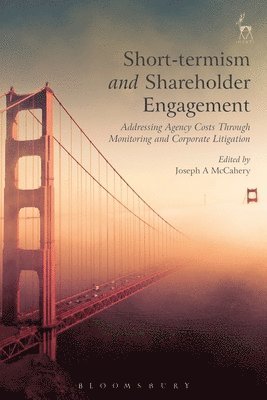
Short-termism and Shareholder Engagement
Addressing Agency Costs through Monitoring and Corporate Litigation
Inbunden, Engelska, 2020
612 kr
Kommande
This edited collection brings together an exceptional group of scholars to discuss a series of most topical issues in the field of comparative corporate law, including short-termism, boards and fiduciary duties, agency costs and corporate litigation.In Part I, the collection provides an account of the rise in institutional investor participation strategies. In Part II, the focus of the book then shifts to consider the fiduciary regime and its legal process rules that provide lawyers with financial incentives to enforce fiduciary norms that address the shareholders’ collective action problem. Moreover, it explores key fiduciary law issues, particularly in the M&A context, from a comparative law standpoint that not only provides the reader with the perspective necessary to understanding US (Delaware) corporate law, but also offers the opportunity to become familiar with the features of company law in England, the Netherlands, and Germany. In Part III, the book looks to how corporate law litigation also serves to address managerial agency costs.
2 661 kr
Skickas inom 7-10 vardagar
This Research Handbook provides a critical examination of the landscape of EU securities law, including crypto-markets, financial innovation and the Capital Markets Union. It explores the enforcement of EU securities regulation ies and related instruments, such as the EU Takeover Regulation.Leading specialists discuss the full length and breadth of the subject, from the history and theory of securities regulation to emerging challenges such as those posed by crypto-assets and crypto-markets. They consider mandatory disclosure, short-selling regulation and growth markets, shedding light on the regulatory framework governing the investment and disclosure requirements of environmental, social and governance assets. The Research Handbook also stands back and considers lawmakers’ attempts to establish coherent regulation that enables financial innovation in an increasingly technology-driven industry, alongside discussions about the value of shareholder activism and the debate between public and private enforcement mechanisms. The Research Handbook on EU Securities Law is an essential reference for scholars and students of financial law and European law. Its forward-thinking insights will also greatly benefit practising lawyers and industry stakeholders in the field of securities.
493 kr
Skickas inom 10-15 vardagar
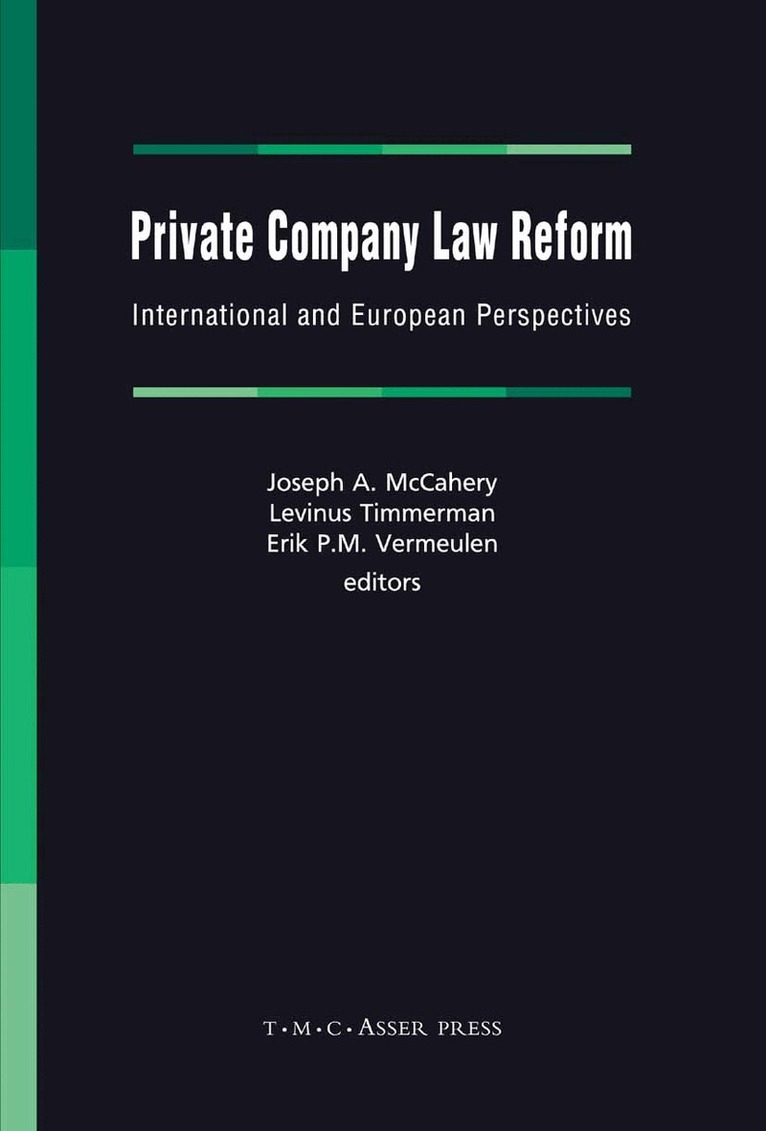
Private Company Law reform is among the most important topics for lawmakers and companies. This well-timed volume explains in details the legal reforms taking place in the principal European jurisdictions, the United States and Asia.The volume brings together a distinguished group of company law scholars to examine the factors leading to the rise of the new unincorporated entities in the US and Asia and explains in detail how private company law forms can be suitably adapted to meet a wide range of firms' needs. It examines the important reforms taking place in private company law across the EU and addresses how the reforms may lead to a more optimal environment for businesses to operate. Finally, it critically explores the advantages of introducing the European Private Company.This book is a valuable tool for scholars, corporate lawyers, practitioners, policymakers and advanced students in law, as well as for entrepreneurs in emerging and developed markets.Joseph A. McCahery is Professor of International Economic Law at Tilburg University, the Netherlands and Professor of Financial Market Regulation, Tilburg Law and Economics Center.Levinus Timmerman is Advocate General in the Supreme Court of the Netherlands and Professor of Foundations of Company Law at the Erasmus University Rotterdam, the Netherlands.Erik P.M. Vermeulen is Professor of Business Law at Tilburg University, Professor of Financial Market Regulation, Tilburg Law and Economics Center, and Vice President at the Corporate Legal Department of Philips International B.V.