Theo Raaijmakers - Böcker
Visar alla böcker från författaren Theo Raaijmakers. Handla med fri frakt och snabb leverans.
3 produkter
3 produkter
4 061 kr
Skickas inom 5-8 vardagar
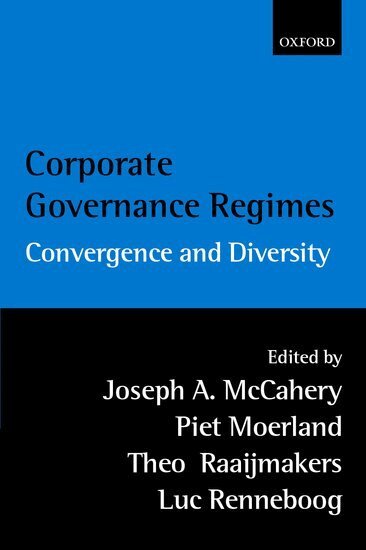
Corporate Governance Regimes addresses corporate law's leading question: whether one or another corporate law regime possesses relative competitive advantage. To this end, the editors have brought together an international team of scholars in economics and law to critically assess the new theories of ownership and control which seek to explain the important efficiency advantages of dispersed ownership and the inevitable limitations of control-oriented systems of governance. Contributors describe and analyse the relative strength of the forces that shape the evolution of corporate law rules and practice. They also raise the issue of whether nations undertaking reforms should develop corporate governance policies that borrow from other systems' best practices, or pursue a course of internally designed corporate governance reforms. And, building on new theories of law and finance, they examine the incentives for introducing meaningful corporate governance reforms that disrupt or destabilize Europe's blockholding regimes.The collection is divided into seven parts. Part One provides not only a means for assessing the key features of market- and control-based systems of governance but a standpoint for determining whether national governance systems are likely to converge on a single, optimal system of governance. Part Two introduces the reader to the building blocks of European corporate governance and the securities law harmonization program. Part Three examines the complex ownership and control structures that are found in Western Europe, investigating the consequences of large shareholdings for minority investors. Part Four offers law and finance analyses of the relationship between legal and financial systems and corporate performance. Part Five looks at the economic perspective on the operation of the market for corporate control and the key legal rules and institutions of the bankruptcy and insolvency regimes in the USA and Britain. Part Six is devoted to exploring the economic effect of institutional shareholder participation in corporate governance in the USA, Britain, and continental Europe. The final section, Part Seven, evaluates empirically the executive compensation arrangements in the USA, Britain, and continental Europe. The contributions supply a pool of current research on the motivational effect of performance-related remuneration and the substantial increase in top executive remuneration in the USA.
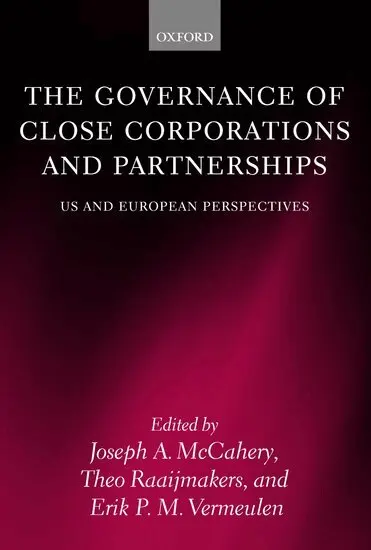
The Governance of Close Corporations and Partnerships
US and European Perspectives
Inbunden, Engelska, 2004
2 258 kr
Skickas inom 5-8 vardagar
This volume focuses upon the processes by which new business organization forms have developed in the US, UK, and continental Europe. Part I addresses the theoretical developments in partnership and close corporation law. In Part II, the contributors offer insights into the forces shaping the evolution of partnership-type business forms in the US, UK, and several European jurisdictions, and Part III provides detailed analyses of the Limited Liability Company (LLC), Limited Liability Partnership (LLP), the European Private Company, and the Dutch partnership form.The debate on the design of business organization forms adapted to meet the current needs of a range of closely held firms has gained momentum amid the continuing pressures to supply the most competitive business form for small and medium-sized enterprises (SMEs). Which economic and political forces are responsible for the emergence of new limited liability forms for SMEs? Over the last decade this question has often been addressed, as corporate law scholars, practitioners, and policymakers have increasingly directed their attention towards introducing partnership-type business forms. In the US, states have incentives to take a proactive attitude towards legislative innovations in the field of business organization law, so as to capture and retain closely held firms. In recent years, a rapid succession of statutory innovations of partnership forms (such as the introduction of the LLC and rapid adoption of the LLP) have transformed business organization law.Similar processes can also be identified in the UK and continental Europe. While the EC has pursued the harmonization of the law of public corporations, there has been no real attempt to adopt a series of similar measures for the benefit of closely held firms. A group of European business leaders and experts, however, have drafted recently a business organization statute appropriate for SMEs engaged in cross-border business.
Influence of IAS/IFRS on the CCCTB, Tax Accounting, Disclosure and Corporate Law Accounting Concepts
A Clash of Cultures
Inbunden, Engelska, 2009
2 653 kr
Tillfälligt slut