Joseph J. Rotman - Böcker
Visar alla böcker från författaren Joseph J. Rotman. Handla med fri frakt och snabb leverans.
10 produkter
10 produkter
702 kr
Skickas inom 7-10 vardagar
An Introduction to Homological Algebra discusses the origins of algebraic topology. It also presents the study of homological algebra as a two-stage affair. First, one must learn the language of Ext and Tor and what it describes. Second, one must be able to compute these things, and often, this involves yet another language: spectral sequences. Homological algebra is an accessible subject to those who wish to learn it, and this book is the author's attempt to make it lovable. This book comprises 11 chapters, with an introductory chapter that focuses on line integrals and independence of path, categories and functors, tensor products, and singular homology. Succeeding chapters discuss Hom and ?; projectives, injectives, and flats; specific rings; extensions of groups; homology; Ext; Tor; son of specific rings; the return of cohomology of groups; and spectral sequences, such as bicomplexes, Kunneth Theorems, and Grothendieck Spectral Sequences. This book will be of interest to practitioners in the field of pure and applied mathematics.
747 kr
Skickas inom 10-15 vardagar
Learning homological algebra is a two-stage affair. First, one must learn the language of Ext and Tor and what it describes. Second, one must be able to compute these things, and, often, this involves yet another language: spectral sequences. This book gives a treatment of homological algebra which motivates the subject in terms of its origins in algebraic topology.In this new edition the book has been updated and revised throughout and new material on sheaves and cup products has been added. The author also included material about homotopical algebra, alias K-theory, contrasting it with homological algebra.
641 kr
Skickas inom 10-15 vardagar
Anyone who has studied abstract algebra and linear algebra as an undergraduate can understand this book. The first six chapters provide material for a first course, while the rest of the book covers more advanced topics. This revised edition retains the clarity of presentation that was the hallmark of the previous editions. From the reviews: "Rotman has given us a very readable and valuable text, and has shown us many beautiful vistas along his chosen route." --MATHEMATICAL REVIEWS
672 kr
Skickas inom 10-15 vardagar
There is a canard that every textbook of algebraic topology either ends with the definition of the Klein bottle or is a personal communication to J. H. C. Whitehead. Of course, this is false, as a glance at the books of Hilton and Wylie, Maunder, Munkres, and Schubert reveals. Still, the canard does reflect some truth. Too often one finds too much generality and too little attention to details. There are two types of obstacle for the student learning algebraic topology. The first is the formidable array of new techniques (e. g. , most students know very little homological algebra); the second obstacle is that the basic defini tions have been so abstracted that their geometric or analytic origins have been obscured. I have tried to overcome these barriers. In the first instance, new definitions are introduced only when needed (e. g. , homology with coeffi cients and cohomology are deferred until after the Eilenberg-Steenrod axioms have been verified for the three homology theories we treat-singular, sim plicial, and cellular). Moreover, many exercises are given to help the reader assimilate material. In the second instance, important definitions are often accompanied by an informal discussion describing their origins (e. g. , winding numbers are discussed before computing 1tl (Sl), Green's theorem occurs before defining homology, and differential forms appear before introducing cohomology). We assume that the reader has had a first course in point-set topology, but we do discuss quotient spaces, path connectedness, and function spaces.
641 kr
Skickas inom 10-15 vardagar
Anyone who has studied abstract algebra and linear algebra as an undergraduate can understand this book. The first six chapters provide material for a first course, while the rest of the book covers more advanced topics. This revised edition retains the clarity of presentation that was the hallmark of the previous editions. From the reviews: "Rotman has given us a very readable and valuable text, and has shown us many beautiful vistas along his chosen route." --MATHEMATICAL REVIEWS
672 kr
Skickas inom 10-15 vardagar
There is a canard that every textbook of algebraic topology either ends with the definition of the Klein bottle or is a personal communication to J. H. C. Whitehead. Of course, this is false, as a glance at the books of Hilton and Wylie, Maunder, Munkres, and Schubert reveals. Still, the canard does reflect some truth. Too often one finds too much generality and too little attention to details. There are two types of obstacle for the student learning algebraic topology. The first is the formidable array of new techniques (e. g. , most students know very little homological algebra); the second obstacle is that the basic defini tions have been so abstracted that their geometric or analytic origins have been obscured. I have tried to overcome these barriers. In the first instance, new definitions are introduced only when needed (e. g. , homology with coeffi cients and cohomology are deferred until after the Eilenberg-Steenrod axioms have been verified for the three homology theories we treat-singular, sim plicial, and cellular). Moreover, many exercises are given to help the reader assimilate material. In the second instance, important definitions are often accompanied by an informal discussion describing their origins (e. g. , winding numbers are discussed before computing 1tl (Sl), Green's theorem occurs before defining homology, and differential forms appear before introducing cohomology). We assume that the reader has had a first course in point-set topology, but we do discuss quotient spaces, path connectedness, and function spaces.
1 007 kr
Skickas inom 7-10 vardagar
This book is the second part of the new edition of Advanced Modern Algebra (the first part published as Graduate Studies in Mathematics, Volume 165). Compared to the previous edition, the material has been significantly reorganized and many sections have been rewritten. The book presents many topics mentioned in the first part in greater depth and in more detail. The five chapters of the book are devoted to group theory, representation theory, homological algebra, categories, and commutative algebra, respectively. The book can be used as a text for a second abstract algebra graduate course, as a source of additional material to a first abstract algebra graduate course, or for self-study.
1 007 kr
Skickas inom 7-10 vardagar
This new edition, now in two parts, has been significantly reorganized and many sections have been rewritten. This first part, designed for a first year of graduate algebra, consists of two courses: Galois theory and Module theory. Topics covered in the first course are classical formulas for solutions of cubic and quartic equations, classical number theory, commutative algebra, groups, and Galois theory. Topics in the second course are Zorn's lemma, canonical forms, inner product spaces, categories and limits, tensor products, projective, injective, and flat modules, multilinear algebra, affine varieties, and Grobner bases.
1 982 kr
Skickas inom 11-20 vardagar
This new edition, now in two parts, has been significantly reorganized and many sections have been rewritten. The first part, designed for a first year of graduate algebra, consists of two courses: Galois theory and Module theory. Topics covered in the first course are classical formulas for solutions of cubic and quartic equations, classical number theory, commutative algebra, groups, and Galois theory. Topics in the second course are Zorn's lemma, canonical forms, inner product spaces, categories and limits, tensor products, projective, injective, and flat modules, multilinear algebra, affine varieties, and Gröbner bases.The second part presents many topics mentioned in the first part in greater depth and in more detail. The five chapters of the book are devoted to group theory, representation theory, homological algebra, categories, and commutative algebra, respectively. The book can be used as a text for a second abstract algebra graduate course, as a source of additional material to a first abstract algebra graduate course, or for self-study.
849 kr
Skickas inom 7-10 vardagar
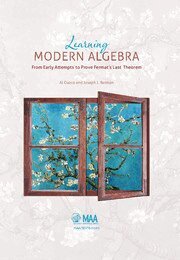
Learning Modern Algebra aligns with the CBMS Mathematical Education of Teachers II recommendations, in both content and practice. It emphasizes rings and fields over groups, and it makes explicit connections between the ideas of abstract algebra and the mathematics used by high school teachers. It provides opportunities for prospective and practicing teachers to experience mathematics for themselves, before the formalities are developed, and it is explicit about the mathematical habits of mind that lie beneath the definitions and theorems.This book is designed for prospective and practicing high school mathematics teachers, but it can serve as a text for standard abstract algebra courses as well. The presentation is organized historically: the Babylonians introduced Pythagorean triples to teach the Pythagorean theorem; these were classified by Diophantus, and eventually this led Fermat to conjecture his Last Theorem. The text shows how much of modern algebra arose in attempts to prove this; it also shows how other important themes in algebra arose from questions related to teaching. Indeed, modern algebra is a very useful tool for teachers, with deep connections to the actual content of high school mathematics, as well as to the mathematics teachers use in their profession that doesn't necessarily ""end up on the blackboard."" The focus is on number theory, polynomials, and commutative rings. Group theory is introduced near the end of the text to explain why generalizations of the quadratic formula do not exist for polynomials of high degree, allowing the reader to appreciate the more general work of Galois and Abel on roots of polynomials.Results and proofs are motivated with specific examples whenever possible, so that abstractions emerge from concrete experience. Applications range from the theory of repeating decimals to the use of imaginary quadratic fields to construct problems with rational solutions. While such applications are integrated throughout, each chapter also contains a section giving explicit connections between the content of the chapter and high school teaching.