Joseph M. Siry - Böcker
Visar alla böcker från författaren Joseph M. Siry. Handla med fri frakt och snabb leverans.
4 produkter
4 produkter
1 024 kr
Skickas inom 11-20 vardagar
In a suburb just north of Philadelphia stands Beth Sholom Synagogue, Frank Lloyd Wright's only synagogue and one of his finest religious buildings. Designated a National Historic Landmark in 2007, Beth Sholom was one of Wright's last completed projects, and for years it has been considered among his greatest masterpieces. But its full story has never been told. "Beth Sholom Synagogue" provides the first in-depth look at the synagogue's conception and realization in relation to Wright's other religious architecture. Beginning with Wright's early career at Adler and Sullivan's architectural firm in Chicago and his design for Unity Temple and ending with the larger works completed just before or soon after his death, Joseph M. Siry skillfully depicts the architect's exploration of geometric forms and structural techniques in creating buildings for worshiping communities.Siry also examines Wright's engagement with his clients, whose priorities stemmed from their denominational identity, and the effect this had on his designs - his client for Beth Sholom, Rabbi Mortimer Cohen, worked with Wright to anchor the building in the traditions of Judaism even as it symbolized the faith's continuing life in postwar America. With each of his religious projects, Wright considered questions of social history and cultural identity as he advanced his program for an expressive, modern American architecture. His search for a way to combine these agendas culminated in Beth Sholom, where the interplay of light, form, and space create a stunning and inspiring place of worship. Filled with illustrations, this remarkable book takes us deep inside the synagogue's design, construction, and reception to bring us an illuminating portrait of the crowning achievement of this important aspect of Wright's career.
Del 11 - Buildings, Landscapes, and Societies
Air-Conditioning in Modern American Architecture, 1890–1970
Inbunden, Engelska, 2021
1 529 kr
Skickas inom 7-10 vardagar
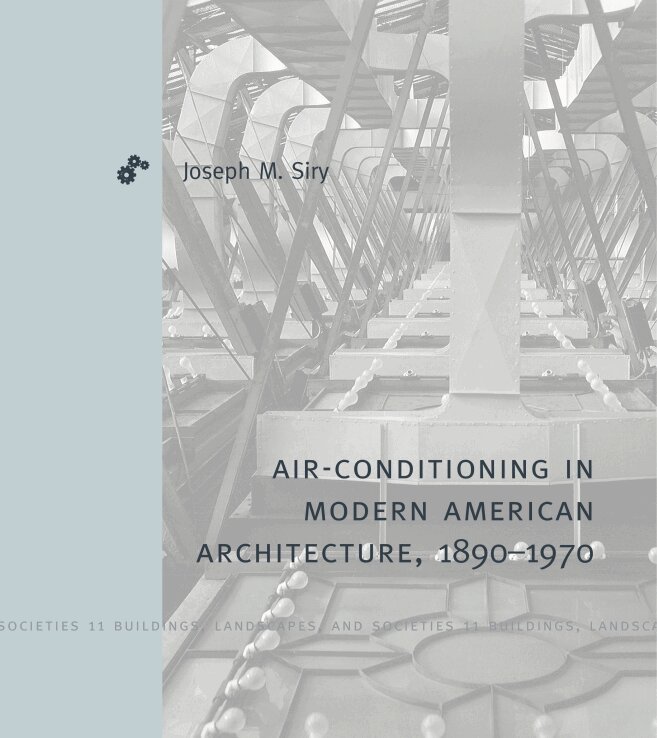
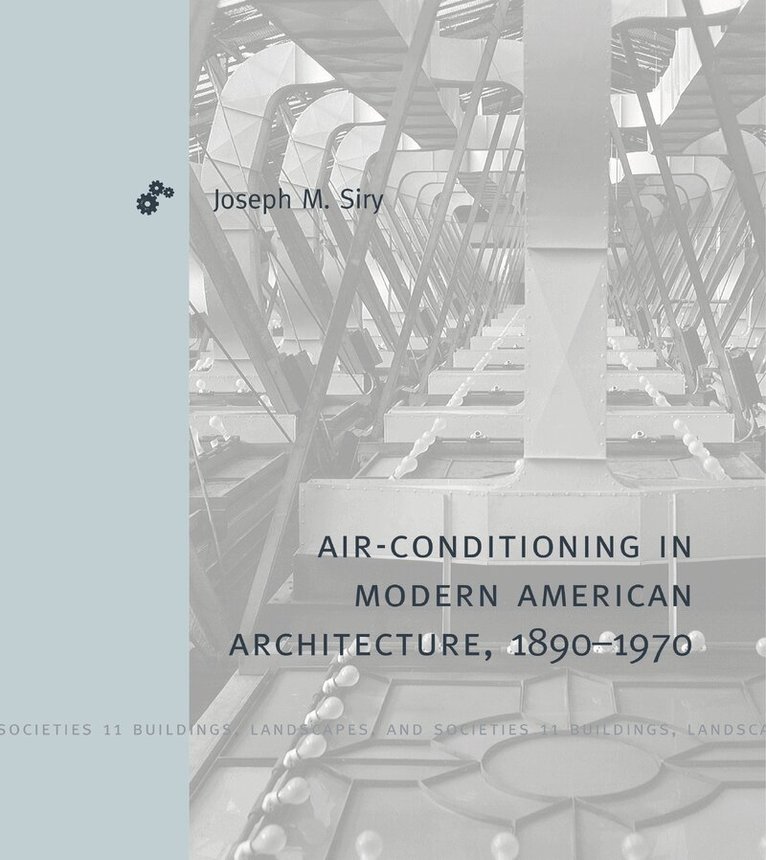
Air-Conditioning in Modern American Architecture, 1890–1970, documents how architects made environmental technologies into resources that helped shape their spatial and formal aesthetic. In doing so, it sheds important new light on the ways in which mechanical engineering has been assimilated into the culture of architecture as one facet of its broader modernist project.Tracing the development and architectural integration of air-conditioning from its origins in the late nineteenth century to the advent of the environmental movement in the early 1970s, Joseph M. Siry shows how the incorporation of mechanical systems into modernism’s discourse of functionality profoundly shaped the work of some of the movement’s leading architects, such as Dankmar Adler, Louis Sullivan, Frank Lloyd Wright, Ludwig Mies van der Rohe, Gordon Bunshaft, and Louis Kahn. For them, the modernist ideal of functionality was incompletely realized if it did not wholly assimilate heating, cooling, ventilating, and artificial lighting. Bridging the history of technology and the history of architecture, Siry discusses air-conditioning’s technical and social history and provides case studies of buildings by the master architects who brought this technology into the conceptual and formal project of modernism.A monumental work by a renowned expert in American modernist architecture, this book asks us to see canonical modernist buildings through a mechanical engineering–oriented lens. It will be especially valuable to scholars and students of architecture, modernism, the history of technology, and American history.
Del 11 - Buildings, Landscapes, and Societies
Air-Conditioning in Modern American Architecture, 1890–1970
Häftad, Engelska, 2022
523 kr
Skickas inom 7-10 vardagar
Air-Conditioning in Modern American Architecture, 1890–1970, documents how architects made environmental technologies into resources that helped shape their spatial and formal aesthetic. In doing so, it sheds important new light on the ways in which mechanical engineering has been assimilated into the culture of architecture as one facet of its broader modernist project.Tracing the development and architectural integration of air-conditioning from its origins in the late nineteenth century to the advent of the environmental movement in the early 1970s, Joseph M. Siry shows how the incorporation of mechanical systems into modernism’s discourse of functionality profoundly shaped the work of some of the movement’s leading architects, such as Dankmar Adler, Louis Sullivan, Frank Lloyd Wright, Ludwig Mies van der Rohe, Gordon Bunshaft, and Louis Kahn. For them, the modernist ideal of functionality was incompletely realized if it did not wholly assimilate heating, cooling, ventilating, and artificial lighting. Bridging the history of technology and the history of architecture, Siry discusses air-conditioning’s technical and social history and provides case studies of buildings by the master architects who brought this technology into the conceptual and formal project of modernism.A monumental work by a renowned expert in American modernist architecture, this book asks us to see canonical modernist buildings through a mechanical engineering–oriented lens. It will be especially valuable to scholars and students of architecture, modernism, the history of technology, and American history.
604 kr
Skickas inom 7-10 vardagar
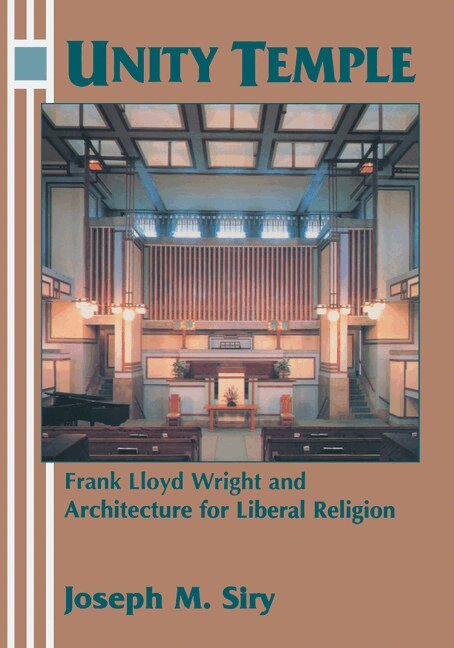
The first in-depth study of one of the seminal works of America's most renowned twentieth-century architect, first published in 1996, is now available in paperback. In this study, Joseph Siry examines the building in the light of Wright's earlier religious architecture, his methods of design, and his innovative construction techniques, particularly the use of reinforced concrete which was here exploited and expressively deployed for the first time. He also sets Unity Temple against the tradition of the liberal Unitarian and Universalist religious culture, the institutional history of the affluent Oak Park congregation that commissioned the building, as well as the social context in which structure was conceived and built. Throughout, Unity Temple is treated as a work of art that embodies both Wright's theory of architecture and his liberal religious ideals.