Joseph O'Rourke - Böcker
Visar alla böcker från författaren Joseph O'Rourke. Handla med fri frakt och snabb leverans.
14 produkter
14 produkter
462 kr
Skickas inom 7-10 vardagar
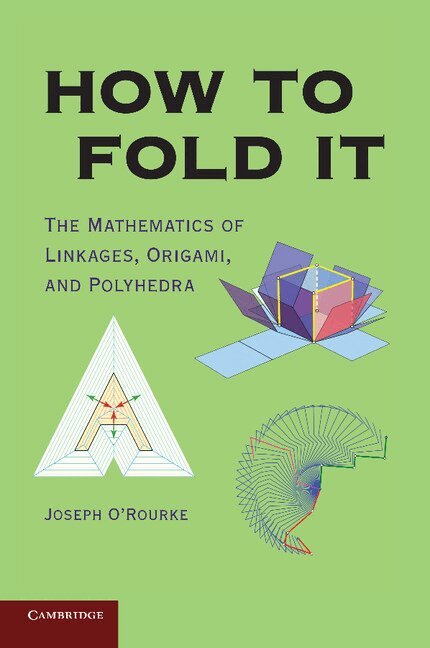
What do proteins and pop-up cards have in common? How is opening a grocery bag different from opening a gift box? How can you cut out the letters for a whole word all at once with one straight scissors cut? How many ways are there to flatten a cube? With the help of 200 colour figures, author Joseph O'Rourke explains these fascinating folding problems starting from high school algebra and geometry and introducing more advanced concepts in tangible contexts as they arise. He shows how variations on these basic problems lead directly to the frontiers of current mathematical research and offers ten accessible unsolved problems for the enterprising reader. Before tackling these, you can test your skills on fifty exercises with complete solutions. The book's website, http://www.howtofoldit.org, has dynamic animations of many of the foldings and downloadable templates for readers to fold or cut out.
636 kr
Skickas inom 7-10 vardagar
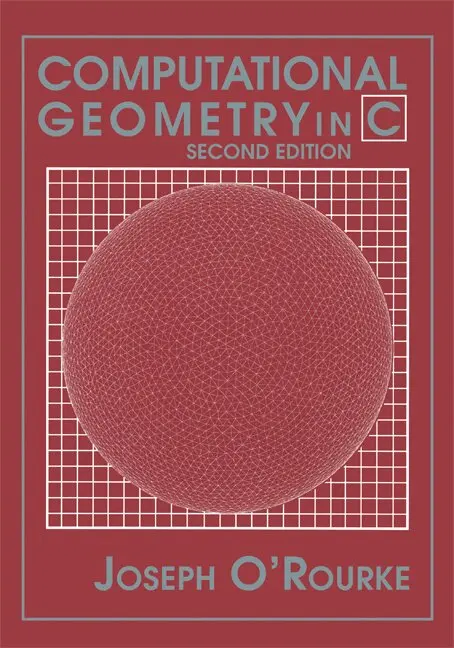
This is the revised and expanded 1998 edition of a popular introduction to the design and implementation of geometry algorithms arising in areas such as computer graphics, robotics, and engineering design. The basic techniques used in computational geometry are all covered: polygon triangulations, convex hulls, Voronoi diagrams, arrangements, geometric searching, and motion planning. The self-contained treatment presumes only an elementary knowledge of mathematics, but reaches topics on the frontier of current research, making it a useful reference for practitioners at all levels. The second edition contains material on several new topics, such as randomized algorithms for polygon triangulation, planar point location, 3D convex hull construction, intersection algorithms for ray-segment and ray-triangle, and point-in-polyhedron. The code in this edition is significantly improved from the first edition (more efficient and more robust), and four new routines are included. Java versions for this new edition are also available. All code is accessible from the book's Web site (http://cs.smith.edu/~orourke/) or by anonymous ftp.
758 kr
Skickas inom 7-10 vardagar
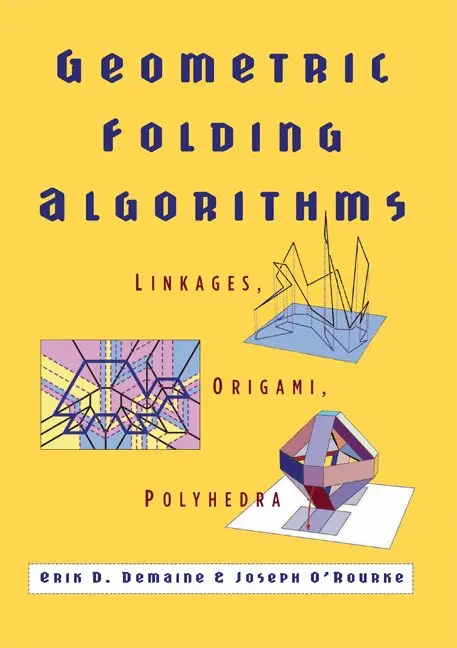
Did you know that any straight-line drawing on paper can be folded so that the complete drawing can be cut out with one straight scissors cut? That there is a planar linkage that can trace out any algebraic curve, or even 'sign your name'? Or that a 'Latin cross' unfolding of a cube can be refolded to 23 different convex polyhedra? Over the past decade, there has been a surge of interest in such problems, with applications ranging from robotics to protein folding. With an emphasis on algorithmic or computational aspects, this treatment gives hundreds of results and over 60 unsolved 'open problems' to inspire further research. The authors cover one-dimensional (1D) objects (linkages), 2D objects (paper), and 3D objects (polyhedra). Aimed at advanced undergraduate and graduate students in mathematics or computer science, this lavishly illustrated book will fascinate a broad audience, from school students to researchers.
1 455 kr
Skickas inom 7-10 vardagar
What do proteins and pop-up cards have in common? How is opening a grocery bag different from opening a gift box? How can you cut out the letters for a whole word all at once with one straight scissors cut? How many ways are there to flatten a cube? With the help of 200 colour figures, author Joseph O'Rourke explains these fascinating folding problems starting from high school algebra and geometry and introducing more advanced concepts in tangible contexts as they arise. He shows how variations on these basic problems lead directly to the frontiers of current mathematical research and offers ten accessible unsolved problems for the enterprising reader. Before tackling these, you can test your skills on fifty exercises with complete solutions. The book's website, http://www.howtofoldit.org, has dynamic animations of many of the foldings and downloadable templates for readers to fold or cut out.
2 100 kr
Skickas inom 7-10 vardagar
Did you know that any straight-line drawing on paper can be folded so that the complete drawing can be cut out with one straight scissors cut? That there is a planar linkage that can trace out any algebraic curve, or even 'sign your name'? Or that a 'Latin cross' unfolding of a cube can be refolded to 23 different convex polyhedra? Over the past decade, there has been a surge of interest in such problems, with applications ranging from robotics to protein folding. With an emphasis on algorithmic or computational aspects, this treatment gives hundreds of results and over 60 unsolved 'open problems' to inspire further research. The authors cover one-dimensional (1D) objects (linkages), 2D objects (paper), and 3D objects (polyhedra). Aimed at advanced undergraduate and graduate students in mathematics or computer science, this lavishly illustrated book will fascinate a broad audience, from school students to researchers.
675 kr
Skickas inom 7-10 vardagar
Discrete geometry is a relatively new development in pure mathematics, while computational geometry is an emerging area in applications-driven computer science. Their intermingling has yielded exciting advances in recent years, yet what has been lacking until now is an undergraduate textbook that bridges the gap between the two. Discrete and Computational Geometry offers a comprehensive yet accessible introduction to this cutting-edge frontier of mathematics and computer science. This book covers traditional topics such as convex hulls, triangulations, and Voronoi diagrams, as well as more recent subjects like pseudotriangulations, curve reconstruction, and locked chains. It also touches on more advanced material, including Dehn invariants, associahedra, quasigeodesics, Morse theory, and the recent resolution of the Poincare conjecture. Connections to real-world applications are made throughout, and algorithms are presented independently of any programming language. This richly illustrated textbook also features numerous exercises and unsolved problems.* The essential introduction to discrete and computational geometry * Covers traditional topics as well as new and advanced material * Features numerous full-color illustrations, exercises, and unsolved problems * Suitable for sophomores in mathematics, computer science, engineering, or physics * Rigorous but accessible * An online solutions manual is available (for teachers only). To obtain access, please e-mail: Vickie_Kearn@press.princeton.edu
675 kr
Skickas inom 7-10 vardagar
The essential introduction to discrete and computational geometry—now fully updated and expandedDiscrete and Computational Geometry bridges the theoretical world of discrete geometry with the applications-driven realm of computational geometry, offering a comprehensive yet accessible introduction to this cutting-edge frontier of mathematics and computer science. Beginning with polygons and ending with polyhedra, it explains how to capture the shape of data given by a set of points, from convex hulls and triangulations to Voronoi diagrams, geometric duality, chains, linkages, and alpha complexes. Connections to real-world applications are made throughout, and algorithms are presented independent of any programming language. Now fully updated and expanded, this richly illustrated textbook is an invaluable learning tool for students in mathematics, computer science, engineering, and physics.Now with new sections on duality and on computational topologyProject suggestions at the end of every chapterCovers traditional topics as well as new and advanced materialFeatures numerous full-color illustrations, exercises, and fully updated unsolved problemsUniquely designed for a one-semester classAccessible to college sophomores with minimal backgroundAlso suitable for more advanced studentsOnline solutions manual (available to instructors)
284 kr
Skickas inom 7-10 vardagar
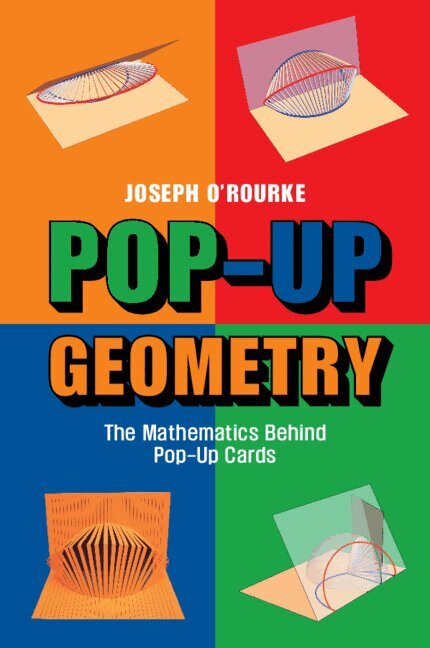
Anyone browsing at the stationery store will see an incredible array of pop-up cards available for any occasion. The workings of pop-up cards and pop-up books can be remarkably intricate. Behind such designs lies beautiful geometry involving the intersection of circles, cones, and spheres, the movements of linkages, and other constructions. The geometry can be modelled by algebraic equations, whose solutions explain the dynamics. For example, several pop-up motions rely on the intersection of three spheres, a computation made every second for GPS location. Connecting the motions of the card structures with the algebra and geometry reveals abstract mathematics performing tangible calculations. Beginning with the nephroid in the 19th-century, the mathematics of pop-up design is now at the frontiers of rigid origami and algorithmic computational complexity. All topics are accessible to those familiar with high-school mathematics; no calculus required. Explanations are supplemented by 140+ figures and 20 animations.
797 kr
Skickas inom 7-10 vardagar
Anyone browsing at the stationery store will see an incredible array of pop-up cards available for any occasion. The workings of pop-up cards and pop-up books can be remarkably intricate. Behind such designs lies beautiful geometry involving the intersection of circles, cones, and spheres, the movements of linkages, and other constructions. The geometry can be modelled by algebraic equations, whose solutions explain the dynamics. For example, several pop-up motions rely on the intersection of three spheres, a computation made every second for GPS location. Connecting the motions of the card structures with the algebra and geometry reveals abstract mathematics performing tangible calculations. Beginning with the nephroid in the 19th-century, the mathematics of pop-up design is now at the frontiers of rigid origami and algorithmic computational complexity. All topics are accessible to those familiar with high-school mathematics; no calculus required. Explanations are supplemented by 140+ figures and 20 animations.
1 390 kr
Skickas inom 7-10 vardagar
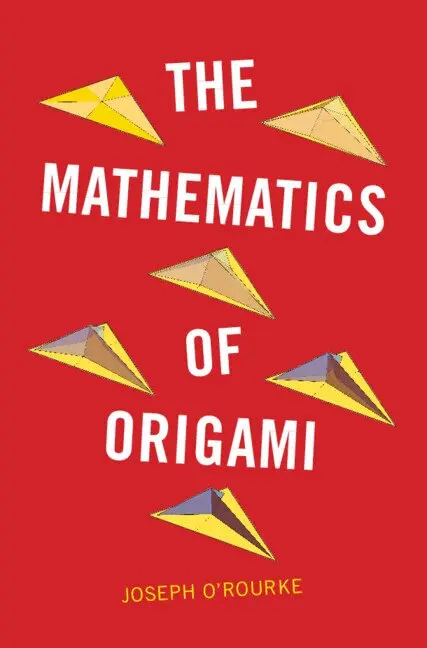
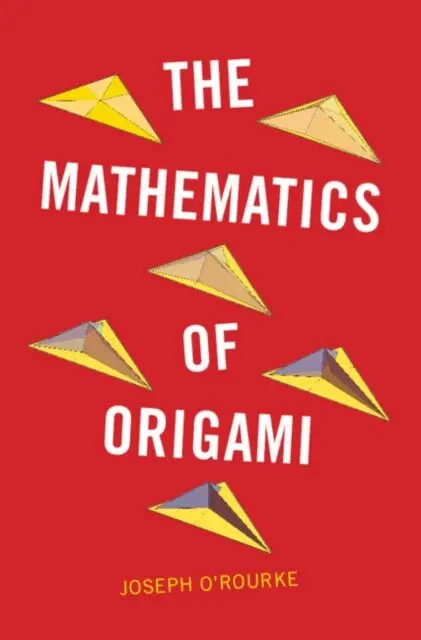
When you see a paper crane, what do you think of? A symbol of hope, a delicate craft, The Karate Kid? What you might not see, but is ever present, is the fascinating mathematics underlying it. Origami is increasingly applied to engineering problems, including origami-based stents, deployment of solar arrays in space, architecture, and even furniture design. The topic is actively developing, with recent discoveries at the frontier (e.g., in rigid origami and in curved-crease origami) and an infusion of techniques and algorithms from theoretical computer science. The mathematics is often advanced, but this book instead relies on geometric intuition, making it accessible to readers with only a high school geometry and trigonometry background. Through careful exposition, more than 160 color figures, and 49 exercises all completely solved in an Appendix, the beautiful mathematics leading to stunning origami designs can be appreciated by students, teachers, engineers, and artists alike.
448 kr
Skickas inom 7-10 vardagar
When you see a paper crane, what do you think of? A symbol of hope, a delicate craft, The Karate Kid? What you might not see, but is ever present, is the fascinating mathematics underlying it. Origami is increasingly applied to engineering problems, including origami-based stents, deployment of solar arrays in space, architecture, and even furniture design. The topic is actively developing, with recent discoveries at the frontier (e.g., in rigid origami and in curved-crease origami) and an infusion of techniques and algorithms from theoretical computer science. The mathematics is often advanced, but this book instead relies on geometric intuition, making it accessible to readers with only a high school geometry and trigonometry background. Through careful exposition, more than 160 color figures, and 49 exercises all completely solved in an Appendix, the beautiful mathematics leading to stunning origami designs can be appreciated by students, teachers, engineers, and artists alike.
3 664 kr
Skickas inom 10-15 vardagar
The Handbook of Discrete and Computational Geometry is intended as a reference book fully accessible to nonspecialists as well as specialists, covering all major aspects of both fields.The book offers the most important results and methods in discrete and computational geometry to those who use them in their work, both in the academic world—as researchers in mathematics and computer science—and in the professional world—as practitioners in fields as diverse as operations research, molecular biology and robotics.Discrete geometry has contributed significantly to the growth of discrete mathematics in recent years. This has been fueled partly by the advent of powerful computers and by the recent explosion of activity in the relatively young field of computational geometry. This synthesis between discrete and computational geometry lies at the heart of this Handbook.A growing list of application fields includes combinatorial optimization, computer-aided design, computer graphics, crystallography, data analysis, error-correcting codes, geographic information systems, motion planning, operations research, pattern recognition, robotics, solid modeling, and tomography.
1 275 kr
Skickas inom 7-10 vardagar
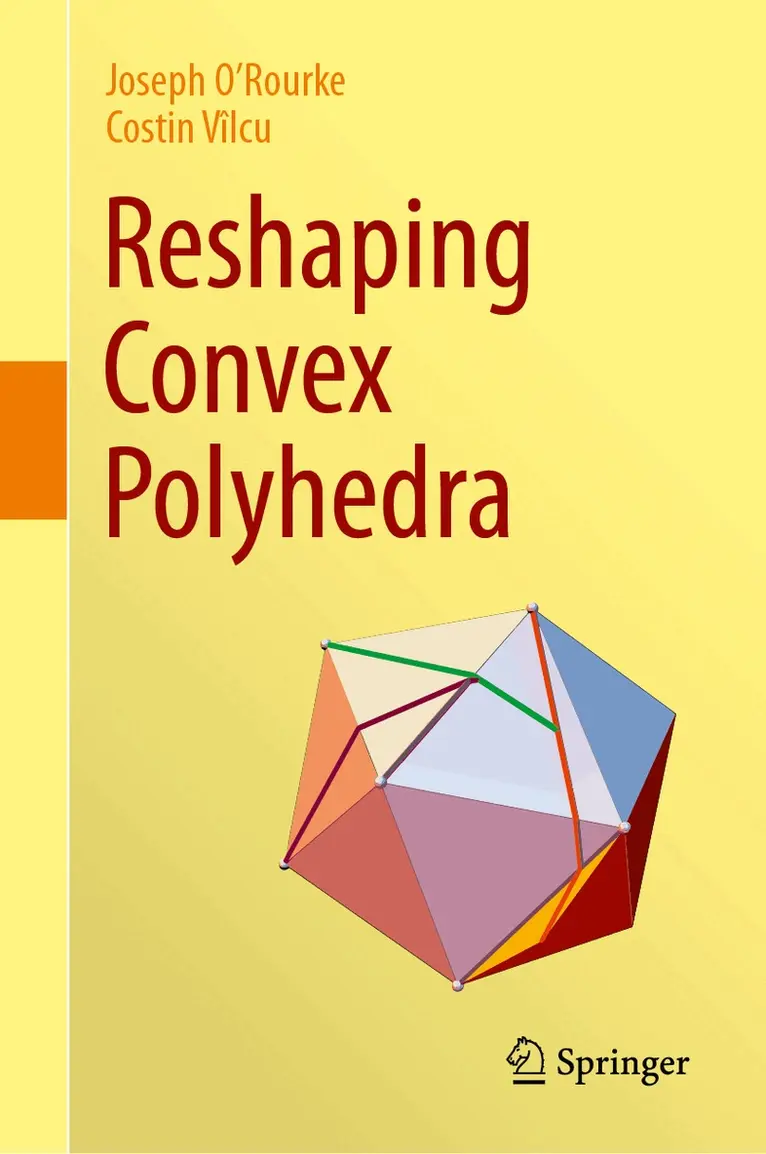
^ the="" study="" of="" convex="" polyhedra="" in="" ordinary="" space="" is="" a="" central="" piece="" classical="" and="" modern="" geometry="" that="" has="" had="" significant="" impact="" on="" many="" areas="" mathematics="" also="" computer="" science.="" present="" book="" project="" by="" joseph="" o’rourke="" costin="" vîlcu="" brings="" together="" two="" important="" strands="" subject="" —="" combinatorics="" polyhedra,="" intrinsic="" underlying="" surface.="" this="" leads="" to="" remarkable="" interplay="" concepts="" come="" life="" wide="" range="" very="" attractive="" topics="" concerning="" polyhedra.="" gets="" message="" across="" thetheory="" although="" with="" roots,="" still="" much="" alive="" today="" continues="" be="" inspiration="" basis="" lot="" current="" research="" activity.="" work="" presented="" manuscript="" interesting="" applications="" discrete="" computational="" geometry,="" as="" well="" other="" mathematics.="" treated="" detail="" include="" unfolding="" onto="" surfaces,="" continuous="" flattening="" convexity="" theory="" minimal="" length="" enclosing="" polygons.="" along="" way,="" open="" problems="" suitable="" for="" graduate="" students="" are="" raised,="" both="" aThe focus of this monograph is converting—reshaping—one 3D convex polyhedron to another via an operation the authors call “tailoring.” A convex polyhedron is a gem-like shape composed of flat facets, the focus of study since Plato and Euclid. The tailoring operation snips off a corner (a “vertex”) of a polyhedron and sutures closed the hole. This is akin to Johannes Kepler’s “vertex truncation,” but differs in that the hole left by a truncated vertex is filled with new surface, whereas tailoring zips the hole closed. A powerful “gluing” theorem of A.D. Alexandrov from 1950 guarantees that, after closing the hole, the result is a new convex polyhedron. Given two convex polyhedra P, and Q inside P, repeated tailoringallows P to be reshaped to Q. Rescaling any Q to fit inside P, the result is universal: any P can be reshaped to any Q. This is one of the main theorems in Part I, with unexpected theoretical consequences.Part II carries out a systematic study of “vertex-merging,” a technique that can be viewed as a type of inverse operation to tailoring. Here the start is P which is gradually enlarged as much as possible, by inserting new surface along slits. In a sense, repeated vertex-merging reshapes P to be closer to planarity. One endpoint of such a process leads to P being cut up and “pasted” inside a cylinder. Then rolling the cylinder on a plane achieves an unfolding of P. The underlying subtext is a question posed by Geoffrey Shephard in 1975 and already implied by drawings by Albrecht Dürer in the 15th century: whether every convex polyhedron can be unfolded to a planar “net.” Toward this end, the authors initiate an exploration of convexity on convex polyhedra, a topic rarely studiedin the literature but with considerable promise for future development.This monograph uncovers new research directions and reveals connections among several, apparently distant, topics in geometry: Alexandrov’s Gluing Theorem, shortest paths and cut loci, Cauchy’s Arm Lemma, domes, quasigeodesics, convexity, and algorithms throughout. The interplay between these topics and the way the main ideas develop throughout the book could make the “journey” worthwhile for students and researchers in geometry, even if not directly interested in specific topics. Parts of the material will be of interest and accessible even to undergraduates. Although the proof difficulty varies from simple to quite intricate, with some proofs spanning several chapters, many examples and 125 figures help ease the exposition and illustrate the concepts.^>
1 275 kr
Skickas inom 10-15 vardagar
^ the="" study="" of="" convex="" polyhedra="" in="" ordinary="" space="" is="" a="" central="" piece="" classical="" and="" modern="" geometry="" that="" has="" had="" significant="" impact="" on="" many="" areas="" mathematics="" also="" computer="" science.="" present="" book="" project="" by="" joseph="" o’rourke="" costin="" vîlcu="" brings="" together="" two="" important="" strands="" subject="" —="" combinatorics="" polyhedra,="" intrinsic="" underlying="" surface.="" this="" leads="" to="" remarkable="" interplay="" concepts="" come="" life="" wide="" range="" very="" attractive="" topics="" concerning="" polyhedra.="" gets="" message="" across="" thetheory="" although="" with="" roots,="" still="" much="" alive="" today="" continues="" be="" inspiration="" basis="" lot="" current="" research="" activity.="" work="" presented="" manuscript="" interesting="" applications="" discrete="" computational="" geometry,="" as="" well="" other="" mathematics.="" treated="" detail="" include="" unfolding="" onto="" surfaces,="" continuous="" flattening="" convexity="" theory="" minimal="" length="" enclosing="" polygons.="" along="" way,="" open="" problems="" suitable="" for="" graduate="" students="" are="" raised,="" both="" aThe focus of this monograph is converting—reshaping—one 3D convex polyhedron to another via an operation the authors call “tailoring.” A convex polyhedron is a gem-like shape composed of flat facets, the focus of study since Plato and Euclid. The tailoring operation snips off a corner (a “vertex”) of a polyhedron and sutures closed the hole. This is akin to Johannes Kepler’s “vertex truncation,” but differs in that the hole left by a truncated vertex is filled with new surface, whereas tailoring zips the hole closed. A powerful “gluing” theorem of A.D. Alexandrov from 1950 guarantees that, after closing the hole, the result is a new convex polyhedron. Given two convex polyhedra P, and Q inside P, repeated tailoringallows P to be reshaped to Q. Rescaling any Q to fit inside P, the result is universal: any P can be reshaped to any Q. This is one of the main theorems in Part I, with unexpected theoretical consequences.Part II carries out a systematic study of “vertex-merging,” a technique that can be viewed as a type of inverse operation to tailoring. Here the start is P which is gradually enlarged as much as possible, by inserting new surface along slits. In a sense, repeated vertex-merging reshapes P to be closer to planarity. One endpoint of such a process leads to P being cut up and “pasted” inside a cylinder. Then rolling the cylinder on a plane achieves an unfolding of P. The underlying subtext is a question posed by Geoffrey Shephard in 1975 and already implied by drawings by Albrecht Dürer in the 15th century: whether every convex polyhedron can be unfolded to a planar “net.” Toward this end, the authors initiate an exploration of convexity on convex polyhedra, a topic rarely studiedin the literature but with considerable promise for future development.This monograph uncovers new research directions and reveals connections among several, apparently distant, topics in geometry: Alexandrov’s Gluing Theorem, shortest paths and cut loci, Cauchy’s Arm Lemma, domes, quasigeodesics, convexity, and algorithms throughout. The interplay between these topics and the way the main ideas develop throughout the book could make the “journey” worthwhile for students and researchers in geometry, even if not directly interested in specific topics. Parts of the material will be of interest and accessible even to undergraduates. Although the proof difficulty varies from simple to quite intricate, with some proofs spanning several chapters, many examples and 125 figures help ease the exposition and illustrate the concepts.^>