• Fri frakt över 249 kr
  • •
  • Snabba leveranser
  • •
  • Billiga böcker
Kundservice

Du är på sajten för privatpersoner.

Företag, bibliotek eller offentlig verksamhet?

Du handlar på classic.bokus.com, där alla dina funktioner finns intakta.
Till classic.bokus.com
Bokus logotyp. Gå till startsidan.
  • Erbjudanden
  • Nyheter
  • Student
  • Topplistor
  • Barn & ungdom
  • Bokus Play
  • E-böcker
  • Pocketböcker
  • Spel & pussel

10% rabatt på allt med kod NYSTART10 →

Sidfot

Mina sidor

    Hjälp

    • Kundservice
    • Vanliga frågor och svar
    • Frakt och leverans
    • Retur vid ångerrätt
    • Reklamera vara
    • Betalning
    • Köpvillkor
    • Allmänna villkor
    • Information om webbplatsens tillgänglighet

    Om Bokus

    • Om oss
    • Pressrum
    • För studenter
    • För företag
    • För bibliotek och offentlig verksamhet
    • För leverantörer
    • Hållbarhet

    Populärt

    • Aktuella erbjudanden
    • Presentkort
    • Studentlitteratur
    • Nya böcker
    • Topplistor
    • Signerade böcker
    • Engelska böcker

    Inspiration

    • Boktips
    • BookTok
    • Populära bokserier
    • Barnbokskaraktärer
    • Populära författare
    Logotyp för Bokus
    Följ oss på Facebook (extern länk)Följ oss på Instagram (extern länk)Följ oss på YouTube (extern länk)Följ oss på TikTok (extern länk)
    bokus @ CookiesAnpassa cookiesIntegritetspolicyKöpvillkor
    Till Citymail hemsida (extern länk)Till Budbee hemsida (extern länk)Till Postnord hemsida (extern länk)Till Schenker hemsida (extern länk)Till Early Bird hemsida (extern länk)Till Walleys hemsida (extern länk)
    1. Naturvetenskap och teknik
    2. Matematik och naturvetenskap
    3. Matematik

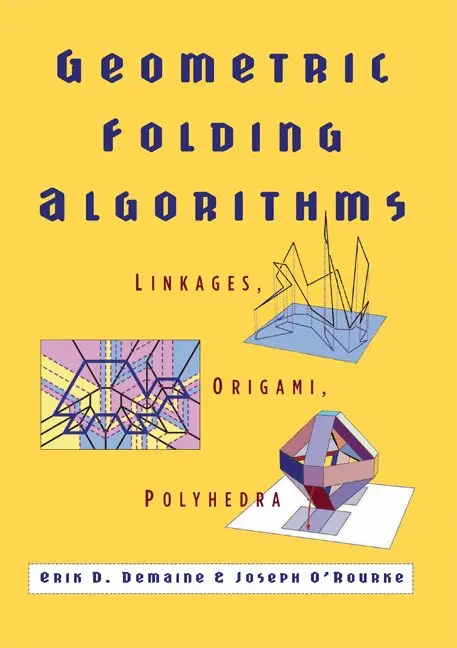
    Geometric Folding Algorithms

    Linkages, Origami, Polyhedra

    AvErik D. Demaine,Joseph O'Rourke

    Häftad, Engelska, 2008

    812 kr

    Beställningsvara. Skickas inom 10-15 vardagar. Fri frakt över 249 kr.

    Fler format och utgåvor

    Inbunden

    2 247 kr

    Beskrivning

    Did you know that any straight-line drawing on paper can be folded so that the complete drawing can be cut out with one straight scissors cut? That there is a planar linkage that can trace out any algebraic curve, or even 'sign your name'? Or that a 'Latin cross' unfolding of a cube can be refolded to 23 different convex polyhedra? Over the past decade, there has been a surge of interest in such problems, with applications ranging from robotics to protein folding. With an emphasis on algorithmic or computational aspects, this treatment gives hundreds of results and over 60 unsolved 'open problems' to inspire further research. The authors cover one-dimensional (1D) objects (linkages), 2D objects (paper), and 3D objects (polyhedra). Aimed at advanced undergraduate and graduate students in mathematics or computer science, this lavishly illustrated book will fascinate a broad audience, from school students to researchers.

    Produktinformation

    • Utgivningsdatum:2008-08-21
    • Mått:175 x 251 x 25 mm
    • Vikt:1 180 g
    • Format:Häftad
    • Språk:Engelska
    • Antal sidor:496
    • Förlag:Cambridge University Press
    • ISBN:9780521715225

    Utforska kategorier

    • Matematik inom Naturvetenskap och teknik

    Mer om författaren

    Erik D. Demaine is the Esther and Harold E. Edgerton Professor of Electrical Engineering and Computer Science at the Massachusetts Institute of Technology, where he joined the faculty in 2001. He is the recipient of several awards, including the MacArthur Fellowship, the Harold E. Edgerton Faculty Achievement Award, the Ruth and Joel Spira Award for Distinguished Teaching, and the NSERC Doctoral Prize. His research interests range throughout algorithms from data structures for improving web searches to the geometry of understanding how proteins relate to the computational difficulty of playing games. He has published more than 150 papers with more than 150 collaborators and coedited the book Tribute to a Mathemagician in honor of the influential recreational mathematician Martin Gardner. Joseph O'Rourke is the Olin Professor of Computer Science at Smith College and the Chair of the Computer Science Department. He recently completed a one-year appointment as Interim Director of Engineering. He has received several grants and awards, including a Presidential Young Investigator Award, a Guggenheim Fellowship, and the NSF Director's Award for Distinguished Teaching Scholars. His research is in the field of computational geometry, where he has published a monograph and a textbook, and he coedited the 1500-page Handbook of Discrete and Computational Geometry. Thirty-one of his more than one hundred papers published in journals and conference proceedings are coauthored with undergraduates.

    Recensioner i media

    'Demaine and O'Rourke are among the best-qualified authors for a book on this subject; and the book that they have written is a delight … it is exceptionally clear and readable. It could be read for pleasure by any mathematics undergraduate, and much of it (though not all) by amateurs with a high school mathematics background … although there are sections that some amateurs will skip, the level is always kept as elementary as locally possible. This book should be in all university libraries, and many professional and amateur mathematicians will want to add it to their personal collections.' Robert Dawson (Halifax), Zentralblatt Math

    Innehållsförteckning

    • Introduction; Part I. Linkages: 1. Problem classification and examples; 2. Upper and lower bounds; 3. Planar linkage mechanisms; 4. Rigid frameworks; 5. Reconfiguration of chains; 6. Locked chains; 7. Interlocked chains; 8. Joint-constrained motion; 9. Protein folding; Part II. Paper: 10. Introduction; 11. Foundations; 12. Simple crease patterns; 13. General crease patterns; 14. Map folding; 15. Silhouettes and gift wrapping; 16. The tree method; 17. One complete straight cut; 18. Flattening polyhedra; 19. Geometric constructibility; 20. Rigid origami and curved creases; Part III. Polyhedra: 21. Introduction and overview; 22. Edge unfolding of polyhedra; 23. Reconstruction of polyhedra; 24. Shortest paths and geodesics; 25. Folding polygons to polyhedra; 26. Higher dimensions.