Joshua M. Karlip – Författare
Visar alla böcker från författaren Joshua M. Karlip. Handla med fri frakt och snabb leverans.
2 produkter
2 produkter
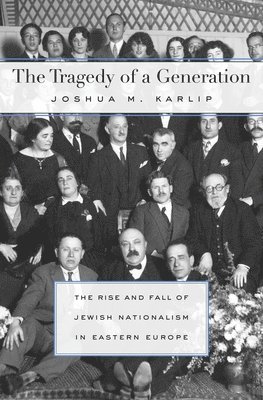
Tragedy of a Generation
The Rise and Fall of Jewish Nationalism in Eastern Europe
Inbunden, Engelska, 2013
563 kr
Skickas inom 10-15 vardagar
The Tragedy of a Generation is the story of the rise and fall of an ideal: an autonomous Jewish nation in Europe. It traces the origins of two influential but overlooked strains of Jewish thought—Yiddishism and Diaspora Nationalism—and documents the waning hopes and painful reassessments of their leading representatives against the rising tide of Nazism and, later, the Holocaust.Joshua M. Karlip presents three figures—Elias Tcherikower, Yisroel Efroikin, and Zelig Kalmanovitch—seen through the lens of Imperial Russia on the brink of revolution. Leaders in the struggle for recognition of the Jewish people as a national entity, these men would prove instrumental in formulating the politics of Diaspora Nationalism, a middle path that rejected both the Zionist emphasis on Palestine and the Marxist faith in class struggle. Closely allied with this ideology was Yiddishism, a movement whose adherents envisioned the Yiddish language and culture, not religious tradition, as the unifying force of Jewish identity.We follow Tcherikower, Efroikin, and Kalmanovitch as they navigate the tumultuous early decades of the twentieth century in pursuit of a Jewish national renaissance in Eastern Europe. Correcting the misconception of Yiddishism as a radically secular movement, Karlip uncovers surprising confluences between Judaism and the avowedly nonreligious forms of Jewish nationalism. An essential contribution to Jewish historiography, The Tragedy of a Generation is a probing and poignant chronicle of lives shaped by ideological conviction and tested to the limits by historical crisis.
1 808 kr
Skickas inom 11-20 vardagar
In 1939, a new Yiddish journal was published in Paris under the name »Oyfn sheydveg« (At the Crossroads). The Authors, primarily Eastern European emigrés, embarked on a quest for an intellectually appropriate response to the political events unfolding before their eyes. Many contributors who were active two decades earlier as Diaspora Nationalists in diverse Eastern European Jewish political parties and institutions now explored new avenues. These included Zionism and Territorialism, but also a return to religious tradition and even to a pre-modern »ghetto life.« Unlike hardly any other literary document, »Oyfn sheydveg« sheds light on the profound crisis of these Jewish intellectuals and on the conclusions they drew in the face of the looming catastrophe.